



• Marxist Philosophy -3

    Marxist Philosophy -3

    III. THE DIALECTICAL METHOD
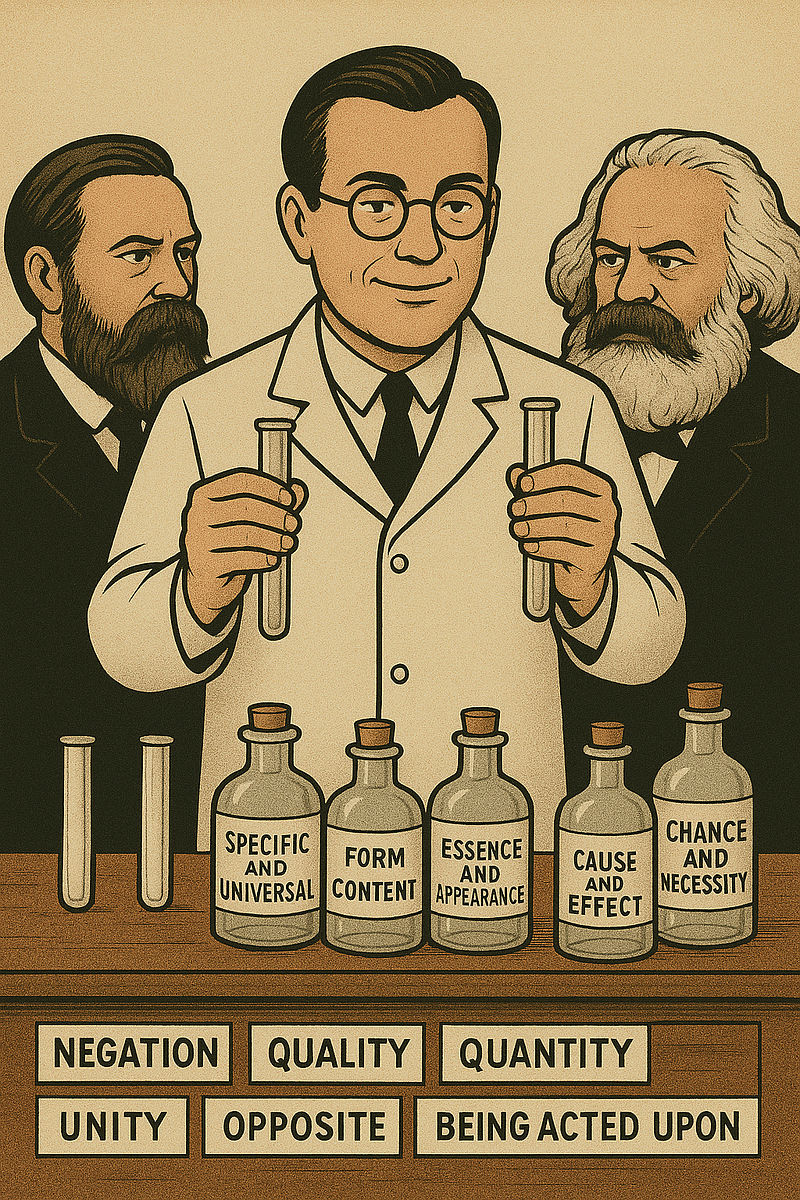
    The dialectical method represents a fundamental advance over metaphysical thinking. Where metaphysics sees fixed things, dialectics sees processes; where metaphysics creates rigid oppositions, dialectics grasps movement and development.
    “The great basic thought that the world is not to be comprehended as a complex of readymade things, but as a complex of processes, in which the things apparently stable no less than their mind images in our heads, the concepts, go through an uninterrupted change of coming into being and passing away, in which, in spite of all seeming accidentally and of all temporary retrogression, a progressive development asserts itself in the end” (lfecgp). This is the essence of dialectical thinking.
    When we observe nature or history with fresh eyes, we see “the picture of an endless entanglement of relations and reactions, permutations and combinations, in which nothing remains what, where and as it was, but everything moves, changes, comes into being and passes away” (suc). We observe “the movements, transitions, connections, rather than the things that move, combine, and are connected” (suc). This is “the primitive, naive but intrinsically correct conception of the world” (suc) that the ancient Greek philosophers, particularly Heraclitus, first clearly formulated: “everything is and is not, for everything is fluid, is constantly changing, constantly coming into being and passing away” (suc).
    The dialectical method stands in sharp contrast to metaphysical thinking. “To the metaphysician, things and their mental reflexes, ideas, are isolated, are to be considered one after the other and apart from each other, are objects of investigation fixed, rigid, given once for all” (suc). The metaphysician thinks in “absolutely irreconcilable antitheses” (suc). But dialectics shows that these rigid oppositions dissolve when examined more closely.
    “Upon closer inquiry, we find that the two poles of an antithesis, positive and negative, e.g., are as inseparable as they are opposed, and that despite all their opposition, they mutually interpenetrate” (suc). Similarly, “cause and effect are conceptions which only hold good in their application to individual cases; but as soon as we consider the individual cases in their general connection with the universe as a whole, they run into each other, and they become confounded when we contemplate that universal action and reaction in which causes and effects are eternally changing places” (suc).
    The same applies to all metaphysical oppositions. “None of these processes and modes of thought enters into the framework of metaphysical reasoning. Dialectics, on the other hand, comprehends things and their representations, ideas, in their essential connection, concatenation, motion, origin and ending” (suc). Every organic being, for example, “is every moment the same and not the same; every moment, it assimilates matter supplied from without, and gets rid of other matter; every moment, some cells of its body die and others build themselves anew” (suc). The being is constantly both itself and not itself, stable and changing simultaneously.
    When investigation proceeds from the dialectical standpoint, “the demand for final solutions and eternal truths ceases once for all; one is always conscious of the necessary limitation of all acquired knowledge, of the fact that it is conditioned by the circumstances in which it was acquired” (lfecgp). One no longer accepts absolute, unchanging truths, but recognizes that “that which is recognized now as true has also its latent false side which will later manifest itself, just as that which is now regarded as false has also its true side by virtue of which it could previously be regarded as true” (lfecgp).
    “One knows that what is maintained to be necessary is composed of sheer accidents and that the so-called accidental is the form behind which necessity hides itself” (lfecgp). The rigid metaphysical antitheses dissolve into relative, interconnected, developing moments of a larger process.
    “For it [dialectical philosophy], nothing is final, absolute, sacred. It reveals the transitory character of everything and in everything; nothing can endure before it except the uninterrupted process of becoming and of passing away, of endless ascendancy from the lower to the higher” (lfecgp). The revolutionary character of dialectics lies precisely here: it shows that “All that exists deserves to perish” (lfecgp). Every stage of development, every social form, every supposedly eternal truth contains within itself the seeds of its own transformation.
    “dialectical philosophy itself is nothing more than the mere reflection of this process in the thinking brain” (lfecgp). Dialectics is not imposed on reality from outside; it is the conceptual grasp of the actual movement of things themselves.
    The dialectical method received its most systematic development in the philosophy of Hegel. His system represented dialectics in idealist form, where “dialectics is the self-development of the concept” (lfecgp). For Hegel, the entire development of nature and history was merely the unfolding of an eternal absolute idea. Yet despite this idealist framework, Hegel’s dialectical method contained profound insights.
    In Hegel’s system, “for the first time the whole world, natural, historical, intellectual, is represented as a process — i.e., as in constant motion, change, transformation, development; and the attempt is made to trace out the internal connection that makes a continuous whole of all this movement and development” (suc). This was an enormous achievement. “From this point of view, the history of mankind no longer appeared as a wild whirl of senseless deeds of violence, all equally condemnable at the judgment seat of mature philosophic reason and which are best forgotten as quickly as possible, but as the process of evolution of man himself” (suc).
    However, Hegel’s system suffered from an internal contradiction. “Upon the one hand, its essential proposition was the conception that human history is a process of evolution, which, by its very nature, cannot find its intellectual final term in the discovery of any so-called absolute truth. But, on the other hand, it laid claim to being the very essence of this absolute truth” (suc). Hegel claimed to have reached the final, complete truth in his own philosophical system—a claim that contradicted the very principle of endless development that dialectics teaches.
    Moreover, Hegel’s idealism meant that “to him, the thoughts within his brain were not the more or less abstract pictures of actual things and processes, but, conversely, things and their evolution were only the realized pictures of the ‘Idea’, existing somewhere from eternity before the world was” (suc). “This way of thinking turned everything upside down, and completely reversed the actual connection of things in the world” (suc).
    The task, therefore, was to preserve the dialectical method while overcoming the idealist system—to keep the revolutionary kernel while discarding the mystical shell. This required placing dialectics on a materialist foundation.

  • Marxist Philosophy -4

    Marxist Philosophy -4

    IV. THE FAILURE OF THE YOUNG HEGELIANS
    Following Hegel’s death, a movement emerged among German philosophers claiming to radicalize and critique his system. These Young Hegelians presented themselves as revolutionaries overthrowing outdated ideas. Yet their critique, despite its radical pretensions, never escaped the prison of pure thought.
    “German criticism has, right up to its latest efforts, never quitted the realm of philosophy” (gi). “Far from examining its general philosophic premises, the whole body of its inquiries has actually sprung from the soil of a definite philosophical system, that of Hegel” (gi). The Young Hegelians remained bound by the very system they claimed to transcend.
    “Not only in their answers but in their very questions there was a mystification” (gi). They believed they were challenging the foundations of the existing order, but in reality they merely rearranged concepts. “The entire body of German philosophical criticism from Strauss to Stirner is confined to criticism of religious conceptions” (gi). Everything—political institutions, legal relations, moral consciousness—was reduced to theological categories and then criticized as religion.
    The Young Hegelians imagined that by changing consciousness, they could change reality. “Since the Young Hegelians consider conceptions, thoughts, ideas, in fact all the products of consciousness, to which they attribute an independent existence, as the real chains of men… it is evident that the Young Hegelians have to fight only against these illusions of consciousness” (gi). Their entire revolutionary program consisted of altering ideas.
    “Since, according to their fantasy, the relationships of men, all their doings, their chains and their limitations are products of their consciousness, the Young Hegelians logically put to men the moral postulate of exchanging their present consciousness for human, critical or egoistic consciousness, and thus of removing their limitations” (gi). Change your thinking, they proclaimed, and you change the world. “This demand to change consciousness amounts to a demand to interpret reality in another way, i.e. to recognise it by means of another interpretation” (gi).
    The absurdity of this position is evident. “The Young-Hegelian ideologists, in spite of their allegedly ‘world-shattering’ statements, are the staunchest conservatives” (gi). Despite their radical rhetoric, they changed nothing. “The most recent of them have found the correct expression for their activity when they declare they are only fighting against ‘phrases’. They forget, however, that to these phrases they themselves are only opposing other phrases, and that they are in no way combating the real existing world when they are merely combating the phrases of this world” (gi).
    This futility was inevitable given their method. “It has not occurred to any one of these philosophers to inquire into the connection of German philosophy with German reality, the relation of their criticism to their own material surroundings” (gi). They never asked how their ideas related to actual economic and social conditions. They remained entirely in the realm of thought, never descending to material reality.
    The Young Hegelians failed to understand that liberation cannot be achieved through consciousness alone. As Engels observes while discussing Feuerbach—who shared this limitation—”’liberation’ is an historical and not a mental act, and it is brought about by historical conditions, the development of industry, commerce, agriculture, the conditions of intercourse” (gi). Real freedom requires real, material transformations, not just new interpretations.
    “Slavery cannot be abolished without the steam-engine and the mule and spinning-jenny, serfdom cannot be abolished without improved agriculture, and… in general, people cannot be liberated as long as they are unable to obtain food and drink, housing and clothing in adequate quality and quantity” (gi). Liberation depends on material conditions, on the development of productive forces, not on philosophical critique.
    The Young Hegelians could not grasp this because they never moved beyond idealism. They criticized Hegel’s conclusions but accepted his idealist method—the primacy of consciousness over material existence. They remained trapped in what they imagined they were escaping.
    Their failure demonstrated that a genuine critique of existing conditions required more than new ideas. It required understanding the material basis of those conditions and the practical means of transforming them. It required moving from the realm of philosophy to the realm of real history, from interpreting the world to changing it. This transition could only be accomplished by uniting the dialectical method with a consistently materialist foundation.

  • Unproductive, Unemployed, Redundant and Exploited Labour

    Unproductive, Unemployed, Redundant and Exploited Labour

    Surplus population and exploitation

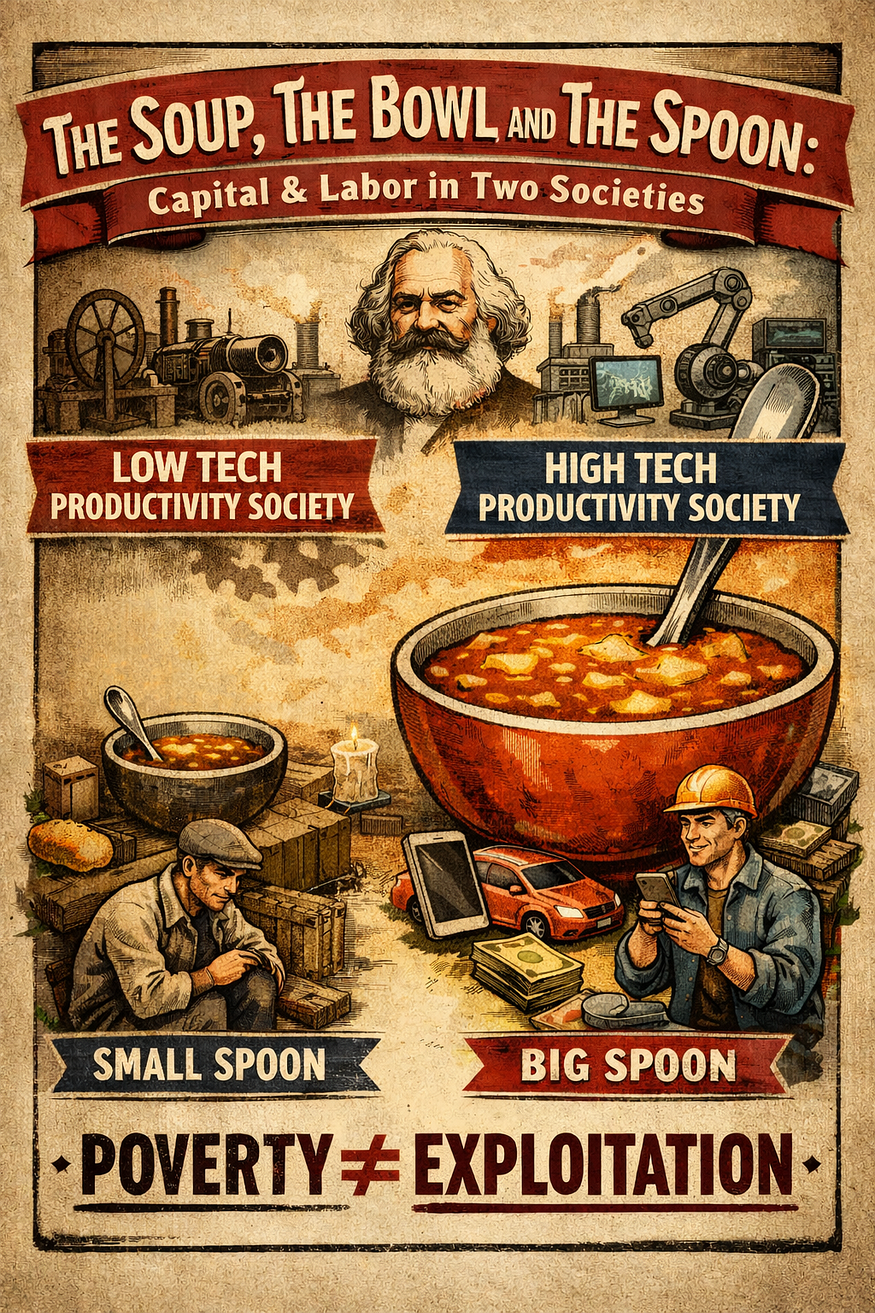
    Capitalist accumulation produces labour mass in multiple and qualitatively distinct forms. These forms are frequently collapsed into one another in economic and political discourse, resulting in conceptual confusion and a moralised understanding of capitalist exploitation. Poverty is often equated with exploitation, inequality is treated as exploitation, and unemployment itself is understood as exploitation. English word exploitation, which in ordinary usage can denote abuse, unfairness, coercion, or moral wrongdoing, suffering and may refer to almost any form of disadvantage or mistreatment. In Marx’s analysis of capitalist mode of production, Exploitation refers to a strictly economic relation: the extraction and appropriation of surplus labour in the form of surplus-value within the circuit of capital. It does not refer to low wages, hardship, inequality, or deprivation as such. Accordingly, exploitation by capital has one precise meaning: labour-power is purchased as capital, set to work in production, and made to produce more value than it costs, with the surplus appropriated by capital. Without this specification, Marx’s critique of political economy collapses into moral protest. With it, exploitation by capital remains a scientific category.

    In Marx’s analysis of capital, productive labour, unproductive labour, the industrial reserve army of labour, and redundant labour are not interchangeable categories. Each arises from a distinct relation between labour and capital within the process of accumulation, and each stands in a different relation to exploitation by capital.

    Productive and Unproductive Labour: The Standpoint of Capital

    From the standpoint of capital, the distinction between productive and unproductive labour does not depend on the concrete activity performed, the level of skill, or the intensity of work. The sole criterion is whether labour functions for capital—that is, whether it enables capital to return as more capital. Labour is productive only insofar as it enters the circuit M–C–M′ and produces surplus-value. All other considerations—usefulness, effort, or payment—are secondary.

    Unproductive Labour and the Absence of Exploitation by Capital

    Consider a carpenter repairing or making a cot in the private house of a capitalist. The labour produces use-value and is paid for, but the transaction does not take the form M–C–M′. What occurs is simple circulation:

    for the capitalist: M–C (money exchanged for a use-value),

    for the worker: C–M (labour exchanged for money).

    No capital is advanced, no accumulation takes place, and no surplus-value is produced. The money spent functions as revenue, not as capital. Therefore, no exploitation by capital occurs.

    This conclusion holds regardless of the wage level. Even extremely low wages do not constitute exploitation by capital here, because exploitation by capital is not defined by low pay, hardship, or inequality, but by the production and appropriation of surplus-value. Without M–C–M′, exploitation by capital cannot occur.

    Productive Labour and Exploitation by Capital

    Now consider the same carpenter employed in the capitalist’s furniture factory, producing a cot for sale. Assume the same skill, the same intensity, the same productivity (one cot in eight hours), and even a higher wage than in the household case.

    Here, labour-power is purchased as capital. The capitalist advances money to buy labour-power, sets it to work in production, and inserts it into the circuit M–C–M′. The commodity is sold, value returns as more value, and surplus-value is produced and appropriated.

    In this case, exploitation by capital occurs, even though productivity, skill, time, and wage are identical—or even superior—to the household case.

    This produces a decisive paradox:

    a wage labourer employed by a capitalist in his private household, paid ₹1000, is not subject to exploitation by capital;

    the same labourer, performing the same labour with the same skill and intensity, employed in the capitalist’s factory, and paid ₹1500, is subject to exploitation by capital.

    The difference lies neither in the labour performed nor in the wage received, but solely in the social relation.

    This establishes a decisive point: exploitation by capital does not arise from productivity, effort, or low wages. It arises exclusively from a specific social relation in which labour-power functions as a moment of capital’s self-expansion.

    The Industrial Reserve Army of Labour: Saleable but Non-Valorised Labour

    Capitalist accumulation necessarily produces a peculiar kind of relative surplus population called industrial reserve army of labour. Consider a carpenter who possesses employable skills that are fully compatible with prevailing production techniques, but who is currently unemployed due to a labour market conditions.

    In this condition:

    the use-value of labour-power exists,

    the exchange-value of labour-power exists,

    labour-power can be valorised,

    but labour-power is not valorised.

    Because labour is not currently employed by capital, no surplus-value is produced, and therefore no exploitation by capital occurs at that moment.

    It is therefore incorrect to treat unemployment as exploitation by capital.

    At the same time, this condition has a decisive social implication. The industrial reserve army of labour is not indifferent to exploitation by capital. On the contrary, workers in the reserve army are compelled to seek employment and therefore long to be exploited by capital, because exploitation by capital presupposes employment, wages, and access to the means of subsistence. Their exclusion from valorisation intensifies competition among workers and strengthens capital’s power over those who are employed.

    Thus, while the reserve army is not itself exploited by capital, its existence conditions and intensifies exploitation by capital of the employed workforce by disciplining wages, enforcing labour discipline, and enabling capital to impose its terms.

    Redundant Unsaleable Labour and Technological Competition

    Alongside the industrial reserve army, capitalist competition and technological change produce redundant unsaleable labour. Consider a carpenter trained exclusively in older methods of production. When CNC machines and new production techniques are introduced, the required skill-set changes.

    In this case:

    the use-value of labour-power remains the same,

    but the exchange-value of labour-power disappears,

    labour-power cannot be valorised,

    and therefore cannot be exploited by capital.

    The carpenter’s labour-power has become outdated relative to the new socially necessary labour-time. Because it no longer corresponds to the prevailing technical conditions of production, it cannot be sold to capital at all. Redundant unsaleable labour is therefore excluded from exploitation by capital, not because it lost usefulness, but because it lacks exchange-value.

    Technological innovation initially allows pioneering capital to produce below the social average and appropriate super-profits. As new methods diffuse through competition, socially necessary labour-time falls, super-profits erode, and less efficient capitals are eliminated. In this process, workers trained in obsolete techniques are expelled from production and transformed into redundant unsaleable labour.

    Unlike the industrial reserve army, redundant unsaleable labour cannot be exploited by capital under existing conditions, because its labour-power cannot be valorised. The exclusion here is not temporary or cyclical, but structural, rooted in the transformation of the labour process itself.

    Exploitation by Capital as a Scientific Category

    Capitalist accumulation simultaneously produces:

    1.productive labour subject to exploitation by capital,

    2.unproductive labour without exploitation by capital,

    3.an industrial reserve army of labour that can be valorised but is not valorised,

    4.redundant unsaleable labour that cannot be valorised and therefore cannot be exploited by capital.

    Exploitation by capital, in Marx’s theory, is not defined by low wages, suffering, hardship, or inequality. It is defined by a specific economic relation: the production and appropriation of surplus-value.