
How Unequal Credit Distorts Competitive Survival
Banks and other financial institutions—indeed, lenders in general—lend cheaply to large capital and expensively to small capital. From the standpoint of finance, this is rational: large borrowers appear safer, small borrowers riskier. But once this financial logic enters production and competition, it produces outcomes that are irrational for productive capital.
This observation should not be misunderstood. This note is not a complete analysis of capitalism, nor a claim that markets or competition do not function. It examines one specific distortion among many—alongside others such as predatory pricing, monopoly power, established brand value, state support, information asymmetry etc—through which competitive outcomes are shaped. Such distortions are distortions, not collapsers of the system. What follows is therefore a partial analysis of a larger structure, not a total theory of capitalism.
The contradiction becomes clear the moment we translate interest rates into simple survival arithmetic.
The Basic Identity
In this essay, the core relationship is straightforward:
Profit = Surplus − Interest
Surplus refers here to the return generated in production before interest is paid. A firm survives only if the surplus it produces is sufficient to cover interest and leave a positive remainder.
Case 1: Equal Productivity, Unequal Credit
Consider two capitals operating in the same industry, producing the same commodity with the same technology.
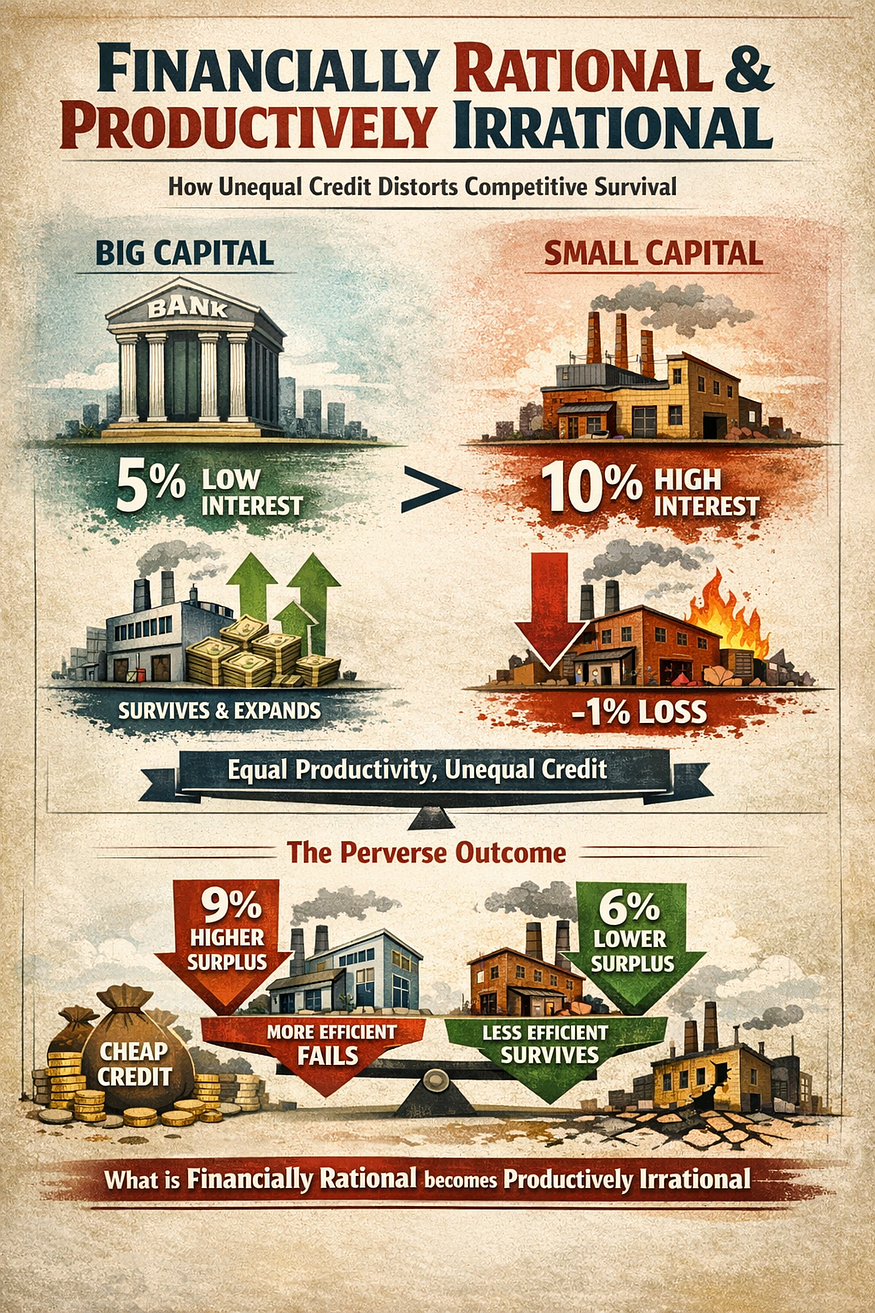
Big Capital borrows at 5% interest
Small Capital borrows at 10% interest
Assume market conditions allow both to generate a 9% surplus.
For Big Capital:
9% surplus − 5% interest = 4% profit
Big Capital survives and expands.
For Small Capital:
9% surplus − 10% interest = −1% loss
Small Capital fails.
Both capitals are equally productive. The difference in outcome is created entirely by finance. Survival is determined not by production, but by the cost of credit.
What is rational for lenders already reshapes competition in ways unrelated to productive performance.
Case 2: The More Productive Capital Fails First
The contradiction deepens when we relax the assumption of equal productivity.
Assume:
Big Capital produces only 6% surplus
Small Capital, using better technology, higher labour intensity, and more efficient organisation, produces 9% surplus
Interest rates remain the same.
For Big Capital:
6% surplus − 5% interest = 1% profit
Big Capital survives.
For Small Capital:
9% surplus − 10% interest = −1% loss
Small Capital fails.
Here the outcome is openly perverse:
a capital producing 9% surplus is eliminated, while a capital producing only 6% survives.
This cannot be explained by inefficiency, lack of effort, or inferior technique. It is produced by finance.
The Survival Threshold
To earn the same modest 1% profit as Big Capital, Small Capital must generate:
10% interest + 1% profit = 11% surplus
This is the decisive asymmetry.
Small Capital is not merely required to be more productive. It must be exceptionally more productive just to remain competitive. Incremental improvements—better machinery, smarter organisation, higher intensity—are insufficient. Each gain is absorbed by higher interest before it can stabilise reproduction.
—
Why Incremental Productivity Cannot Save Small Capital
Productive development is necessarily gradual. Learning takes time, innovations diffuse slowly, and mistakes are unavoidable.
Finance allows no such time.
Big Capital, protected by cheap credit, can survive at low surplus, absorb losses, cut prices, and wait. Small Capital, burdened by costly credit, must perform at exceptional levels immediately and continuously.
As a result, productivity ceases to regulate competition. Access to cheap money replaces efficiency as the decisive factor.
The Core Contradiction
From the standpoint of finance capital, differential interest rates are rational. Loans are priced by safety and repayment certainty.
But once this logic governs production and competition, it becomes irrational for productive capital. It:
protects less efficient, accumulated capital,
eliminates more efficient, emerging capital,
discourages experimentation and innovation,
and accelerates concentration.
The contradiction can be stated plainly:
What is financially rational becomes productively irrational.
The credit system secures money, but undermines production.
Leave a Reply