
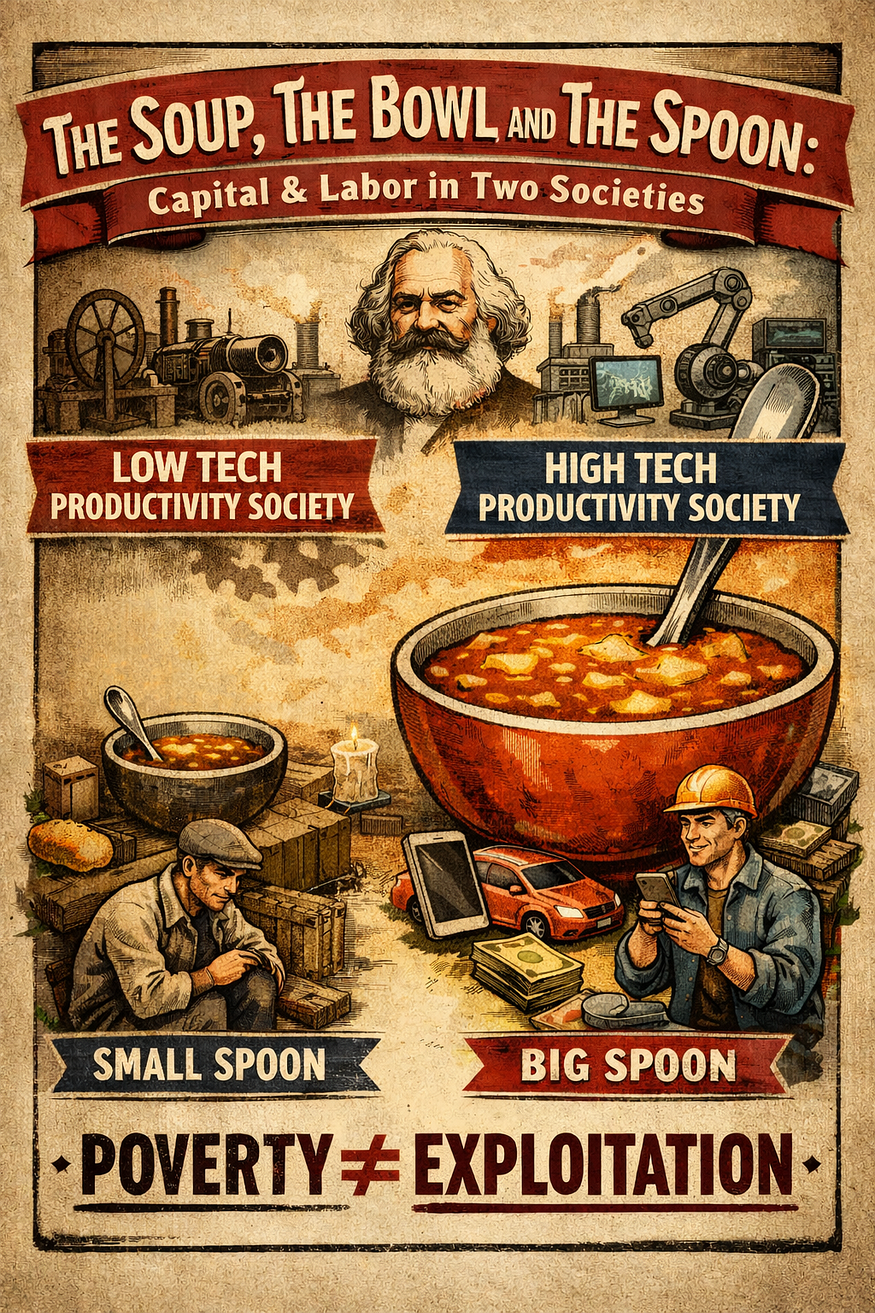
The Soup, the Bowl, and the Spoon:
The Fixed Bowl Fallacy
Marx says in a polemic against Weston “Citizen Weston’s argument rested, in fact, upon two premises: firstly, the amount of national production is a fixed thing, a constant quantity or magnitude, as the mathematicians would say; secondly, that the amount of real wages, that is to say, of wages as measured by the quantity of the commodities they can buy, is a fixed amount, a constant magnitude.”
Marx responds that National production is not constant. Year after year, the value and mass of production increase. The productive powers of labor expand continuously, requiring ever-changing amounts of money to circulate this growing output. What holds true across years holds true for every average day: the magnitude of national production changes continuously. Apart from population changes, this must be so because of the continuous change in the accumulation of capital and the productive powers of labor.
“Citizen Weston illustrated his theory by telling you that a bowl contains a certain quantity of soup, to be eaten by a certain number of persons, an increase in the broadness of the spoons would produce no increase in the amount of soup.”
Marx’s response established the analytical framework: “Citizen Weston, on his part, has forgotten that the bowl from which the workmen eat is filled with the whole produce of national labour, and that what prevents them fetching more out of it is neither the narrowness of the bowl nor the scantiness of its contents, but only the smallness of their spoons.”
Capitalism does not operate with a fixed bowl. Through rising productivity, technological change, and the organization of labor, it constantly expands total social wealth. The bowl grows. Yet capitalism simultaneously and systematically limits the spoon — the worker’s share of that wealth — unless forced otherwise.
Let us use this Bowl-Spoon analogy to study and understand capitalism’s reality through the lens of Marx’s labor theory of value.
The Analogy and Its Components
The metaphor distinguishes two elements:
- The bowl represents the total social product
- The spoon represents wages — the portion of that value workers receive
What remains after the spoon extracts from the bowl constitutes capital’s share for the next round of accumulation.
In Marx’s terms:
C + V + S = Total social product (the bowl)
Where:
- C (constant capital) represents the means of production — machinery, raw materials, buildings — reproduced in each cycle
- V (variable capital) represents wages paid to workers — what they consume to reproduce their labor power
- S (surplus value) represents the unpaid labor appropriated by capital
Workers produce the entire new value V + S through their labor but receive only V as wages. Capital appropriates S and accumulates it, expanding total capital to C + S in the next cycle.
Absolute Poverty: The Size of the Spoon
Absolute poverty refers to the absolute size of the spoon. It answers a concrete question: does the worker receive enough to meet minimum material needs — food, shelter, basic security?
Capitalism expands productive capacity. Marx recognized this without hesitation: “The number and extent of his so-called necessary wants, as also the modes of satisfying them, are themselves the product of historical development” (Capital, Vol. I).
As productivity rises, the bowl grows, making it possible for the spoon to grow as well. Capitalism has therefore often reduced absolute poverty compared to earlier modes of production. Marx plainly acknowledged: “The material position of the worker has improved” (Wage Labour and Capital).
To deny this constitutes not radicalism but denial of material reality.
Exploitation: The Gap Between Soup Produced and Soup Received
This improvement in material conditions does not tell the whole story. Marx immediately adds what is usually ignored: “But at the cost of his social position” (Wage Labour and Capital).
Exploitation does not concern how small the spoon is. It concerns how much soup the worker produces beyond what they receive. Marx defines exploitation precisely: “Surplus labour is the excess of labour performed beyond the necessary labour” (Capital, Vol. I).
Necessary labor V fills the spoon. Surplus labor S fills capital’s share. A worker can therefore escape absolute poverty and still be exploited if they produce far more soup than they are allowed to consume. Absolute poverty and exploitation are related but distinct phenomena.
Relative Poverty: When the Bowl Grows Faster Than the Spoon
Relative poverty does not mean deprivation. It means a declining share of growing social wealth.
Marx explains the social nature of satisfaction: “Our desires and pleasures spring from society; we measure them, therefore, by society and not by the objects which serve for their satisfaction” (Wage Labour and Capital).
More sharply: “A house may be large or small; as long as the neighbouring houses are likewise small, it satisfies all social requirement for a residence. But let there arise next to the little house a palace, and the little house shrinks to a hut” (Wage Labour and Capital).
Under capitalism, the bowl expands rapidly. Capital resists the spoon’s growth while workers fight to enlarge it. The distance between them widens, though the absolute size of the spoon may also increase. Capitalism as a system, therefore, tends to abolish absolute poverty while intensifying relative poverty.
Who Makes the Bowl Bigger, and Who Makes the Spoon Bigger
The class logic becomes clear here. Capital, as a system, expands total social wealth. Competition compels it to raise productivity, introduce machinery, and expand output. The imperative to accumulate drives technological advancement and organizational efficiency.
But capital has no inherent tendency to enlarge the spoon. Marx is explicit: “The general tendency of capitalist production is not to raise, but to sink the average standard of wages” (Value, Price and Profit).
The enlargement of the spoon occurs only through class struggle. Marx therefore insists: “Trades unions work well as centres of resistance against the encroachments of capital” (Value, Price and Profit).
Capital expands the wealth-bowl. Class struggle determines its distribution — the spoon’s size.
A Concrete Example: Two Societies
Consider two societies:
Society A (Low Technology):
- C = 10
- V = 10
- S = 1
- Rate of exploitation = S/V = 1/10 = 0.1 = 10%
Society B (High Technology):
- C = 100
- V = 20
- S = 20
- Rate of exploitation = S/V = 20/20 = 1 = 100%
In the high-technology, high-capital society, exploitation is considerably higher, yet workers receive more in absolute terms — more actual commodities — than workers in the low-technology, low-capital society despite being exploited less.
The productivity of any labor is directly proportional to the productivity of the constant capital employed. The increase in productivity increases the absolute amount of commodities workers enjoy, despite higher exploitation.
Society A: Absolute Poverty With Low Exploitation
The bowl is small because productivity is low. Workers produce only slightly more soup than fills their own spoon, leaving a small surplus.
- The spoon is small → workers are poor (no phones, no bicycles)
- Workers receive the major part of what they produce → low exploitation
This society exhibits absolute poverty even with low exploitation because of backward productive forces.
Society B: High Exploitation Without Absolute Poverty
The bowl is large because productivity is high. Workers produce a great deal of soup in absolute terms and receive a much larger spoon than in Society A. But most of the soup they produce is appropriated by capital.
- The spoon is larger → workers consume more commodities(consumes smartphones,owns a car)
- Workers receive only small part of what they produce → high exploitation exists
This society exhibits exploitation without absolute poverty.
The Core Insight
The bowl-soup-spoon analogy clarifies that poverty concerns the size of the spoon while exploitation concerns the division of the soup. They often appear together but describe different realities. Confusing them leads either to denying exploitation when workers live better or to assuming exploitation without analyzing production.
The Paradox: Capital Accumulation as Precondition for Workers’ Material Improvement
Because workers’ material gains depend on the expansion of total social wealth, the increase of capital becomes a necessary precondition for any lasting improvement in workers’ conditions — even as this same accumulation deepens their exploitation.
Marx states this without ambiguity: “To say that the worker has an interest in the rapid growth of capital means only this: that the more speedily the worker augments the wealth of the capitalist, the larger will be the crumbs which fall to him” (Wage Labour and Capital).
The growth of capital enlarges the bowl. Without that expansion, there is no material basis for a larger spoon. But this growth does not abolish exploitation; it reproduces it on an expanded scale.
Conclusion
Absolute poverty and exploitation are related but not identical. Absolute poverty concerns the size of the spoon. Exploitation concerns the gap between soup produced and soup received. Relative poverty emerges when the bowl grows faster than the spoon.
Capital creates wealth by expanding the bowl. Class struggle determines how much of that wealth reaches the spoon. Capitalism can abolish absolute poverty while deepening exploitation and relative poverty simultaneously. This is not a contradiction to be resolved morally but a structural dynamic to be understood scientifically.
The growth of capital — the expansion of the bowl — is therefore an essential precondition for the improvement of workers’ material conditions. Yet this same growth perpetually reproduces the extraction of surplus value, widening the gap between what workers produce and what they receive.
Marx captures this contradiction precisely: “The most favorable condition for wage-labour is the most rapid possible growth of productive capital… The more productive capital grows, the more the division of labour and the application of machinery expands. The more the division of labour and the application of machinery expands, the more competition among the workers expands and the more their wages contract” (Wage Labour and Capital).
Understanding this contradiction is essential for analyzing capitalism scientifically rather than morally.
Let us not fall into the traps of: (1) Liberal confusion that equates poverty with exploitation, (2) Moral Marxism that equates exploitation with misery, (3) Vulgar economism that equates higher wages with the end of exploitation.
Leave a Reply