Category: world

  • The Great Health Insurance Heist

    The Great Health Insurance Heist

    The Great Health Insurance Heist: A Citizen’s Guide to the Scam You’re Already Paying For

    Politician: Thank you. My dear citizens, today is a historic day! We are launching “Aarogya Suraksha” – a scheme to provide free health insurance for all! No more worrying about medical bills. You can now walk into any empaneled private hospital and get top-quality treatment. Because, let’s be honest, our government hospitals are not as clean or modern as we would like. This is a new dawn!

    Citizen: That sounds fantastic, sir. So, this insurance – how much will it cost me?

    Politician: Not a single rupee! It is absolutely free for you. The government will pay your premium. Health insurance is a pillar of financial prudence, and we are making it accessible to everyone.

    Citizen: I see. So, you, personally, will pay for me?

    Politician: No, no. From the state treasury. The people’s money for the people’s welfare!

    Citizen: And this treasury money… you will give it to this gentleman’s insurance company?

    Insurance Owner: That is correct. We are the risk managers. We will pool the premiums and ensure the scheme runs smoothly.

    Citizen: For everyone in the country? That’s a lot of premiums. But sir, you are a business. After you pay out all the hospital claims, and after your office costs, salaries, and advertising… you need to make a profit, right? That’s why you’re in business.

    Insurance Owner: That is a fundamental principle of commerce. We provide a valuable service, and a reasonable profit is our reward for efficiency and capital investment.

    Citizen: Understood. So, when I’m sick, this “claim money” you get from the government… you will hand it over to me?

    Bureaucrat: No. The model is cashless. The payment is made directly to the healthcare provider upon completion of treatment. The beneficiary does not handle funds.

    Citizen: So, you will treat me for free?

    Hospital Owner: Absolutely. The insurance will cover everything. You just need your Aadhaar card.

    Citizen: But why would you do that? You’re also a business. After you pay for the doctors, the medicines, the equipment… you also need to make a profit.

    Hospital Owner: Naturally. A margin is essential for growth, innovation, and maintaining our world-class facilities. The treatment is free for you, but the system sustains itself.

    Citizen: It’s all becoming clear. So, the government takes tax money, gives it to the insurance company, which takes a profit, who then pays the hospital, which also takes a profit. Two layers of profit, all from the public treasury.

    Politician: You are missing the point! The point is service delivery! The point is that the citizen gets treatment!

    Citizen: My question is, why are these specific companies chosen? How do we know they are the best?

    Politician: They are renowned, trusted partners! Furthermore, they are strong believers in our nation’s development… They even contribute to the democratic process…

    Citizen: They fund your election campaigns?

    Politician: They make lawful donations to the political process, which is the lifeblood of any democracy! We need funds to reach the people, to tell them about our good work like this scheme!

    Citizen: Which brings me to my final point. The government is always short of money. Where will you find the billions needed for this?

    Bureaucrat: The allocation will be re-prioritized. Inefficient and redundant expenditures will be rationalized. The budget for the Public Health Infrastructure mission is being scaled down, as the new scheme will ultimately reduce the burden on it.

    Citizen: Let me get this straight. The government will cut funding for public hospitals and use that money to fund this new scheme.

    Let’s be clear about what we are evolving from. Ideally, the system should be simple and efficient:
    Our Taxes= Healthcare in Public Hospitals.

    But we all know the old reality. It was:
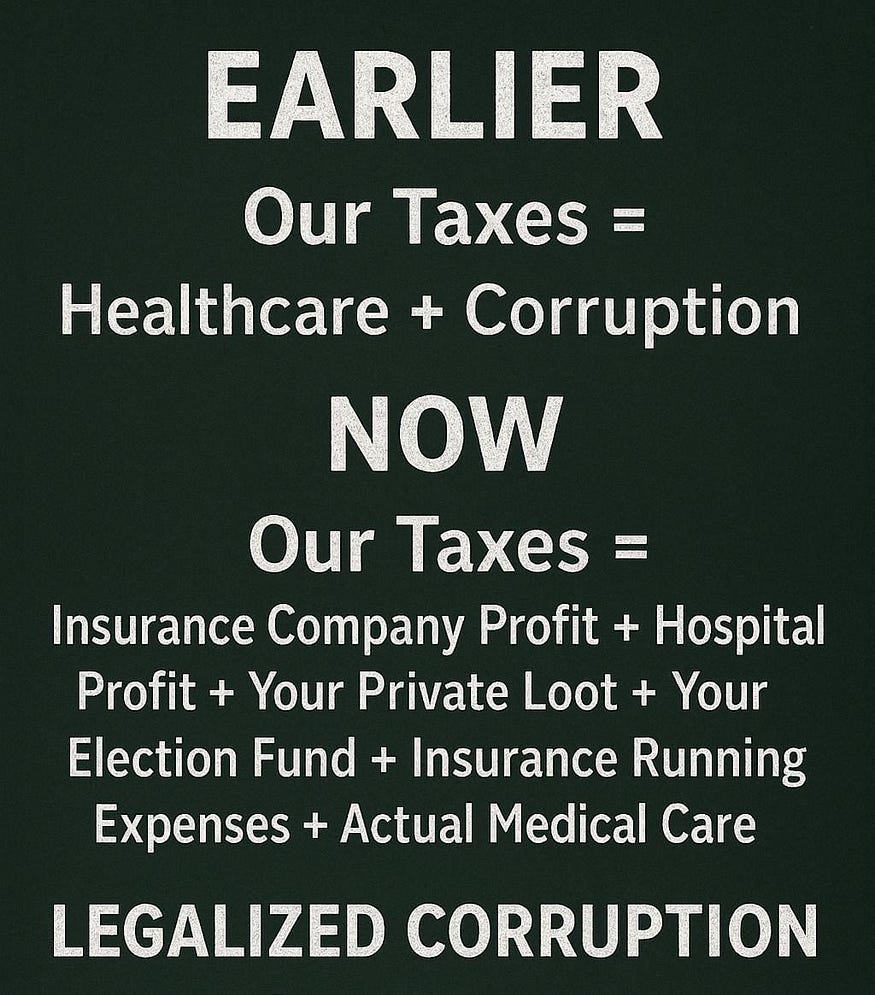
    Our Taxes= Healthcare + Corruption.

    It was a leaky bucket. But now, you haven’t fixed the leaks. You have created a whole new, more expensive bucket, and you’ve made the leaks a formal part of the design! You have evolved corruption into a legal, institutionalized system.

    Now, the formula is:
    Our Taxes= Insurance Company Profit + Hospital Profit + Politician’s Private Loot + Your Election Fund + Insurance Running Expenses + Actual Medical Care.

    This isn’t progress. This is corruption 2.0. You’ve replaced small, under-the-table bribes with massive, on-the-books profits for your partners, funded entirely by the public. You didn’t stop the theft; you just wrote a law to justify it.

    Politician: This is slander! A gross oversimplification of a complex policy!

    Citizen: The math is simple. You haven’t eliminated corruption. You’ve just privatized it and made the taxpayer pay a premium for it. What a brilliant scam.
    My apologies.I meant to say scheme.

  • Theory of Force and Imperialism

    Theory of Force and Imperialism

    I. Engels on Dühring’s Theory of Force and Its Rebuttal

    In the three chapters on the theory of force in Anti-Dühring, Engels takes up Dühring’s claim that political and military force is the primary determinant of social and economic relations. Dühring treats force as an autonomous historical power, capable of shaping economic life from the outside. Against this view, Engels reconstructs the real conditions under which force operates and exposes the material basis that Dühring systematically ignores.

    Engels begins by demonstrating that modern force is inconceivable without a definite level of economic development. Military power is not produced by will, courage, or political decree, but by the productive capacity of society itself. As Engels states, “The triumph of force depends upon the production of weapons, and the production of weapons depends upon production in general.” What appears as political or military superiority is therefore grounded in superiority of productive forces.

    This dependence is most clearly visible in the organisation of modern armed forces. Engels emphasises that “Nothing is more dependent on economic prerequisites than precisely army and navy.” The ability to raise, equip, and sustain military forces presupposes an advanced productive base. Hence, “The army, and with it war, is possible only through the development of industry.” Whether industry is directed toward peaceful production or military destruction does not alter its determining role, since “Industry remains industry, whether it is applied to the production or the destruction of things.”

    Technological advances in production thus directly reshape political and military relations. Engels points out that “And the introduction of fire-arms had a revolutionising effect not only on the conduct of war itself, but also on the political relationships of domination and subjection.” Military outcomes are therefore decided not by abstract force but by material conditions, a fact Engels underscores when he writes: “So, then, the revolver triumphs over the sword; and this will probably make even the most childish axiomatician comprehend that force is no mere act of the will, but requires the existence of very real preliminary conditions before it can come into operation…”

    Having established that military and political force arise from economic development, Engels turns to the question of purpose. Against the notion that force exists for its own sake or for mere political display, he insists that force is always instrumental. “But force is only the means; the aim, on the other hand, is economic advantage.” Even where force appears autonomous, it remains bound by economic limits: “Force, however, cannot make any money; at most it can take away money that has already been made …”

    For this reason, the exercise of force is never purely political. Its outcomes necessarily translate into material consequences, since “Every victory of force in the long run leads to economic results.”

    Through this critique, Engels decisively overturns Dühring’s theory of force. Military and political power do not stand above economic life; they arise from it, depend on it, and ultimately serve economic ends. Force, far from being the foundation of society, is itself conditioned by the development of production and by the material interests of the ruling class.

    II. Imperialism and Engels’ Theory of Force

    Engels’ critique of Dühring’s theory of force provides a materialist framework that clarifies the logic of imperialism. Once force is understood as arising from economic development and serving economic ends, imperialism can no longer be treated as a matter of political ambition, national psychology, or military tradition. It must be understood as a necessary form of capitalist expansion under conditions of uneven economic development.

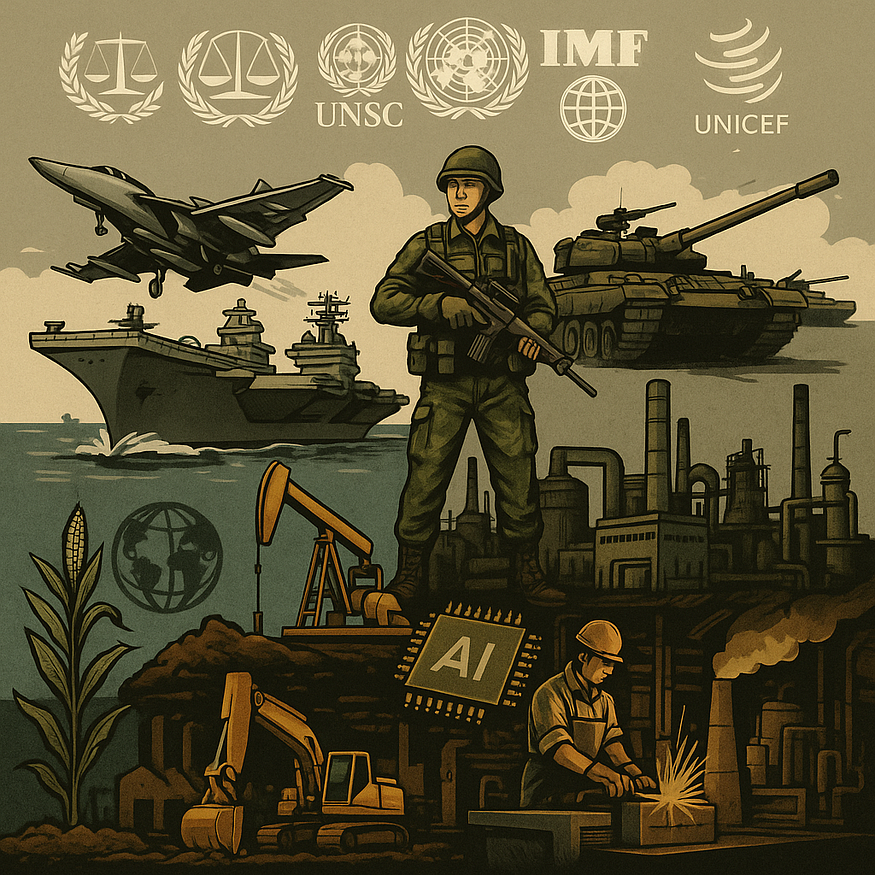
    Imperial domination presupposes a hierarchy of productive capacities among societies. Those formations that achieve superiority of productive forces necessarily acquire military superiority, not as an independent achievement, but as a derivative of their economic base. Engels’ insistence that military power rests on industry explains why imperial power consistently flows from economically advanced centres toward less developed regions. The ability to manufacture weapons, maintain standing armies and navies, and sustain prolonged military expenditure is inseparable from advanced production and accumulated capital.

    At the level of the Country, the same material logic governs the use of political force within capitalism. Political domination is employed to discipline and suppress competing capitals, to crush dissent, and to contain labour movements that struggle for higher wages, improved living conditions, and expanded social security.

    At the same time, the bourgeois state also provides social security assistance, welfare spending, and limited concessions in order to secure the consent and goodwill of the working class and stabilise the conditions of accumulation. State power intervenes both repressively and integratively, limiting the claims of labour whenever they threaten profitability while selectively accommodating them when social stability or reproduction of labour-power requires it.

    The provision and control of infrastructure is likewise a central function of the bourgeois nation-state. Roads, ports, energy systems, communications, and urban infrastructure are necessary conditions for capital accumulation, but control over infrastructure is simultaneously a form of control over the population itself.

    These practices are not deviations from capitalism but integral to its normal functioning. What a state does to a capitalist nation, the imperialist nation or system seeks to do to the whole world. The same framework, once established domestically, necessarily extends outward, reproducing itself on a global scale. Imperialism similarly combines coercion with incorporation, repression with concession, building international infrastructure, development projects, and quasi-“global welfare” mechanisms, while using control over these infrastructures to secure economic advantage and political domination on a world scale.

    For this reason, imperialist force is not episodic but structural. It is exercised not only in moments of open war, but continuously through the control of trade routes, strategic territories, and political conditions of exchange. In Engels’ framework, such force does not stand outside the economy; it is the political form through which economic power secures its reproduction. Military superiority thus functions as the guarantor of unequal economic relations already rooted in differences in productivity and development.

    Equally decisive is Engels’ insistence that force is a means rather than an end. Imperialism does not deploy force for prestige or domination as such, but for material advantage. Even when force appears autonomous, it remains economically constrained. Force cannot create value; it can only redistribute wealth already produced. Imperialist coercion therefore serves to secure favourable conditions for appropriation, accumulation, and expansion.

    Conclusion

    Engels’ polemic against Dühring’s theory of force can help us, in certain essential aspects, in understanding modern imperialism. The preconditions for capitalism within a country and for imperialism at the level of the world are both economic. The process of accumulation in capitalism within a nation and the process of accumulation through imperialism on a world scale are both economic. The ambitions of capitalism within a country and the ambitions of imperialism globally are likewise economic in character. Political and military power do not stand above the fundamental laws of capital; they function as their instruments. Just as political and military force serves capital in organising, disciplining, and reproducing accumulation within a nation, so imperialist political and military power serves capital in organising, disciplining, and reproducing accumulation at the global level. In both cases, force is not the source of wealth, but the means through which economic domination is secured and maintained.