
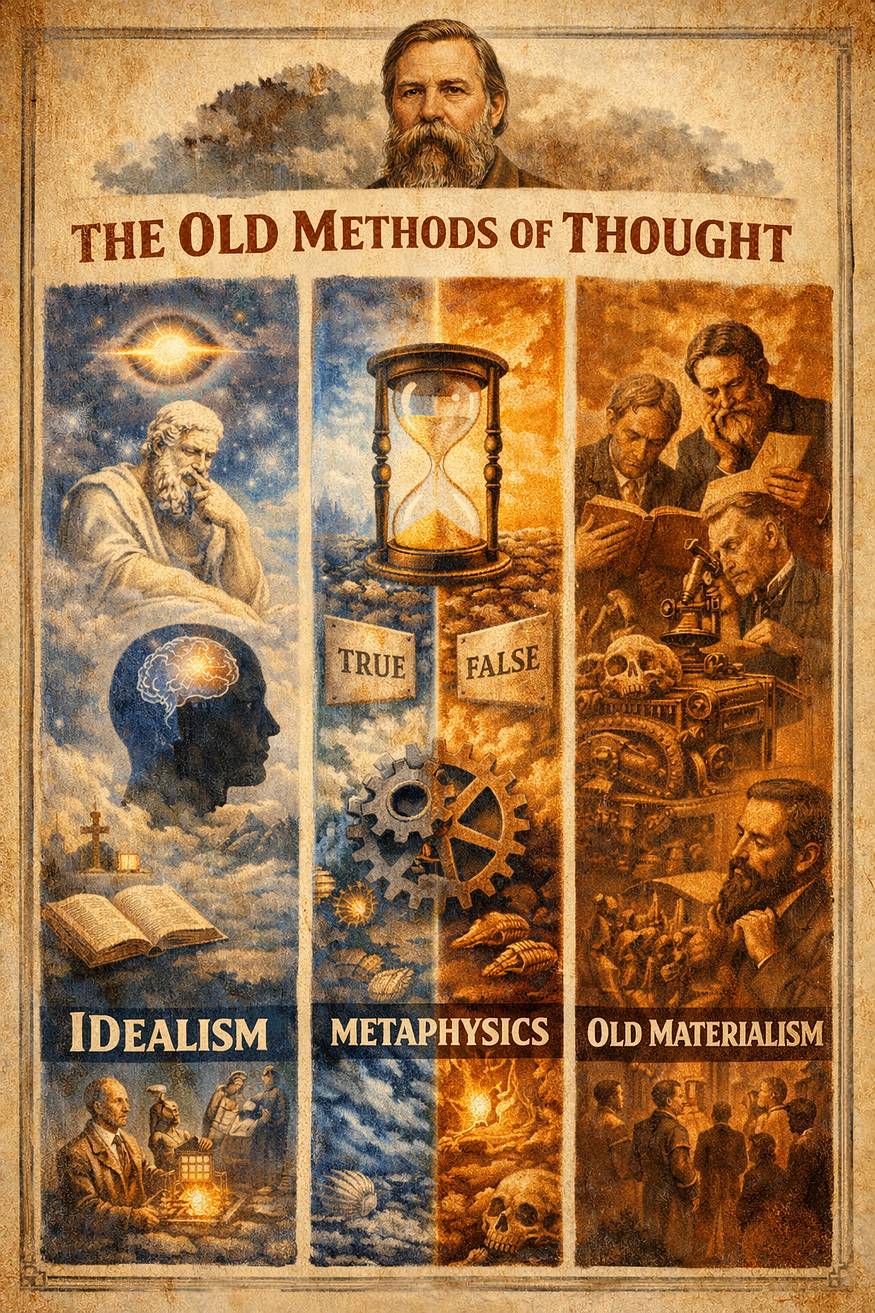
II. THE OLD METHODS OF THOUGHT
A. Idealism
Idealism asserts that spirit, thought, or the concept is the primary reality from which material existence derives. In its most developed form, idealism holds that “thinking and its thought-product, the idea, is here the primary, nature the derivative, which only exists at all by the condescension of the idea” (lfecgp). Nature becomes merely “the ‘alienation’ of the absolute idea, so to say, a degradation of the idea” (lfecgp).
This ideological perversion means “regarding real things as images of this or that stage of the absolute concept” (lfecgp)—making thought prior to material reality. The world of nature and history becomes nothing but the unfolding of an eternal idea existing independently of any human brain. The actual processes we observe are treated as mere copies of a conceptual self-movement occurring somewhere beyond time and space.
B. Metaphysics
While idealism concerns the question of primacy, metaphysics describes a particular method of thought. “The old method of investigation and thought which… [is called] ‘metaphysical’, which preferred to investigate things as given, as fixed and stable” (lfecgp). This approach sees reality as composed of finished, unchanging objects rather than as processes in constant development.
“The old metaphysics, which accepted things as finished objects, arose from a natural science which investigated dead and living things as finished objects” (lfecgp). This method had its historical justification: “It was necessary first to examine things before it was possible to examine processes. One had first to know what a particular thing was before one could observe the changes it was undergoing” (lfecgp). In the early stages of scientific development, this approach made sense.
However, the metaphysical method creates rigid, absolute oppositions. It produces “the antithesis, insuperable for the still common old metaphysics, between true and false, good and bad, identical and different, necessary and accidental” (lfecgp). For the metaphysician, “a thing either exists or does not exist; a thing cannot at the same time be itself and something else. Positive and negative absolutely exclude one another; cause and effect stand in a rigid antithesis, one to the other” (suc).
The metaphysical mode of thinking becomes inadequate once science advances to studying change and development. “When this investigation had progressed so far that it became possible to take the decisive step forward, that is, to pass on the systematic investigation of the changes which these things undergo in nature itself, then the last hour of the old metaphysic struck” (lfecgp). Modern science reveals that “while natural science up to the end of the last century was predominantly a collecting science, a science of finished things, in our century it is essentially a systematizing science, a science of the processes, of the origin and development of these things and of the interconnection which binds all these natural processes into one great whole” (lfecgp).
C. Old Materialism
Materialism correctly identifies nature as primary, but the older forms of materialism suffered from severe limitations. The materialism that emerged in the 18th century “was predominantly mechanical, because at that time, of all natural sciences, only mechanics, and indeed only the mechanics of solid bodies — celestial and terrestrial — in short, the mechanics of gravity, had come to any definite close” (lfecgp).
“This exclusive application of the standards of mechanics to processes of a chemical and organic nature… constitutes the first specific but at that time inevitable limitations of classical French materialism” (lfecgp). Everything, including living organisms and human society, was explained purely through mechanical causes—the pushing and pulling of material particles.
“The second specific limitation of this materialism lay in its inability to comprehend the universe as a process, as matter undergoing uninterrupted historical development” (lfecgp). Like the metaphysicians, the old materialists saw nature as essentially unchanging, moving “eternally, in a circle and therefore never moved from the spot; it produced the same results over and over again” (lfecgp). They could not grasp nature and history as undergoing real development.
Even more problematic was the contemplative character of old materialism, particularly in its representative Feuerbach. “The chief defect of all hitherto existing materialism – that of Feuerbach included – is that the thing, reality, sensuousness, is conceived only in the form of the object or of contemplation, but not as sensuous human activity, practice, not subjectively” (tof). The old materialism merely observed the world; it did not understand human activity itself as “objective activity” (tof).
Feuerbach “wants sensuous objects, really distinct from the thought objects, but he does not conceive human activity itself as objective activity” (tof). “Hence, in The Essence of Christianity, he regards the theoretical attitude as the only genuinely human attitude, while practice is conceived and fixed only in its dirty-judaical manifestation” (tof). Feuerbach fails to grasp “the significance of ‘revolutionary’, of ‘practical-critical’, activity” (tof).
This contemplative character means that “Feuerbach, not satisfied with abstract thinking, wants contemplation; but he does not conceive sensuousness as practical, human-sensuous activity” (tof). The result is that “the highest point reached by contemplative materialism, that is, materialism which does not comprehend sensuousness as practical activity, is contemplation of single individuals and of civil society” (tof). Old materialism remains passive, unable to grasp the active, transformative role of human practice.
Furthermore, in treating human beings, Feuerbach makes a crucial error. “Feuerbach resolves the religious essence into the human essence. But the human essence is no abstraction inherent in each single individual. In its reality it is the ensemble of the social relations” (tof). By treating man as an isolated abstraction rather than as embedded in concrete social relations, Feuerbach cannot truly overcome idealism. “As far as Feuerbach is a materialist he does not deal with history, and as far as he considers history he is not a materialist” (lfecgp).
The old materialism, whether mechanical or contemplative, thus proves inadequate. It correctly identifies the material basis of reality but fails to grasp that reality as process, as development, and as shaped by human practical activity. A new synthesis was necessary.
Leave a Reply