
I. THE FUNDAMENTAL QUESTION OF PHILOSOPHY
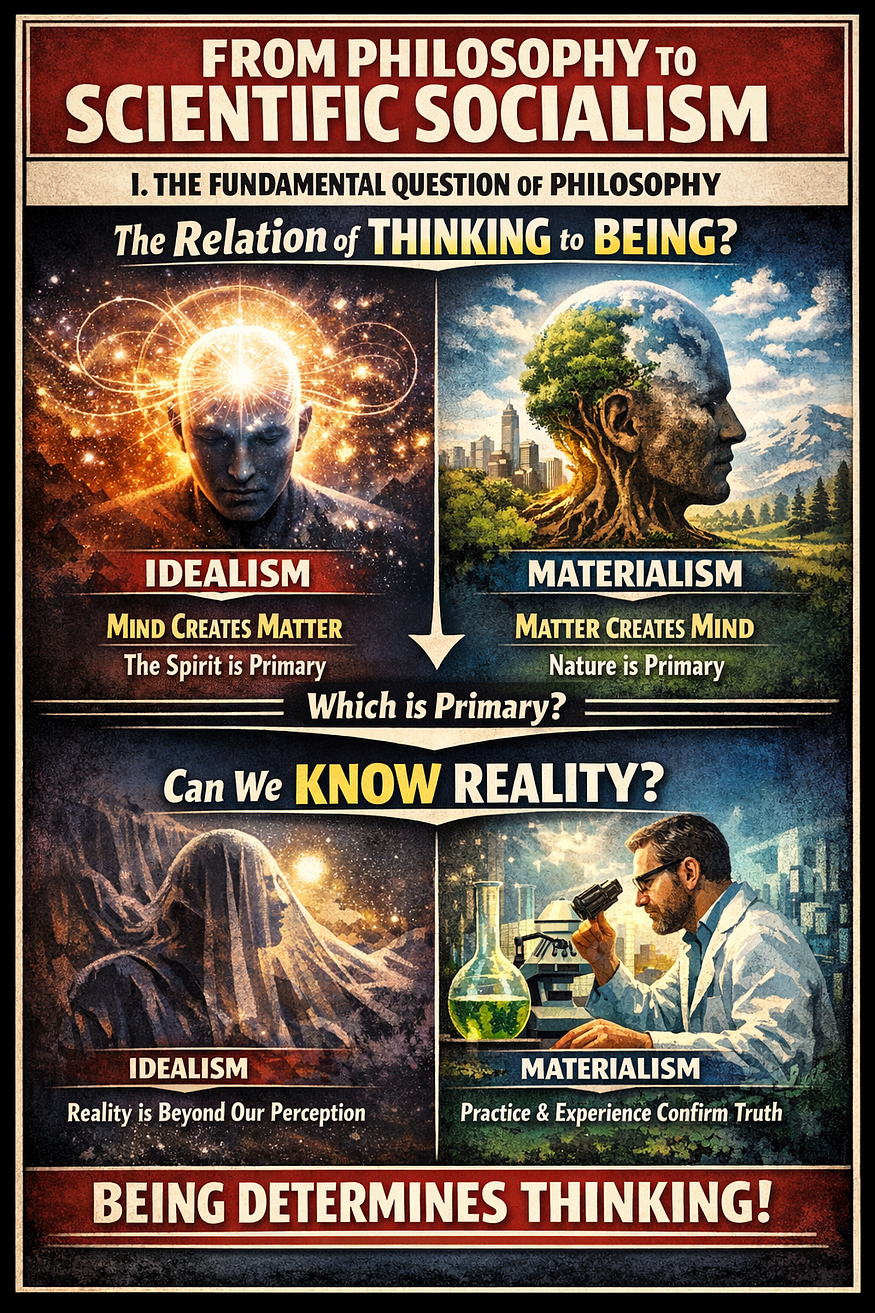
“The question of the relation of thinking to being, the relation of the spirit to nature” (lfecgp) is what Engels identifies as “the paramount question of the whole of philosophy” (lfecgp). This fundamental question divides all philosophers into two great camps, and the answer given determines the entire character of a philosophical system.
“Those who asserted the primacy of spirit to nature and, therefore, in the last instance, assumed world creation in some form or other… comprised the camp of idealism. The others, who regarded nature as primary, belong to the various schools of materialism” (lfecgp). This division is not arbitrary but reflects a basic choice about what exists first and what is derived: does mind create matter, or does matter produce mind?
For idealism, the spiritual principle is fundamental. In its developed form, “the absolute concept does not only exist — unknown where — from eternity, it is also the actual living soul of the whole existing world” (lfecgp). According to this view, “the dialectical development apparent in nature and history… is only a copy [Abklatsch] of the self-movement of the concept going on from eternity, no one knows where, but at all events independently of any thinking human brain” (lfecgp). Thus idealism makes thought prior to being, treating material reality as merely the realization or reflection of pre-existing ideas.
Materialism takes the opposite position. “Matter is not a product of mind, but mind itself is merely the highest product of matter” (lfecgp). For materialists, “Nature exists independently of all philosophy. It is the foundation upon which we human beings, ourselves products of nature, have grown up” (lfecgp). Here, being precedes thinking; consciousness arises from material existence, not the reverse.
But the fundamental question has a second aspect beyond the question of primacy. As Engels explains, there is also “the question of the relation of thinking and being” in terms of knowledge: can our thoughts correctly reflect reality? (lfecgp). Can we know the world as it actually is, or are we forever separated from reality by the veil of our perceptions? While some philosophers doubt whether “our senses give us correct representations of the objects we perceive through them” (lfecgp), the materialist answer is clear: practice proves the correctness of our perceptions. “The proof of the pudding is in the eating. From the moment we turn to our own use these objects, according to the qualities we perceive in them, we put to an infallible test the correctness or otherwise of our sense-perception” (lfecgp).
This question of primacy—whether spirit or nature, thinking or being comes first—is not merely an academic debate. It determines one’s entire approach to understanding the world and to changing it. The choice between idealism and materialism shapes how we comprehend history, society, and human action itself.
these are the references for this series of essays
lfecgp = Ludwig Fauerbach and end of Classical German Philosophy
pccpe=Preface to A Contribution to the Critique of Political Economy
tof = Thesis on Fauerbach
suc = Socialism Utopian and Scientific
gi = German Ideology
Leave a Reply