
III. THE DIALECTICAL METHOD
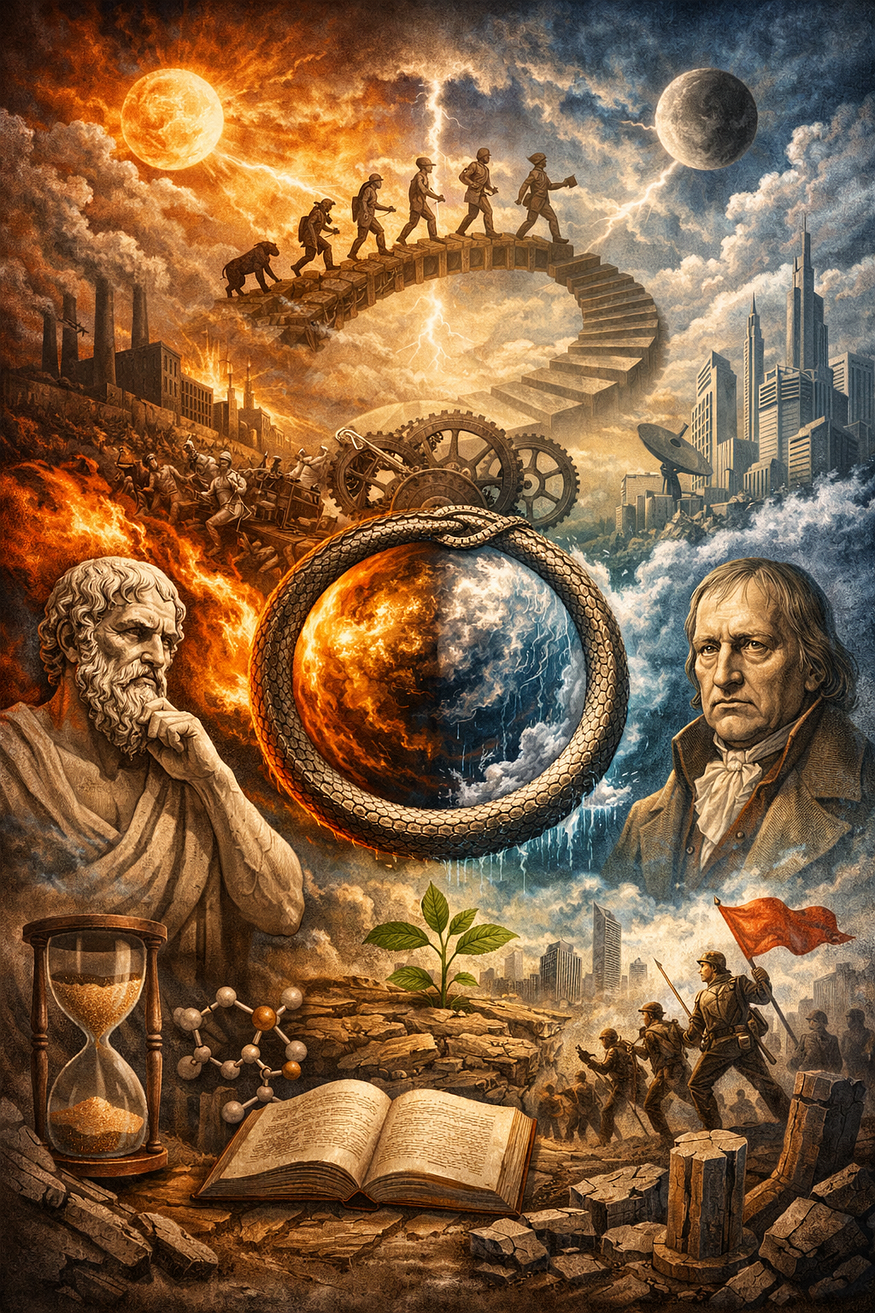
The dialectical method represents a fundamental advance over metaphysical thinking. Where metaphysics sees fixed things, dialectics sees processes; where metaphysics creates rigid oppositions, dialectics grasps movement and development.
“The great basic thought that the world is not to be comprehended as a complex of readymade things, but as a complex of processes, in which the things apparently stable no less than their mind images in our heads, the concepts, go through an uninterrupted change of coming into being and passing away, in which, in spite of all seeming accidentally and of all temporary retrogression, a progressive development asserts itself in the end” (lfecgp). This is the essence of dialectical thinking.
When we observe nature or history with fresh eyes, we see “the picture of an endless entanglement of relations and reactions, permutations and combinations, in which nothing remains what, where and as it was, but everything moves, changes, comes into being and passes away” (suc). We observe “the movements, transitions, connections, rather than the things that move, combine, and are connected” (suc). This is “the primitive, naive but intrinsically correct conception of the world” (suc) that the ancient Greek philosophers, particularly Heraclitus, first clearly formulated: “everything is and is not, for everything is fluid, is constantly changing, constantly coming into being and passing away” (suc).
The dialectical method stands in sharp contrast to metaphysical thinking. “To the metaphysician, things and their mental reflexes, ideas, are isolated, are to be considered one after the other and apart from each other, are objects of investigation fixed, rigid, given once for all” (suc). The metaphysician thinks in “absolutely irreconcilable antitheses” (suc). But dialectics shows that these rigid oppositions dissolve when examined more closely.
“Upon closer inquiry, we find that the two poles of an antithesis, positive and negative, e.g., are as inseparable as they are opposed, and that despite all their opposition, they mutually interpenetrate” (suc). Similarly, “cause and effect are conceptions which only hold good in their application to individual cases; but as soon as we consider the individual cases in their general connection with the universe as a whole, they run into each other, and they become confounded when we contemplate that universal action and reaction in which causes and effects are eternally changing places” (suc).
The same applies to all metaphysical oppositions. “None of these processes and modes of thought enters into the framework of metaphysical reasoning. Dialectics, on the other hand, comprehends things and their representations, ideas, in their essential connection, concatenation, motion, origin and ending” (suc). Every organic being, for example, “is every moment the same and not the same; every moment, it assimilates matter supplied from without, and gets rid of other matter; every moment, some cells of its body die and others build themselves anew” (suc). The being is constantly both itself and not itself, stable and changing simultaneously.
When investigation proceeds from the dialectical standpoint, “the demand for final solutions and eternal truths ceases once for all; one is always conscious of the necessary limitation of all acquired knowledge, of the fact that it is conditioned by the circumstances in which it was acquired” (lfecgp). One no longer accepts absolute, unchanging truths, but recognizes that “that which is recognized now as true has also its latent false side which will later manifest itself, just as that which is now regarded as false has also its true side by virtue of which it could previously be regarded as true” (lfecgp).
“One knows that what is maintained to be necessary is composed of sheer accidents and that the so-called accidental is the form behind which necessity hides itself” (lfecgp). The rigid metaphysical antitheses dissolve into relative, interconnected, developing moments of a larger process.
“For it [dialectical philosophy], nothing is final, absolute, sacred. It reveals the transitory character of everything and in everything; nothing can endure before it except the uninterrupted process of becoming and of passing away, of endless ascendancy from the lower to the higher” (lfecgp). The revolutionary character of dialectics lies precisely here: it shows that “All that exists deserves to perish” (lfecgp). Every stage of development, every social form, every supposedly eternal truth contains within itself the seeds of its own transformation.
“dialectical philosophy itself is nothing more than the mere reflection of this process in the thinking brain” (lfecgp). Dialectics is not imposed on reality from outside; it is the conceptual grasp of the actual movement of things themselves.
The dialectical method received its most systematic development in the philosophy of Hegel. His system represented dialectics in idealist form, where “dialectics is the self-development of the concept” (lfecgp). For Hegel, the entire development of nature and history was merely the unfolding of an eternal absolute idea. Yet despite this idealist framework, Hegel’s dialectical method contained profound insights.
In Hegel’s system, “for the first time the whole world, natural, historical, intellectual, is represented as a process — i.e., as in constant motion, change, transformation, development; and the attempt is made to trace out the internal connection that makes a continuous whole of all this movement and development” (suc). This was an enormous achievement. “From this point of view, the history of mankind no longer appeared as a wild whirl of senseless deeds of violence, all equally condemnable at the judgment seat of mature philosophic reason and which are best forgotten as quickly as possible, but as the process of evolution of man himself” (suc).
However, Hegel’s system suffered from an internal contradiction. “Upon the one hand, its essential proposition was the conception that human history is a process of evolution, which, by its very nature, cannot find its intellectual final term in the discovery of any so-called absolute truth. But, on the other hand, it laid claim to being the very essence of this absolute truth” (suc). Hegel claimed to have reached the final, complete truth in his own philosophical system—a claim that contradicted the very principle of endless development that dialectics teaches.
Moreover, Hegel’s idealism meant that “to him, the thoughts within his brain were not the more or less abstract pictures of actual things and processes, but, conversely, things and their evolution were only the realized pictures of the ‘Idea’, existing somewhere from eternity before the world was” (suc). “This way of thinking turned everything upside down, and completely reversed the actual connection of things in the world” (suc).
The task, therefore, was to preserve the dialectical method while overcoming the idealist system—to keep the revolutionary kernel while discarding the mystical shell. This required placing dialectics on a materialist foundation.
Leave a Reply