Category: philosophy

  • Hair-Splitting Etymological Debates

    Hair-Splitting Etymological Debates

    Against Etymological Politics:

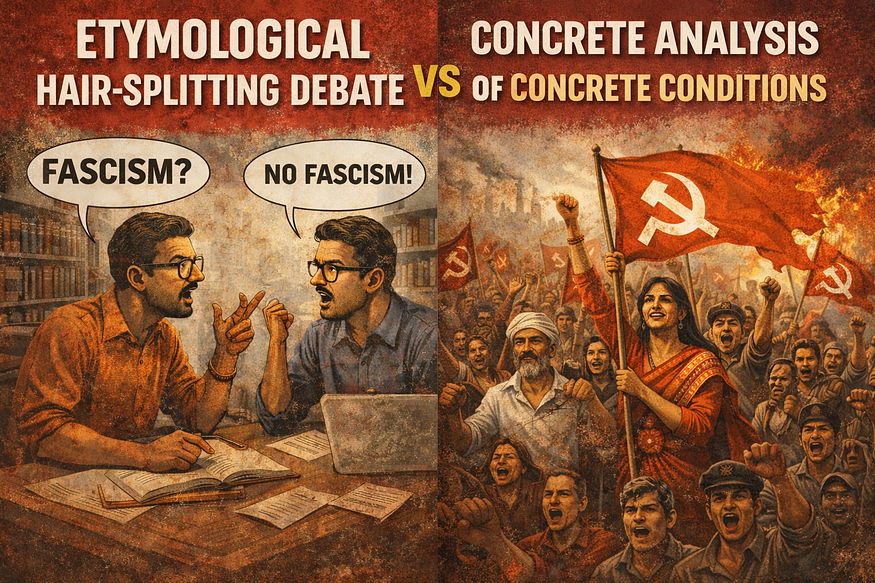
    Marxism is not a politics of naming, moral signalling, or linguistic purity. It is a scientific method and a guide to revolutionary practice. Lenin defined it with absolute clarity: “Concrete analysis of concrete conditions.” Any approach that replaces this method with wordplay is not Marxism, but idealism in radical disguise.

    The liberal and ultra-left obsession with whether present-day India should be called “fascist” rather than “neo-fascist” exemplifies this degeneration. It is not grounded in political economy, class analysis, or historical investigation. It is an etymological fixation masquerading as politics.

    These critics do not analyse Indian capitalism. They do not examine the ruling-class alliance of monopoly capital, feudal remnants, and imperialist integration. They do not analyse the state, the reorganisation of consent and coercion, or the concrete mechanisms through which authoritarianism advances. They do not propose strategy, organisation, or mass struggle. They propose a word.

    Italy in the 1930s was not Germany in the 1930s. Italy in the 1930s is not Italy in 2025. And Italy in the 1930s is certainly not India in 2025. History does not reproduce political forms mechanically; it transforms them through distinct material conditions, class structures, and historical paths. To demand that contemporary authoritarianism conform exactly to the classical European fascist model is to abandon empirical analysis in favour of historical analogy. Marxism rejects such imitation.

    This is where the decisive historical difference between Europe and India must be stated clearly. In much of Europe, fascism represented the withdrawal of bourgeois-democratic rights that the working class had already won and materially exercised through mass parties, trade unions, and parliamentary struggle. In India, democratic rights were formally granted in 1950 but were never substantively realised for the working masses. Constitutional guarantees largely existed on paper, while real access to political power, economic security, and institutional protection remained structurally denied. It is therefore historically inaccurate to claim that the Indian working class has now “lost” democratic rights in the same sense as European workers under classical fascism. One cannot lose what one never substantively possessed.

    Marx himself warned against the illusion of mechanical repetition: “History repeats itself, first as tragedy, second as farce.” Fascism does not return as a replica. Forms may echo the past, but their content is shaped by new historical conditions. Italy in the 1930s, Germany in the 1930s, and India today occupy entirely different positions within world capitalism and have followed fundamentally different paths of development.

    India’s capitalism emerged through colonial domination, not through a bourgeois revolution. Contemporary authoritarianism operates through elections, identity mobilisation, media control, judicial hollowing, and the dominance of monopoly capital—without abolishing parliamentary forms. This cannot be understood through the classical fascist template.

    On the basis of empirical Marxist analysis, the present conjuncture is therefore correctly characterised as neo-fascism. The prefix “neo” is not a concession; it is a theoretical necessity. It recognises historical transformation. Only those incapable of analysis mistake conceptual development for dilution.

    The etymological camp is unconcerned with characteristics, class content, or strategy. Its entire political practice is criticism without responsibility. Liberal critics want the moral comfort of calling everything “fascism” without the burden of struggle. Ultra-left critics want revolutionary language without the discipline of mass politics. Both converge in the same sterile activity: attacking an established communist party while contributing nothing to resistance.

    Their politics consists of denunciation instead of organisation, rhetoric instead of strategy, and armchair commentary instead of risk. They confuse naming with understanding and critique with action.

    Marxism is not performed in comment sections. It is tested in struggle. Those serious about fighting authoritarianism must engage with concrete analysis, real forces, and real tasks—not semantic purity.

    As Engels put it with enduring relevance:
    Etymological tricks are the last resort of idealist philosophy.”

    And idealism—liberal or ultra-left—has never overthrown a ruling class.

  • Marxist Philosophy -1

    Marxist Philosophy -1

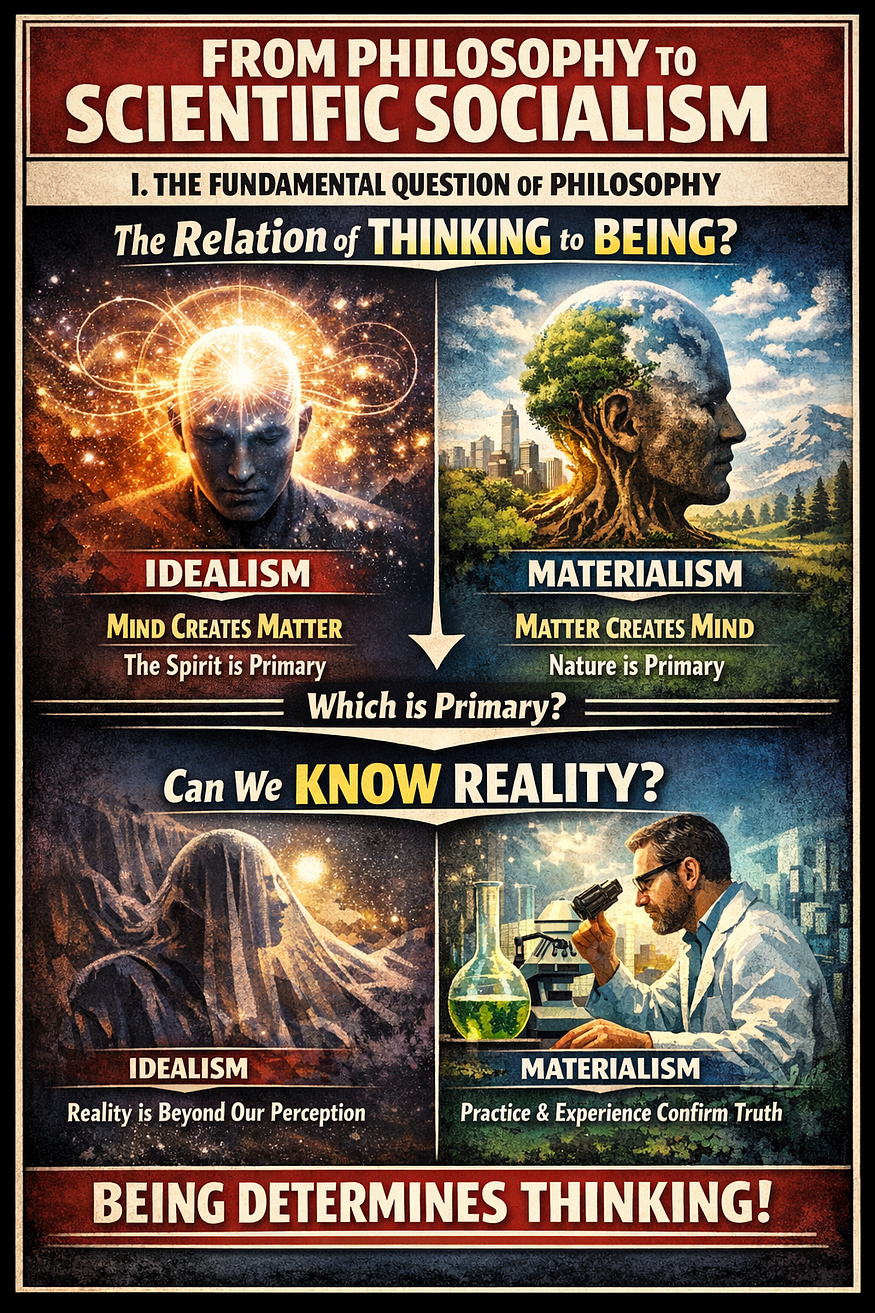
    I. THE FUNDAMENTAL QUESTION OF PHILOSOPHY
    “The question of the relation of thinking to being, the relation of the spirit to nature” (lfecgp) is what Engels identifies as “the paramount question of the whole of philosophy” (lfecgp). This fundamental question divides all philosophers into two great camps, and the answer given determines the entire character of a philosophical system.
    “Those who asserted the primacy of spirit to nature and, therefore, in the last instance, assumed world creation in some form or other… comprised the camp of idealism. The others, who regarded nature as primary, belong to the various schools of materialism” (lfecgp). This division is not arbitrary but reflects a basic choice about what exists first and what is derived: does mind create matter, or does matter produce mind?
    For idealism, the spiritual principle is fundamental. In its developed form, “the absolute concept does not only exist — unknown where — from eternity, it is also the actual living soul of the whole existing world” (lfecgp). According to this view, “the dialectical development apparent in nature and history… is only a copy [Abklatsch] of the self-movement of the concept going on from eternity, no one knows where, but at all events independently of any thinking human brain” (lfecgp). Thus idealism makes thought prior to being, treating material reality as merely the realization or reflection of pre-existing ideas.
    Materialism takes the opposite position. “Matter is not a product of mind, but mind itself is merely the highest product of matter” (lfecgp). For materialists, “Nature exists independently of all philosophy. It is the foundation upon which we human beings, ourselves products of nature, have grown up” (lfecgp). Here, being precedes thinking; consciousness arises from material existence, not the reverse.
    But the fundamental question has a second aspect beyond the question of primacy. As Engels explains, there is also “the question of the relation of thinking and being” in terms of knowledge: can our thoughts correctly reflect reality? (lfecgp). Can we know the world as it actually is, or are we forever separated from reality by the veil of our perceptions? While some philosophers doubt whether “our senses give us correct representations of the objects we perceive through them” (lfecgp), the materialist answer is clear: practice proves the correctness of our perceptions. “The proof of the pudding is in the eating. From the moment we turn to our own use these objects, according to the qualities we perceive in them, we put to an infallible test the correctness or otherwise of our sense-perception” (lfecgp).
    This question of primacy—whether spirit or nature, thinking or being comes first—is not merely an academic debate. It determines one’s entire approach to understanding the world and to changing it. The choice between idealism and materialism shapes how we comprehend history, society, and human action itself.

    these are the references for this series of essays

    lfecgp = Ludwig Fauerbach and end of Classical German Philosophy
    pccpe=Preface to A Contribution to the Critique of Political Economy
    tof = Thesis on Fauerbach
    suc = Socialism Utopian and Scientific
    gi = German Ideology

    eblb = The Eighteenth Brumaire of Louis Bonaparte

  • Marxist Philosophy - 2

    Marxist Philosophy - 2

    II. THE OLD METHODS OF THOUGHT
    A. Idealism
    Idealism asserts that spirit, thought, or the concept is the primary reality from which material existence derives. In its most developed form, idealism holds that “thinking and its thought-product, the idea, is here the primary, nature the derivative, which only exists at all by the condescension of the idea” (lfecgp). Nature becomes merely “the ‘alienation’ of the absolute idea, so to say, a degradation of the idea” (lfecgp).
    This ideological perversion means “regarding real things as images of this or that stage of the absolute concept” (lfecgp)—making thought prior to material reality. The world of nature and history becomes nothing but the unfolding of an eternal idea existing independently of any human brain. The actual processes we observe are treated as mere copies of a conceptual self-movement occurring somewhere beyond time and space.
    B. Metaphysics
    While idealism concerns the question of primacy, metaphysics describes a particular method of thought. “The old method of investigation and thought which… [is called] ‘metaphysical’, which preferred to investigate things as given, as fixed and stable” (lfecgp). This approach sees reality as composed of finished, unchanging objects rather than as processes in constant development.
    “The old metaphysics, which accepted things as finished objects, arose from a natural science which investigated dead and living things as finished objects” (lfecgp). This method had its historical justification: “It was necessary first to examine things before it was possible to examine processes. One had first to know what a particular thing was before one could observe the changes it was undergoing” (lfecgp). In the early stages of scientific development, this approach made sense.
    However, the metaphysical method creates rigid, absolute oppositions. It produces “the antithesis, insuperable for the still common old metaphysics, between true and false, good and bad, identical and different, necessary and accidental” (lfecgp). For the metaphysician, “a thing either exists or does not exist; a thing cannot at the same time be itself and something else. Positive and negative absolutely exclude one another; cause and effect stand in a rigid antithesis, one to the other” (suc).
    The metaphysical mode of thinking becomes inadequate once science advances to studying change and development. “When this investigation had progressed so far that it became possible to take the decisive step forward, that is, to pass on the systematic investigation of the changes which these things undergo in nature itself, then the last hour of the old metaphysic struck” (lfecgp). Modern science reveals that “while natural science up to the end of the last century was predominantly a collecting science, a science of finished things, in our century it is essentially a systematizing science, a science of the processes, of the origin and development of these things and of the interconnection which binds all these natural processes into one great whole” (lfecgp).
    C. Old Materialism
    Materialism correctly identifies nature as primary, but the older forms of materialism suffered from severe limitations. The materialism that emerged in the 18th century “was predominantly mechanical, because at that time, of all natural sciences, only mechanics, and indeed only the mechanics of solid bodies — celestial and terrestrial — in short, the mechanics of gravity, had come to any definite close” (lfecgp).
    “This exclusive application of the standards of mechanics to processes of a chemical and organic nature… constitutes the first specific but at that time inevitable limitations of classical French materialism” (lfecgp). Everything, including living organisms and human society, was explained purely through mechanical causes—the pushing and pulling of material particles.
    “The second specific limitation of this materialism lay in its inability to comprehend the universe as a process, as matter undergoing uninterrupted historical development” (lfecgp). Like the metaphysicians, the old materialists saw nature as essentially unchanging, moving “eternally, in a circle and therefore never moved from the spot; it produced the same results over and over again” (lfecgp). They could not grasp nature and history as undergoing real development.
    Even more problematic was the contemplative character of old materialism, particularly in its representative Feuerbach. “The chief defect of all hitherto existing materialism – that of Feuerbach included – is that the thing, reality, sensuousness, is conceived only in the form of the object or of contemplation, but not as sensuous human activity, practice, not subjectively” (tof). The old materialism merely observed the world; it did not understand human activity itself as “objective activity” (tof).
    Feuerbach “wants sensuous objects, really distinct from the thought objects, but he does not conceive human activity itself as objective activity” (tof). “Hence, in The Essence of Christianity, he regards the theoretical attitude as the only genuinely human attitude, while practice is conceived and fixed only in its dirty-judaical manifestation” (tof). Feuerbach fails to grasp “the significance of ‘revolutionary’, of ‘practical-critical’, activity” (tof).
    This contemplative character means that “Feuerbach, not satisfied with abstract thinking, wants contemplation; but he does not conceive sensuousness as practical, human-sensuous activity” (tof). The result is that “the highest point reached by contemplative materialism, that is, materialism which does not comprehend sensuousness as practical activity, is contemplation of single individuals and of civil society” (tof). Old materialism remains passive, unable to grasp the active, transformative role of human practice.
    Furthermore, in treating human beings, Feuerbach makes a crucial error. “Feuerbach resolves the religious essence into the human essence. But the human essence is no abstraction inherent in each single individual. In its reality it is the ensemble of the social relations” (tof). By treating man as an isolated abstraction rather than as embedded in concrete social relations, Feuerbach cannot truly overcome idealism. “As far as Feuerbach is a materialist he does not deal with history, and as far as he considers history he is not a materialist” (lfecgp).
    The old materialism, whether mechanical or contemplative, thus proves inadequate. It correctly identifies the material basis of reality but fails to grasp that reality as process, as development, and as shaped by human practical activity. A new synthesis was necessary.