
IV. THE FAILURE OF THE YOUNG HEGELIANS
Following Hegel’s death, a movement emerged among German philosophers claiming to radicalize and critique his system. These Young Hegelians presented themselves as revolutionaries overthrowing outdated ideas. Yet their critique, despite its radical pretensions, never escaped the prison of pure thought.
“German criticism has, right up to its latest efforts, never quitted the realm of philosophy” (gi). “Far from examining its general philosophic premises, the whole body of its inquiries has actually sprung from the soil of a definite philosophical system, that of Hegel” (gi). The Young Hegelians remained bound by the very system they claimed to transcend.
“Not only in their answers but in their very questions there was a mystification” (gi). They believed they were challenging the foundations of the existing order, but in reality they merely rearranged concepts. “The entire body of German philosophical criticism from Strauss to Stirner is confined to criticism of religious conceptions” (gi). Everything—political institutions, legal relations, moral consciousness—was reduced to theological categories and then criticized as religion.
The Young Hegelians imagined that by changing consciousness, they could change reality. “Since the Young Hegelians consider conceptions, thoughts, ideas, in fact all the products of consciousness, to which they attribute an independent existence, as the real chains of men… it is evident that the Young Hegelians have to fight only against these illusions of consciousness” (gi). Their entire revolutionary program consisted of altering ideas.
“Since, according to their fantasy, the relationships of men, all their doings, their chains and their limitations are products of their consciousness, the Young Hegelians logically put to men the moral postulate of exchanging their present consciousness for human, critical or egoistic consciousness, and thus of removing their limitations” (gi). Change your thinking, they proclaimed, and you change the world. “This demand to change consciousness amounts to a demand to interpret reality in another way, i.e. to recognise it by means of another interpretation” (gi).
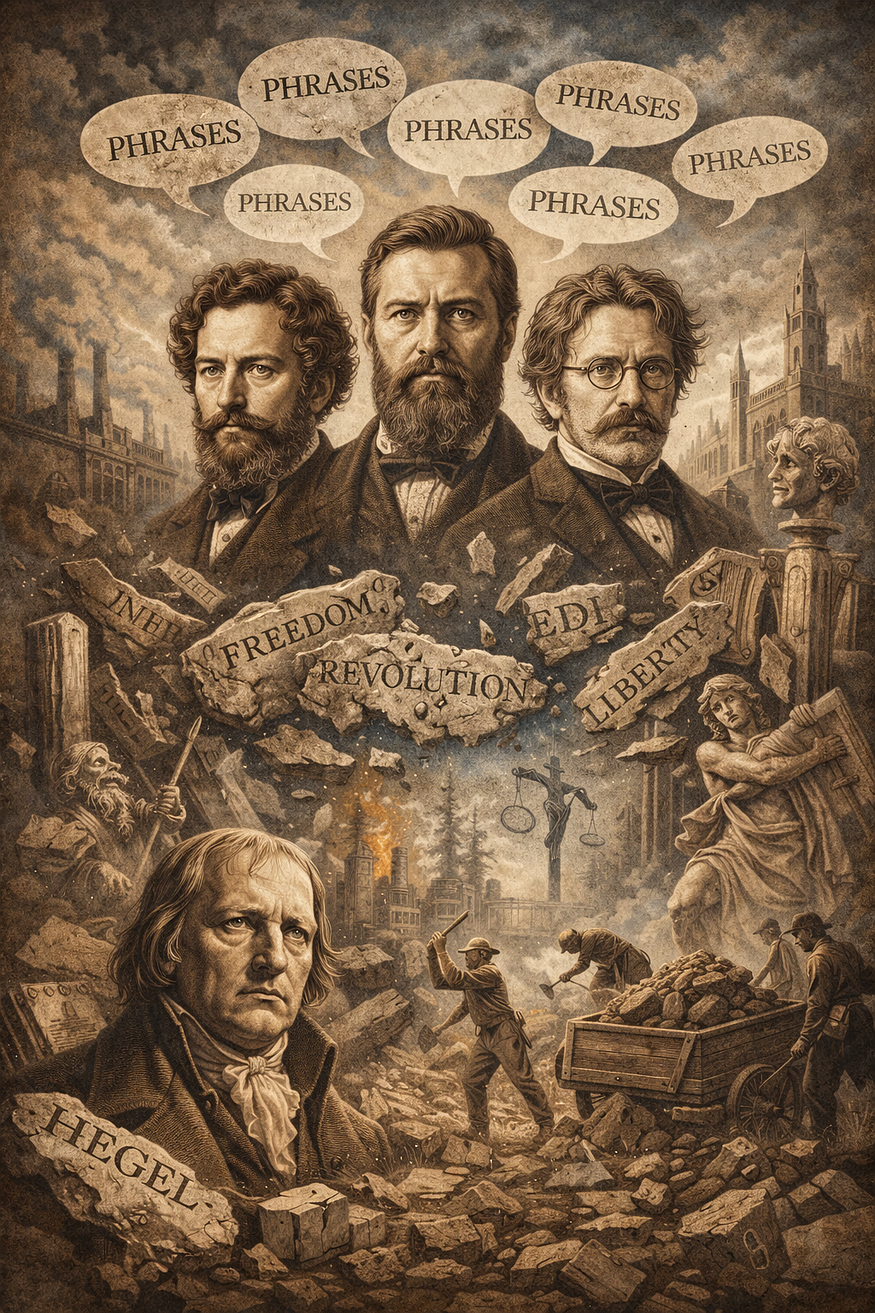
The absurdity of this position is evident. “The Young-Hegelian ideologists, in spite of their allegedly ‘world-shattering’ statements, are the staunchest conservatives” (gi). Despite their radical rhetoric, they changed nothing. “The most recent of them have found the correct expression for their activity when they declare they are only fighting against ‘phrases’. They forget, however, that to these phrases they themselves are only opposing other phrases, and that they are in no way combating the real existing world when they are merely combating the phrases of this world” (gi).
This futility was inevitable given their method. “It has not occurred to any one of these philosophers to inquire into the connection of German philosophy with German reality, the relation of their criticism to their own material surroundings” (gi). They never asked how their ideas related to actual economic and social conditions. They remained entirely in the realm of thought, never descending to material reality.
The Young Hegelians failed to understand that liberation cannot be achieved through consciousness alone. As Engels observes while discussing Feuerbach—who shared this limitation—”’liberation’ is an historical and not a mental act, and it is brought about by historical conditions, the development of industry, commerce, agriculture, the conditions of intercourse” (gi). Real freedom requires real, material transformations, not just new interpretations.
“Slavery cannot be abolished without the steam-engine and the mule and spinning-jenny, serfdom cannot be abolished without improved agriculture, and… in general, people cannot be liberated as long as they are unable to obtain food and drink, housing and clothing in adequate quality and quantity” (gi). Liberation depends on material conditions, on the development of productive forces, not on philosophical critique.
The Young Hegelians could not grasp this because they never moved beyond idealism. They criticized Hegel’s conclusions but accepted his idealist method—the primacy of consciousness over material existence. They remained trapped in what they imagined they were escaping.
Their failure demonstrated that a genuine critique of existing conditions required more than new ideas. It required understanding the material basis of those conditions and the practical means of transforming them. It required moving from the realm of philosophy to the realm of real history, from interpreting the world to changing it. This transition could only be accomplished by uniting the dialectical method with a consistently materialist foundation.
Leave a Reply