
Surplus population and exploitation
Capitalist accumulation produces labour mass in multiple and qualitatively distinct forms. These forms are frequently collapsed into one another in economic and political discourse, resulting in conceptual confusion and a moralised understanding of capitalist exploitation. Poverty is often equated with exploitation, inequality is treated as exploitation, and unemployment itself is understood as exploitation. English word exploitation, which in ordinary usage can denote abuse, unfairness, coercion, or moral wrongdoing, suffering and may refer to almost any form of disadvantage or mistreatment. In Marx’s analysis of capitalist mode of production, Exploitation refers to a strictly economic relation: the extraction and appropriation of surplus labour in the form of surplus-value within the circuit of capital. It does not refer to low wages, hardship, inequality, or deprivation as such. Accordingly, exploitation by capital has one precise meaning: labour-power is purchased as capital, set to work in production, and made to produce more value than it costs, with the surplus appropriated by capital. Without this specification, Marx’s critique of political economy collapses into moral protest. With it, exploitation by capital remains a scientific category.
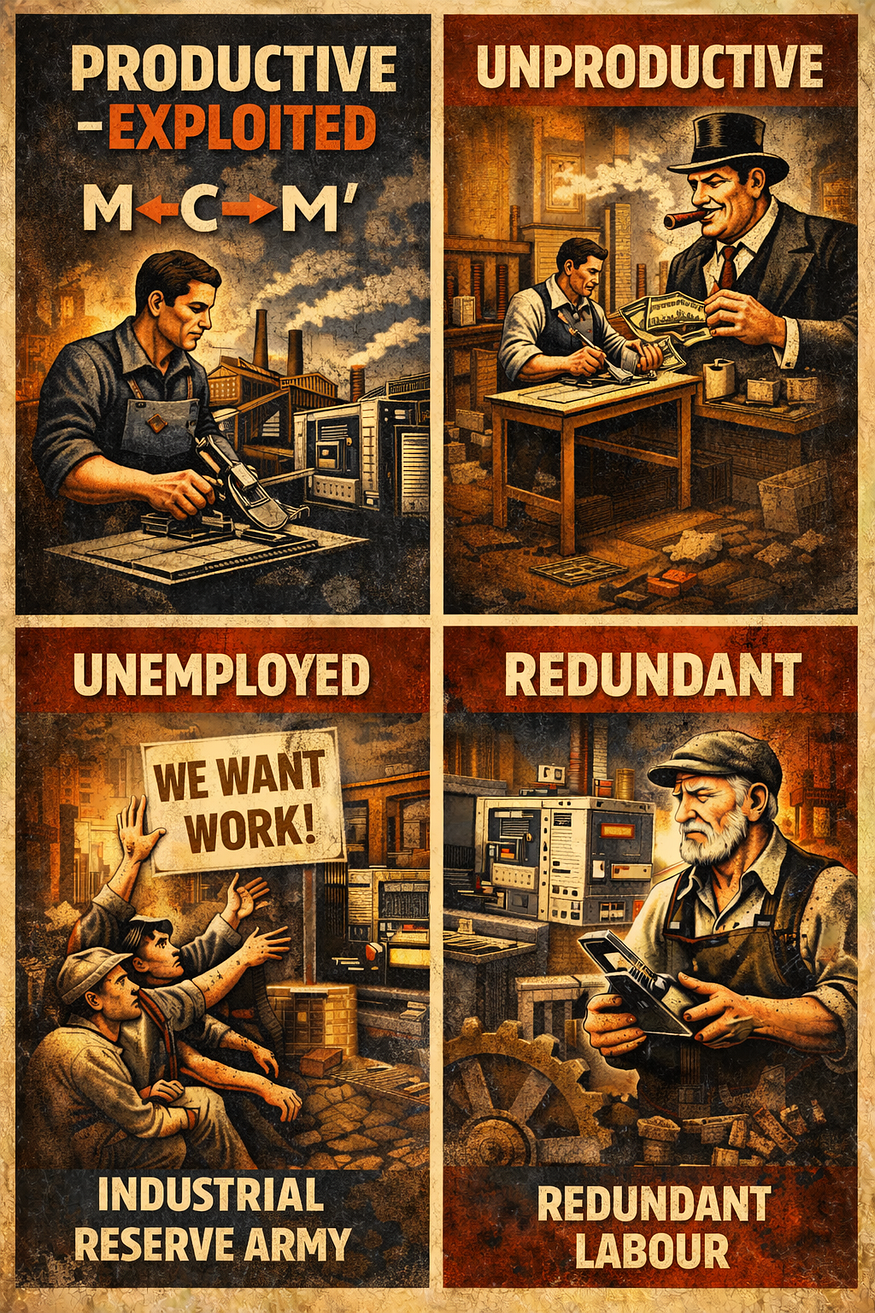
In Marx’s analysis of capital, productive labour, unproductive labour, the industrial reserve army of labour, and redundant labour are not interchangeable categories. Each arises from a distinct relation between labour and capital within the process of accumulation, and each stands in a different relation to exploitation by capital.
Productive and Unproductive Labour: The Standpoint of Capital
From the standpoint of capital, the distinction between productive and unproductive labour does not depend on the concrete activity performed, the level of skill, or the intensity of work. The sole criterion is whether labour functions for capital—that is, whether it enables capital to return as more capital. Labour is productive only insofar as it enters the circuit M–C–M′ and produces surplus-value. All other considerations—usefulness, effort, or payment—are secondary.
Unproductive Labour and the Absence of Exploitation by Capital
Consider a carpenter repairing or making a cot in the private house of a capitalist. The labour produces use-value and is paid for, but the transaction does not take the form M–C–M′. What occurs is simple circulation:
for the capitalist: M–C (money exchanged for a use-value),
for the worker: C–M (labour exchanged for money).
No capital is advanced, no accumulation takes place, and no surplus-value is produced. The money spent functions as revenue, not as capital. Therefore, no exploitation by capital occurs.
This conclusion holds regardless of the wage level. Even extremely low wages do not constitute exploitation by capital here, because exploitation by capital is not defined by low pay, hardship, or inequality, but by the production and appropriation of surplus-value. Without M–C–M′, exploitation by capital cannot occur.
Productive Labour and Exploitation by Capital
Now consider the same carpenter employed in the capitalist’s furniture factory, producing a cot for sale. Assume the same skill, the same intensity, the same productivity (one cot in eight hours), and even a higher wage than in the household case.
Here, labour-power is purchased as capital. The capitalist advances money to buy labour-power, sets it to work in production, and inserts it into the circuit M–C–M′. The commodity is sold, value returns as more value, and surplus-value is produced and appropriated.
In this case, exploitation by capital occurs, even though productivity, skill, time, and wage are identical—or even superior—to the household case.
This produces a decisive paradox:
a wage labourer employed by a capitalist in his private household, paid ₹1000, is not subject to exploitation by capital;
the same labourer, performing the same labour with the same skill and intensity, employed in the capitalist’s factory, and paid ₹1500, is subject to exploitation by capital.
The difference lies neither in the labour performed nor in the wage received, but solely in the social relation.
This establishes a decisive point: exploitation by capital does not arise from productivity, effort, or low wages. It arises exclusively from a specific social relation in which labour-power functions as a moment of capital’s self-expansion.
The Industrial Reserve Army of Labour: Saleable but Non-Valorised Labour
Capitalist accumulation necessarily produces a peculiar kind of relative surplus population called industrial reserve army of labour. Consider a carpenter who possesses employable skills that are fully compatible with prevailing production techniques, but who is currently unemployed due to a labour market conditions.
In this condition:
the use-value of labour-power exists,
the exchange-value of labour-power exists,
labour-power can be valorised,
but labour-power is not valorised.
Because labour is not currently employed by capital, no surplus-value is produced, and therefore no exploitation by capital occurs at that moment.
It is therefore incorrect to treat unemployment as exploitation by capital.
At the same time, this condition has a decisive social implication. The industrial reserve army of labour is not indifferent to exploitation by capital. On the contrary, workers in the reserve army are compelled to seek employment and therefore long to be exploited by capital, because exploitation by capital presupposes employment, wages, and access to the means of subsistence. Their exclusion from valorisation intensifies competition among workers and strengthens capital’s power over those who are employed.
Thus, while the reserve army is not itself exploited by capital, its existence conditions and intensifies exploitation by capital of the employed workforce by disciplining wages, enforcing labour discipline, and enabling capital to impose its terms.
Redundant Unsaleable Labour and Technological Competition
Alongside the industrial reserve army, capitalist competition and technological change produce redundant unsaleable labour. Consider a carpenter trained exclusively in older methods of production. When CNC machines and new production techniques are introduced, the required skill-set changes.
In this case:
the use-value of labour-power remains the same,
but the exchange-value of labour-power disappears,
labour-power cannot be valorised,
and therefore cannot be exploited by capital.
The carpenter’s labour-power has become outdated relative to the new socially necessary labour-time. Because it no longer corresponds to the prevailing technical conditions of production, it cannot be sold to capital at all. Redundant unsaleable labour is therefore excluded from exploitation by capital, not because it lost usefulness, but because it lacks exchange-value.
Technological innovation initially allows pioneering capital to produce below the social average and appropriate super-profits. As new methods diffuse through competition, socially necessary labour-time falls, super-profits erode, and less efficient capitals are eliminated. In this process, workers trained in obsolete techniques are expelled from production and transformed into redundant unsaleable labour.
Unlike the industrial reserve army, redundant unsaleable labour cannot be exploited by capital under existing conditions, because its labour-power cannot be valorised. The exclusion here is not temporary or cyclical, but structural, rooted in the transformation of the labour process itself.
Exploitation by Capital as a Scientific Category
Capitalist accumulation simultaneously produces:
1.productive labour subject to exploitation by capital,
2.unproductive labour without exploitation by capital,
3.an industrial reserve army of labour that can be valorised but is not valorised,
4.redundant unsaleable labour that cannot be valorised and therefore cannot be exploited by capital.
Exploitation by capital, in Marx’s theory, is not defined by low wages, suffering, hardship, or inequality. It is defined by a specific economic relation: the production and appropriation of surplus-value.
Leave a Reply