
The Science of Satisfaction: Why Relative Poverty Matters
Why does a worker today — earning many times what their grandfather earned, owning a smartphone and a car — often feel poorer? Why does material improvement fail to generate contentment?
Inflation is a common explanation, but it is insufficient. If we compare real consumption rather than nominal wages — holding inflation constant by examining the basket of commodities actually consumed (food, clothing, electricity, data, appliances, vehicles, and communication) — the conclusion is clear: today’s worker consumes a larger and qualitatively superior basket than earlier generations. In absolute, material terms, the worker is better off.
Yet dissatisfaction persists.
The reason is that human satisfaction is not governed by absolute conditions but by relative position. What matters is not only what one consumes, but how that consumption compares — with neighbours, with higher classes, and with socially visible standards of life. A growing basket does not guarantee satisfaction if others’ baskets grow faster, or if the social benchmark of what counts as “normal” rises even more rapidly.
This distinction is crucial for understanding modern social dissatisfaction.
Absolute and Relative Poverty
There is no fixed or transhistorical standard of poverty. What counted as deprivation in one era (no horse) differs from another (no internet). Even “basic needs” are historically variable. Any definition of “absolute” poverty necessarily incorporates the social standards of a particular time and place.
Absolute poverty refers to deprivation below the historically determined minimum required for the reproduction of labour power. Relative poverty refers to deprivation measured against the prevailing standard of life in a given society — one’s position within the social distribution of wealth and power.
As Marx puts it: “It is not so much the absolute consumption of the worker as his relative consumption which makes his position either happy or unhappy.”
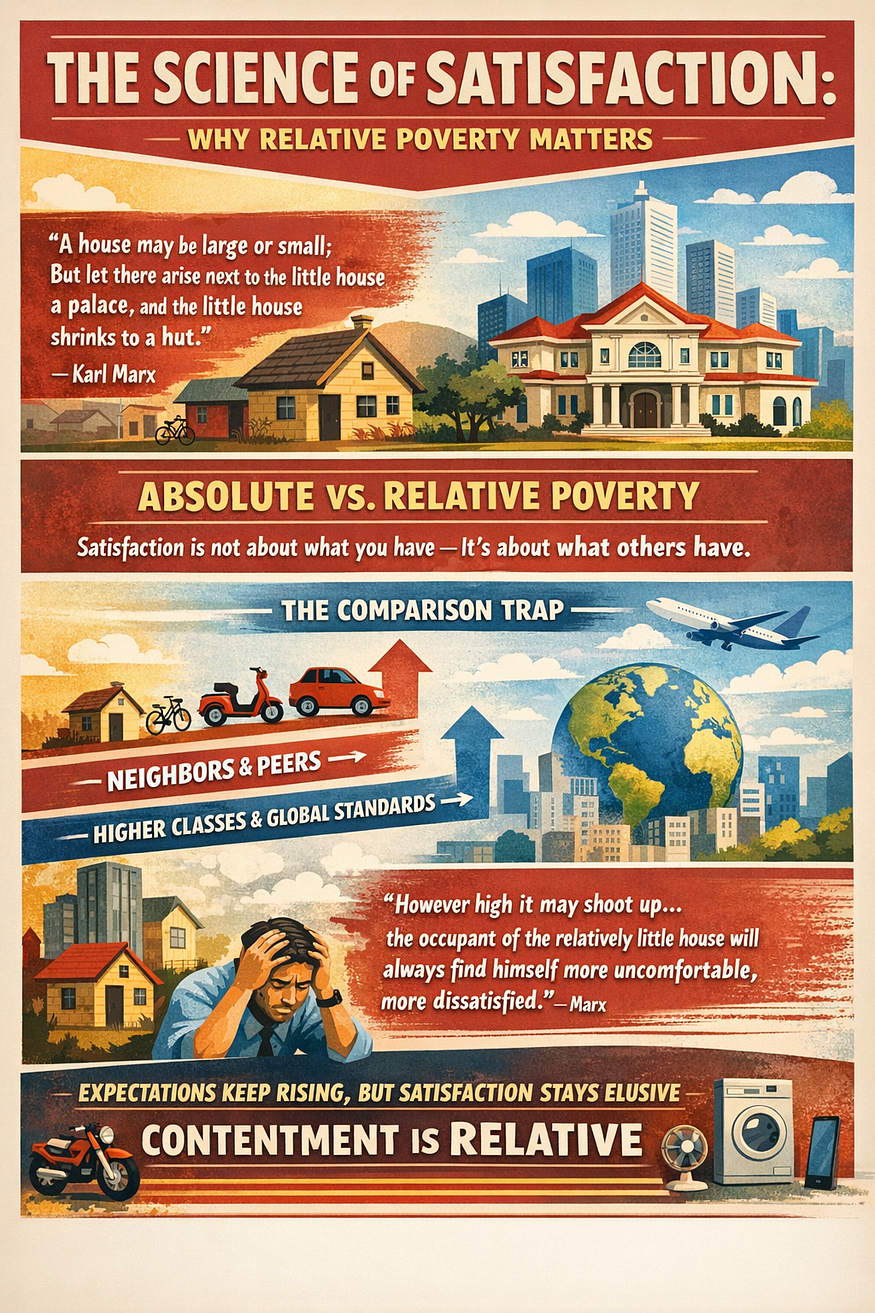
Marx’s house–palace metaphor captures this logic precisely: “A house may be large or small; as long as the neighboring houses are likewise small, it satisfies all social requirement for a residence. But let there arise next to the little house a palace, and the little house shrinks to a hut.” The house does not change; only the comparison does — yet satisfaction turns into dissatisfaction.
This is because, as Marx explains, “Our desires and pleasures spring from society; we measure them, therefore, by society and not by the objects which serve for their satisfaction. Because they are of a social nature, they are of a relative nature.”
The Mechanics of Comparison
Comparison operates first within immediate social reference groups — neighbours, colleagues, classmates. Urban life intensifies this through income-segregated spaces. When both you and your neighbour have bicycles, equilibrium exists. Your neighbour upgrades to a motorcycle. Later, when you do the same, your neighbour has a car. You have advanced absolutely, but fallen behind relatively.
Comparison then extends upward across classes, and in a globalised world, across countries. Marx describes this dynamic clearly: “However high it may shoot up in the course of civilisation, if the neighboring palace rises in equal or even in greater measure, the occupant of the relatively little house will always find himself more uncomfortable, more dissatisfied.”
Dissatisfaction also arises from comparison with one’s own past. People require forward movement in their lives. Stagnation produces frustration even when absolute conditions remain adequate. Expectations rise with civilisation, and failing to meet rising expectations generates dissatisfaction.
Capitalism institutionalises this process by constantly expanding what counts as “necessary.” Marx writes: “The number and extent of his so-called necessary wants… depend therefore to a great extent on the degree of civilisation of a country.” The Communist Manifesto adds: “In place of the old wants, satisfied by the production of the country, we find new wants, requiring for their satisfaction the products of distant lands and climes.” Luxury becomes necessity; satisfaction recedes as expectations advance.
Why This Matters
This is not ingratitude, nor a failure to appreciate progress. It reflects the fundamentally social nature of human satisfaction. Contentment depends not on absolute material levels, but on relative position within a moving social structure.
This is why economic growth alone fails to dissolve discontent. As long as inequality widens or expectations rise faster than conditions improve, dissatisfaction persists — even amid real material gains.
This is the science of satisfaction: human satisfaction is structurally relative. And it is this relativity that continues to shape social tension, political consciousness, and social change.
Leave a Reply