
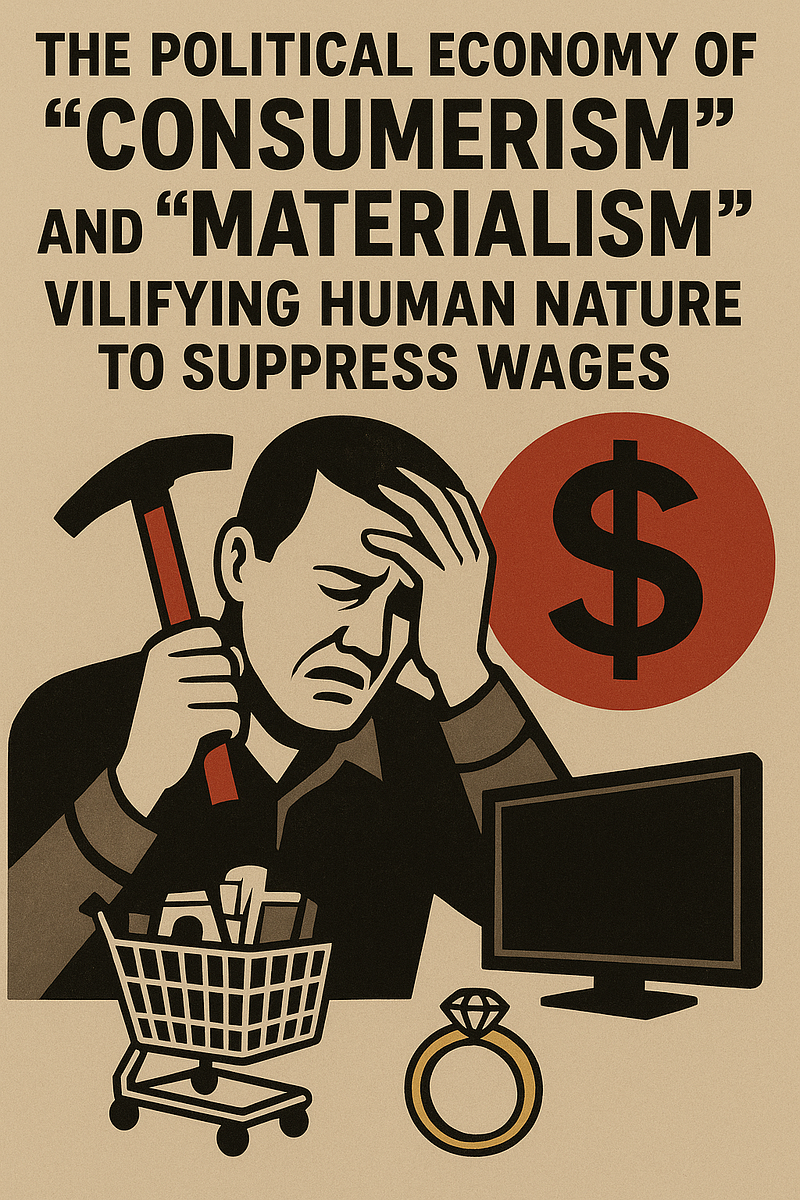
The Political Economy of “Consumerism” and “Materialism”: Vilifying Human Nature to Suppress Wages
Consumerism and materialism are words that vilify natural human desires. Consumerism means excessive consumption — purchasing beyond what is “necessary.” Materialism means caring too much about physical possessions and worldly pleasures. Both terms treat fundamental human activities as moral failings to discipline workers into accepting less.
Consumption and Material Desire are Human Nature
The desire for material goods and worldly pleasures is not new — it is human nature. Throughout history, humans have sought better food, comfortable shelter, beautiful objects, and physical pleasure. Our ancestors crafted jewelry, developed cuisines, and traded across continents for desired goods.
“Consumerism” and “materialism” pathologize desires that have always existed, suggesting that caring about the material world — having enough to eat, a warm home, pleasurable experiences — is somehow shallow or spiritually corrupt. This reframes deprivation as virtue rather than injustice.
The Politics of “Essential” and “Spiritual”
What counts as essential versus excessive varies by time and place. Refrigerators were luxuries; now they’re necessities. When the wealthy say workers should accept basic “essentials,” they define essentials far below their own standard while enjoying every material comfort.
“Consumerism” and “materialism” stigmatize working-class demands while justifying elite abundance, providing moral cover for inequality.
Vilifying Material Desire Suppresses Wages
When workers are told to reject “materialistic” desires, they’re asked to accept inadequate wages. This reframes a political question — how much should workers earn? — as moral — are you too focused on worldly pleasures?
The wealthy pursue every material pleasure — multiple homes, private jets, gourmet experiences — yet moral panic targets ordinary people wanting comfortable housing or entertainment. Workers are counseled toward “higher” fulfillment precisely when material striving might translate into wage demands.
There is nothing spiritually superior about poverty. The desire for worldly pleasures is natural and healthy, not a moral defect.
The Working Class Should Enjoy More Material Comfort
Social progress means enabling everyone to have more material security and comfort. When workers afford better housing, health improves. When they afford labor-saving devices, they gain time for rest and education. When they enjoy good food and leisure, they develop their capacities more fully. Material advancement is not a distraction from human flourishing but its prerequisite.
A more materially sophisticated life, rich in worldly pleasures and comforts, for all people is our aim.
The Perverse Logic: Fighting Capitalism by Suppressing Workers
Some claim that materialism and consumerism are bad things that happened *because of capitalism*. In the name of fighting capitalism, they want the working class to fight their own materialist desires and reject consumerism. This is profound deception.
Suppressing workers’ material aspirations doesn’t hurt capital — it helps capital earn more profit. When workers accept lower wages in the name of anti-capitalism or anti-consumerism, they enable more efficient exploitation, not less. The fight against capitalism is not a fight against workers wanting material comfort — it is a fight for workers to have more. Asking workers to reject material desires in the name of opposing capitalism is asking them to do capital’s work for it.
The Contradiction — and How Globalization Resolves It for Capital
Capitalist economies require consumer demand. Historically, employers wanted to pay less while the system needed workers to consume more. However, this contradiction is less pronounced in globally connected markets.
Where Country A consumes goods produced in Country B, which consumes goods from Country C, capital can suppress local wages while finding markets elsewhere. Factory owners in Bangladesh pay poverty wages because clothes sell in Europe. Tech companies pay Chinese workers minimally because products are consumed globally.
At the local level, suppressing wages actively helps profiteering. While the contradiction of overproduction still exists globally, it is displaced. Individual capitalists benefit immediately from wage suppression without facing immediate market consequences.
This is why the ruling class embraces the “consumerism” and “materialism” outcry — even when framed as anti-capitalist. Globalized markets allow them to suppress wages locally (increasing profits) while relying on consumption elsewhere (realizing profits). The moral campaign provides ideological cover for global wage suppression, convincing workers everywhere that wanting material comfort is the problem rather than unequal distribution.
Resources, Environment, and the Real Solution
When we speak of limited resources versus unlimited consumption potentially resulting in depletion of natural resources and environmental degradation, yes, this concern is correct. But the solution is not to suppress workers’ consumption or vilify their material desires. The solution is to control and plan production itself.
A centrally planned economy that produces for the use values of the members of society — rather than for profit — is the answer. The problem is not that workers want too much, but that capitalist production is anarchic, wasteful, and oriented toward profit maximization rather than human need. Planned production can allocate resources rationally, eliminate wasteful duplication, end planned obsolescence, and ensure environmental sustainability while *increasing* material abundance for workers.
Blaming consumption — blaming workers for wanting things — deflects from the real issue: irrational, profit-driven production. We don’t need workers to consume less; we need democratic control over what is produced, how it is produced, and for whom.
Conclusion
“Consumerism” and “materialism” vilify natural desires to justify wage suppression — even when claiming to oppose capitalism. But fighting capitalism does not mean fighting workers’ material desires. It means fighting for workers to have more, not less. When we suppress consumption and accept lower wages in the name of opposing consumerism, we help capitalism exploit us more efficiently.
Environmental concerns are real, but the solution is planned production for human need, not suppressing workers’ consumption. The working class should enjoy more material comfort and worldly pleasures, not less. A materially sophisticated life for all is not excess but the proper goal.
Of course, the solution is class solidarity and proletarian revolution. Only through the collective organization and revolutionary action of the working class can we overthrow the capitalist system that requires our deprivation for its profit. Only through proletarian power can we establish a planned economy that produces abundance for all rather than wealth for the few. The question is not whether workers should want material abundance — we should and we do. The question is whether we will organize collectively to seize it.
Leave a Reply