
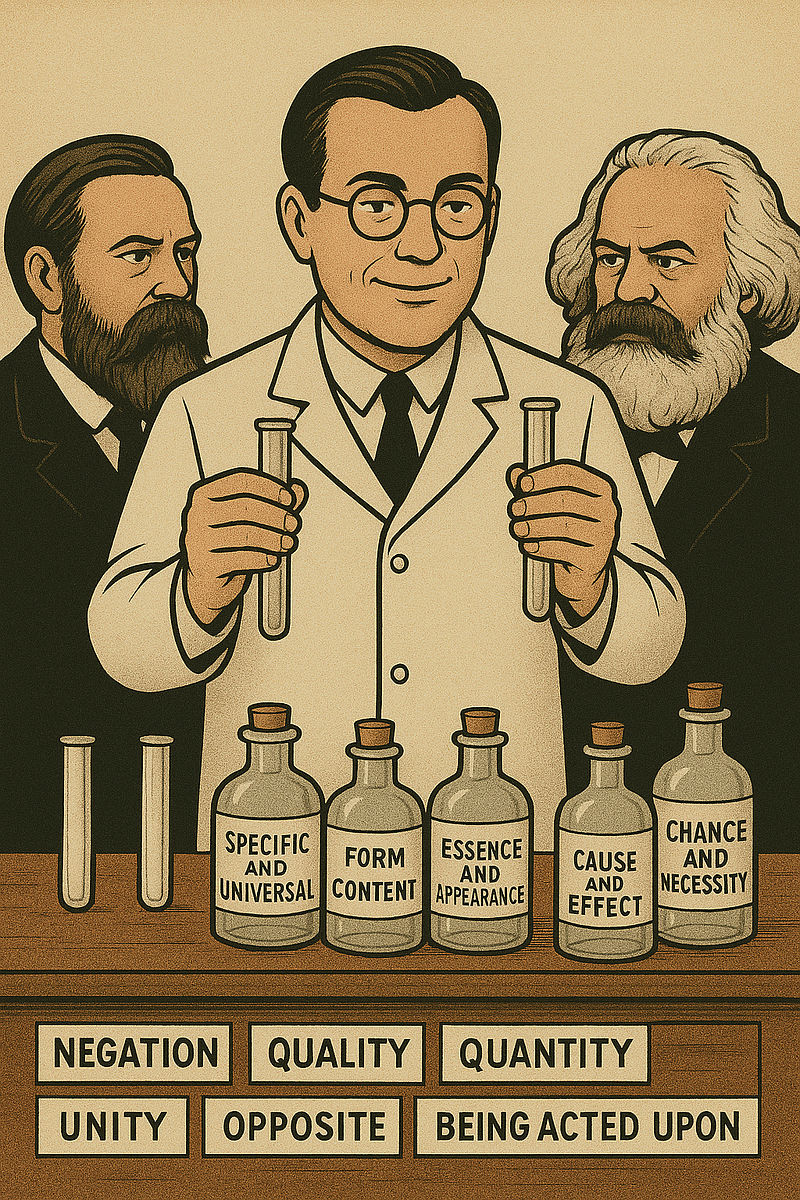
Marxism vs Myth of 3 Laws and Categories
1.Engels & three laws
The origin of so-called “three laws of dialectics/ three basic laws of development” can be traced back to a single, unfinished section of Engels’ Dialectics of Nature. Nowhere else in the entire body of Marx’s or Engels’ writings do we find these laws systematically enumerated. This makes it necessary to revisit their actual source in Engels’ writings. #1,#2
1.1 Unfinished manuscripts- the source of the myth of the “three laws”
In 1879 manuscript fragment Dialectics (posthumously published in dialectics of nature), Engels wrote that it is from the history of nature and human society that the laws of dialectics are abstracted. According to him, they are nothing but the most general laws of these two aspects of historical development, as well as of thought itself. He stated that they can, in the main, be reduced to three: 1.the law of the transformation of quantity into quality and vice versa, 2.the law of the interpenetration of opposites, 3.and the law of the negation of the negation. Engels pointed out that all three were developed by Hegel in his idealist fashion as mere laws of thought. He argued that the mistake lay in foisting these laws onto nature and history as if they were laws of thought, instead of deducing them from reality. This, he said, produced the forced and often outrageous treatment that made the universe appear as though it were arranged according to a system of thought. He explained that if this approach is reversed — deriving the laws from nature and history instead of imposing them — everything becomes simple, and the dialectical laws that seem so mysterious in idealist philosophy become as clear as daylight. Engels also observed that anyone even slightly acquainted with Hegel would know that in hundreds of passages Hegel himself gives striking examples from nature and history to illustrate the dialectical laws. He concluded that the aim was to show that the dialectical laws are truly laws of the development of nature and, therefore, also valid for theoretical natural science. #6
This part is often lifted out of context and held up as the definitive statement that Engels had codified three eternal laws. But that reading overlooks the character of Dialectics of Nature itself: the book is not a finished, systematic treatise but a collection of notes, sketches, and working fragments produced in the late 1870s — early 1880s. This manuscript is better read as a record of inquiry than as a final doctrine.
1.2 Internal inconsistencies
In the 1878 manuscript fragment Outline of the General Plan (posthumously published in dialectics of nature), Engels sketches out four basic laws of dialectics, including a “fourth law” he calls the “spiral form of development.”#7
Yet in the 1879 manuscript fragment Dialectics (posthumously published in dialectics of nature), only first three laws are enumerated.#6
This internal inconsistency — four laws in one fragment, three in another — suggests a working process: Engels was experimenting with formulations, trying different schematisations, not issuing a canonical list.
In the 1876 manuscript fragment The eternal laws of nature Dialectics (posthumously published in dialectics of nature), Engels emphasizes the historical and domain-specific character of natural laws, observing that what are often called eternal laws of nature are, in truth, historically conditioned and dependent on specific material circumstances.#8
But in the 1879 manuscript fragment Dialectics (posthumously published in dialectics of nature), Engels enumerated three most general laws of development. #6
Similarly, several such fragmentary-self-contradictory notes in the manuscripts compiled under dialectics of nature reveal the provisional nature of this work.
In 1877–78, Engels published Anti-Duhring as a comprehensive rebuttal to Eugen Dühring’s philosophy, while concurrently pursuing his research on the “dialectics of nature.” Although the work references concepts such as the “negation of the negation” and the transformation of quantity into quality, these were employed as polemical instruments against the metaphysical arguments of duhring rather than formalized doctrine. It should be noted that in his published works, Engels never codified dialectics into three or four fixed laws.
This contrast is important. The unpublished notes reveal tentative explorations, while the published polemic from the same period avoids any fixation. Taken together, they undermine the notion that Engels intended to bequeath future generations a compact ‘three-law’ toolkit.
These inconsistencies indicate that Engels was still experimenting during the late 1870’s and had not settled on a definitive formulation of three laws.
1.3 1879 manuscript and 1885 preface
In the 1879 manuscript Dialectics (posthumously published in dialectics of nature), Engels explicitly stated that his aim was not to write a handbook of dialectics but to demonstrate that these three laws are applicable to theoretical natural science. This remark appears in the same context as his enumeration of the three laws.#6
Interestingly, in the 1885 preface to Anti-Duhring, Engels looked back on this very attempt and soberly acknowledged its limits. He said that Hegel described the laws of dialectical change in a broad, all-encompassing way, but his formulation was wrapped in mysticism. One of the main aims of Marx and Engels, he explained, was to strip away that mystical layer and present the laws in a clear and simple form. Engels confessed that he believed the same patterns of change run through everything: in nature, in history, and in the development of human thought. To verify this more concretely, he reviewed mathematics and the natural sciences in detail, seeking to confirm that these laws really do appear everywhere. Yet this old “philosophy of nature,” despite its valuable insights and fertile ideas, ultimately could not satisfy Marx and Engels.#9,#10
Taken together, this historical trajectory makes it clear that the “three laws,” as popularly presented, were never a completed “system” by Engels but rather a snapshot of his dialectical research in progress — a thesis in development, an argument still being worked out. It was a tryst with dialectics, not its final codification.
This becomes clearer when we contrast these unfinished notes with Engels’ later, published works of the 1880s.
1.4 Engels on Philosophy of nature
One may ask why it should be considered problematic if the “three laws of dialectics” were ultimately formulated by later interpreters rather than by Engels himself. The reason is that this codification runs directly counter to the orientation of Engels’s own mature works. In his major published writings of the 1880s, he not only refrained from proposing any universal dialectical laws but in fact mounted a decisive argument against such overarching philosophies and system-making.
In 1880, Engels wrote that modern materialism had itself become essentially dialectical and no longer required the assistance of a “queenly” philosophy that claimed to stand above and govern the sciences. Once each particular science was compelled to clarify its place within the overall totality of knowledge and reality, Engels argued, the notion of a separate “special science” tasked with comprehending that totality became superfluous or unnecessary. #11
By 1886, Engels sharpened this judgment further. He argued that the major scientific breakthroughs of his time had made it possible to demonstrate not only the interconnections within specific natural processes but also the links between these different spheres as a whole. With empirical data now available, it was possible to present a roughly systematic picture of nature’s interconnectedness grounded in actual facts. Earlier, this task had fallen to “natural philosophy,” which, lacking sufficient evidence, filled the gaps with speculation. Engels acknowledged that this older philosophy had produced some brilliant anticipations but also considerable error — an outcome inevitable under those conditions. With the dialectical character of natural interconnections now asserting itself, Engels concluded that “natural philosophy” had been definitively rendered obsolete; any attempt to revive it would be not only superfluous but a step backwards.#12
In 1885, Engels noted that the “system-building” tendencies of Eugen Duhring were far from unique in contemporary Germany. At the time, complete systems of cosmogony, philosophy of nature, politics, and economics seemed to spring up overnight “like mushrooms,” with even minor scholars and students attempting to construct entire systems.#13
In 1886, Engels commented on Hegel in a similar vein: the demand to maintain a consistent “system” often compelled Hegel to resort to forced constructions.#14
The reduction of Marxism to “three basic laws” and “categories” is a regression into the very kind of philosophical system-building that Engels condemned. He dismissed any “special science” of totality as not only superfluous but a step backward — a critique aimed squarely at the forced, artificial systems of German idealism, including Hegel’s. This formulation of “three laws and categories” replaces dialectics as a living method with dead dogma.
2.Marxism is not the systematization of categories, but the critique of categorical systematization.
At its core, Marxism — or dialectical materialism — is fundamentally a critique on fixed categories, not their mere enumeration or systematization. The trajectory of Western classical philosophy was to analyse reality through a framework of opposing, static categories. Hegel’s greatest contribution was to infuse these categories with a dialectical character, revealing how opposites like cause and effect or form and essence are not rigid polarities but fluid moments within a dynamic, unfolding process. This was, in essence, a critique of the static and ahistorical treatment of conceptual thought.
Marx and Engels adopted and radicalized this dialectical method by grounding it in material reality. It is crucial to recognize that their use of traditional categories was not an endorsement of categorical thinking per se, but a continuation and deepening of this critique on the categorical thinking.
This critical, dialectical approach is often misrepresented as a straightforward application of philosophical categories. Nothing could be further from the truth. Marx and Engels never treated categories as a ready-made framework to be imposed on reality, nor did they dogmatically apply categorical analysis to every problem. Their revolutionary method was to begin from the opposite direction: from the material reality and not from the universal laws or categories. The goal was never to fit the world into an abstract philosophical system, but to develop concepts that emerged from and explained the world itself. The analysis must always start from the ground of material reality, not from the scaffolding of pre-existing categories.
In light of modern science, the notion of a timeless set of universal categories has become increasingly untenable. Modern science reveals a reality defined by dynamic complexity, emergence, and interdependence — a reality that cannot be captured by a fixed, philosophical toolkit. To cling to such a scheme today is akin to using stones and sticks in an age of modern warfare; it is grossly inadequate.
This tendency to reify categories into a closed framework is not a minor issue; it is symptomatic of the urge to construct complete philosophical systems, a tendency Engels repeatedly criticized. The very act of presenting a set of obsolete categories as categories of dialectical materialism is itself the first step toward problem. It creates a fixed syllabus for dogma, ensuring that in due course, what should be a method of inquiry will succumb to codification. This transforms a proposed toolkit into a metaphysical framework, presenting these concepts not as historical abstractions but as the fundamental, unchanging building blocks of reality itself. This is the complete reversal of the materialist method, which must always derive its concepts from concrete reality, not impose them upon it as ultimate truths.
3.Marx coquetting with Hegel:
A potential defence of this dogmatic approach might point to Marx’s own work, specifically the notoriously abstract first chapters of Capital. Isn’t his use of a Hegelian style proof that he accepted this categorical and law-based framework? To believe so is to profoundly misunderstand Marx’s stated purpose.
In 1873 Marx explained in the Postface to the Second German Edition, that although he had exposed and criticized Hegel’s dialectic nearly thirty years earlier, the intellectual climate of the 1860s forced him to take a stand of a different kind. By the time Marx was drafting Capital, the so-called Epigones of German philosophy had swung to the opposite extreme. Instead of engaging critically with Hegel, they dismissed him entirely as a dead dog. In that context, Marx chose to openly avow himself a pupil of that mighty thinker and, in the abstract chapters on value, by coquetting with the modes of expression peculiar to Hegel.#15
Marx’s “coquetry” with Hegelian language was a polemical and stylistic tactic, not a philosophical endorsement of dialectics as a system of universal laws.
4.Conclusion
A close examination of Engels’s writings reveals a clear pattern: the famous “three laws of dialectics” were never a settled doctrine. They appear only only in his unpublished notes from the late 1870s, where he was openly experimenting — at one point listing three laws, at another proposing a fourth, and elsewhere even questioning the very idea of eternal laws altogether. These fragments represent a process of inquiry, not a finished system. To treat them as dogma is to fundamentally misunderstand their purpose.
This experimental phase stands in sharp contrast to Engels’s mature published work, where he explicitly rejected philosophical system-building. He argued that a “special science” meant to stand above other sciences was unnecessary and even regressive. Rather than creating a fixed toolkit of laws, Engels moved toward a method rooted in concrete reality.
Marx’s approach was consistent with this view. His use of Hegelian language in Capital was strategic — a polemical effort to defend dialectics in a hostile intellectual climate, not an endorsement of Hegel’s system of categories. Both thinkers understood dialectics as a critical method rather than a set of predefined laws.
The reduction of dialectics to “three laws” and “categories” is not only a misreading of Marx and Engels — it is a reversal of their method. Marxism is a critique of fixed categories, not a new metaphysical system. Presenting it as a rigid framework betrays the flexible, materialist spirit that defines their work.
The mere observability of patterns in selective samples does not elevate them to the status of universal law. To make such a claim is a regression into idealism, merely substituting Hegel’s Absolute Spirit with a new set of rigid laws. While categorical analysis is a useful tool, its concepts are neither ultimate nor sufficient to encapsulate the profound complexity of reality.
Defenders of the three laws and categories framework claim that it is a useful heuristic and pedagogical toolkit. However, these laws and categories are fundamentally metaphysical and idealist. An idealist system of metaphysical laws and categories must not be presented as a toolkit for understanding dialectical materialism.
Moreover, this discussion is not merely academic nitpicking. This distortion has serious political and educational consequences. To a modern proletariat familiar with advanced science, such formulas appear naive, dogmatic, and even superstitious. True education in dialectical materialism must emphasize critical thinking and concrete analysis — not the enumeration of abstract laws.
In short, fidelity to Marx, Engels, and Marxism means embracing their method of inquiry, not enshrining their unfinished notes as system of finished doctrine. The Marx and Engels version of dialectical materialism is a living science, not a system of metaphysics.
5.Footnotes References& Notes:
#1 Disclaimer- Scope- boundaries- On sources
Dialectical Materialism — Marxism — is my philosophical worldview. The arguments presented here are not a rejection of it, but an attempt to strengthen it by distinguishing it from schematic, dogmatic, and reductionist interpretations. Am I refuting Marxism? No. Am I refuting dialectical materialism? No. Am I rejecting Engels? Absolutely not. What I am opposing is the wrong, dogmatic interpretation of Engels — the distortion that reduces his living method to a dead catechism. I also want to make it clear that my critique has nothing in common with the Euro-Marxist trend that cancels or bashes Engels. Those approaches dismiss Engels as a deviation from Marx, or strip him of philosophical significance. I reject that view entirely. My argument is the opposite: I defend Engels by returning to his own mature works, where he rejected dogmatic system-building and insisted on a living, materialist method. I would be both happy and honoured if comrades or readers could respond by pointing out any mistakes in my understanding, so that the discussion may contribute to collective clarity.
I restrict myself here to Engels’ writings, with an occasional reference to Marx. The contributions of later thinkers and the debates they generated are important, but I set them aside in order to keep the focus clear.
The proofs, arguments, and quotes selected here are not an exhaustive representation. They are pulled out as specific illustrations. In fact, the overarching logic of Engels’ work in these texts is a polemic against supra-scientific, Metaphysical Idealist system-building.
In this essay I have employed simplified, accessible English renderings of certain quotations, to make the flow of argument smoother. These renderings are not verbatim quotations but paraphrased adaptations of the original passages, intended to preserve their substantive meaning while avoiding overly technical or archaic phrasing. The corresponding original texts for these adapted passages are listed in the References section for ease of cross-checking. The primary source material consulted is the Marxist Internet Archive (marxists.org).
#2: Engels-tryst with dialectics-Notes, Polemics and Theory
Engels worked intensively on questions of natural philosophy during the 1870s and 1880s. The manuscripts from this period, left unfinished, were later assembled and published posthumously as Dialectics of Nature (1925). While still engaged in this project, he published Anti-Duhring (1877), a polemic against Eugen Dühring’s system. If Anti-Duhring was primarily polemical, Socialism: Utopian and Scientific (1880) — extracted and revised from it — was a constructive exposition, presenting in systematic form the joint outlook of Marx and Engels. Since Marx was alive at the time, this book carried his approval. Engels later added to this corpus with Ludwig Feuerbach and the End of Classical German Philosophy (1886), a retrospective on the philosophical roots of historical materialism. The 1885 Preface to Anti-Duhring is also noteworthy as an important supplement to these works.
Furthermore, it is important to distinguish between a polemic and a positive exposition. A polemic is a targeted argument directed against a particular error or opponent; it does not, in itself, constitute a systematic presentation of one’s own theory. For instance, Marx’s The Poverty of Philosophy was written as a polemic against Proudhon, Engels’s Anti-Dühring as a polemic against Eugen Dühring, and Marx’s Critique of the Gotha Programme as a polemic against the draft programme of the German workers’ party. While such works brilliantly clarify and defend Marxist principles, their structure and content are shaped by the specific positions they are refuting. They are reactive interventions rather than step-by-step expositions of the Marxist system, and a collection of polemics does not amount to a theory.
#6. 1979, Engels. Manuscript” Dialectics” compiled and published in 1925 as “Dialectics of nature”
It is, therefore, from the history of nature and human society that the laws of dialectics are abstracted. For they are nothing but the most general laws of these two aspects of historical development, as well as of thought itself. And indeed, they can be reduced in the main to three:
The law of the transformation of quantity into quality and vice versa;
The law of the interpenetration of opposites;
The law of the negation of the negation.
All three are developed by Hegel in his idealist fashion as mere laws of thought: the first, in the first part of his Logic, in the Doctrine of Being; the second fills the whole of the second and by far the most important part of his Logic, the Doctrine of Essence; finally the third figures as the fundamental law for the construction of the whole system. The mistake lies in the fact that these laws are foisted on nature and history as laws of thought and not deduced from them. This is the source of the whole forced and often outrageous treatment; the universe, willy-nilly, is made out to be arranged in accordance with a system of thought which itself is only the product of a definite stage of evolution of human thought. If we turn the thing round, then everything becomes simple, and the dialectical laws that look so extremely mysterious in idealist philosophy at once become simple and clear as noonday.
Moreover, anyone who is even only slightly acquainted with his Hegel will be aware that in hundreds of passages Hegel is capable of giving the most striking individual illustrations from nature and history of the dialectical laws.
We are not concerned here with writing a handbook of dialectics, but only with showing that the dialectical laws are really laws of development of nature, and therefore are valid also for theoretical natural science. Hence we cannot go into the inner interconnection of these laws with one another.
#7. 1878, Engels. Manuscript “Outline of the General Plan”, compiled and published in 1925 as “Dialectics of nature”
Outline of the General Plan,
(1) Historical introduction: the metaphysical outlook has become impossible in natural science owing to the very development of the latter.
(2) Course of the theoretical development in Germany since Hegel (old preface). The return to dialectics takes place unconsciously, hence contradictorily and slowly.
(3) Dialectics as the science of universal inter-connection. Main laws: transformation of quantity and quality — mutual penetration of polar opposites and transformation into each other when carried to extremes-development through contradiction or negation of the negation — spiral form of development.
(4) The inter- connection of the sciences. Mathematics, mechanics, physics, chemistry, biology. St. Simon (Comte), and Hegel.
(5) Apercus [reflections, remarks) on the separate sciences and their dialectical content:
1. Mathematics: dialectical aids and expressions. Mathematical infinite really occurring.
2. Celestial mechanics-now resolved into a process. — Mechanics: point of departure was inertia, which is only the negative expression of the indestructibility of motion.
3. Physics-transitions of molecular motions into one another. Clausius and Loschmidt.
4. Chemistry: theories, energy.
5. Biology. Darwinism. Necessity and chance.
(6) The limits of knowledge. Du-Bois-Reymond and Nägeli. -Helmholtz, Kant, Hume.
(7) The mechanical theory. Haeckel.
(8) The plastidule soul — Haeckel and Nägeli.
(9) Science and teaching — Virchow.
(10) The cell state — Virchow.
(11) Darwinian politics and theory of society — Haeckel and Schmidt. — Differentiation of man through labour. — Application of economics to natural science. Helmholtz’s “work” (Populäre Vortrage, II).
#8. 1876, Engels. Manuscript “The eternal laws of nature”, compiled and published in 1925 as “Dialectics of nature”
The eternal laws of nature also become transformed more and more into historical ones. That water is fluid from 0°-100°C. is an eternal law of nature, but for it to be valid, there must be (1) water, (2) the given temperature, (3) normal pressure. On the moon there is no water, in the sun only its elements, and the law does not exist for these two heavenly bodies. The laws of meteorology are also eternal, but only for the earth or for a body of the size, density, axial inclination, and temperature of the earth, and on condition that it has an atmosphere of the same mixture of oxygen and nitrogen and with the same amounts of water vapour being evaporated and precipitated. The moon has no atmosphere, the sun one of glowing metallic vapours; the former has no meteorology, that of the latter is quite different from ours. Our whole official physics, chemistry, and biology are exclusively geocentric, calculated only for the earth. We are still quite ignorant of the conditions of electric and magnetic tensions on the sun, fixed stars, and nebulae, even on the planets of a different density from ours. On the sun, owing to high temperature, the laws of chemical combination of the elements are suspended or only momentarily operative at the limits of the solar atmosphere, the compounds becoming dissociated again on approaching the sun. The chemistry of the sun is just in process of arising, and is necessarily quite different from that of the earth, not overthrowing the latter but standing outside it. In the nebulae perhaps there do not exist even those of the 65 elements which are possibly themselves of compound nature. Hence, if we wish to speak of general laws of nature that are uniformly applicable to all bodies — from the nebula to man — we are left only with gravity and perhaps the most general form of the theory of the transformation of energy, vulgo the mechanical theory of heat. But, on its general, consistent application to all phenomena of nature, this theory itself becomes converted into a historical presentation of the successive changes occurring in a system of the universe from its origin to its passing away, hence into a history in which at each stage different laws, i.e., different phenomenal forms of the same universal motion, predominate, and so nothing remains as absolutely universally valid except — motion.
#9. Engels, 1885. preface to anti during
It goes without saying that my recapitulation of mathematics and the natural sciences was undertaken in order to convince myself also in detail — of what in general I was not in doubt — that in nature, amid the welter of innumerable changes, the same dialectical laws of motion force their way through as those which in history govern the apparent fortuitousness of events; the same laws which similarly form the thread running through the history of the development of human thought and gradually rise to consciousness in thinking man; the laws which Hegel first developed in all-embracing but mystic form, and which we made it one of our aims to strip of this mystic form and to bring clearly before the mind in their complete simplicity and universality. It goes without saying that the old philosophy of nature — in spite of its real value and the many fruitful seeds it contained — was unable to satisfy us.
#10, authors note
It is striking that Engels alternates between the plural (“we,” “our,” “us”) when describing shared aims with Marx — such as stripping mysticism from Hegel’s formulations or admitting that the philosophy of nature could not satisfy us — and the singular when stating, “I was in no doubt” about the universality of the laws. This shift suggests that the personal conviction in their applicability to all of nature was Engels’ alone, not Marx’s.
#11. Engels, 1880. socialism utopian and scientific
Modern materialism is essentially dialectic, and no longer requires the assistance of that sort of philosophy which, queen-like, pretended to rule the remaining mob of sciences. As soon as each special science is bound to make clear its position in the great totality of things and of our knowledge of things, a special science dealing with this totality is superfluous or unnecessary.
#12. Engels, 1886. Ludwig Feuerbach and the End of Classical German Philosophy
Thanks to these three great discoveries, and the other immense advances in natural science, we have now arrived at the point where we can demonstrate the interconnection between the processes in nature not only in particular spheres but also the interconnection of these particular spheres on the whole, and so can present in an approximately systematic form a comprehensive view of the interconnection in nature by means of the facts provided by an empirical science itself. To furnish this comprehensive view was formerly the task of so-called natural philosophy. It could do this only by putting in place of the real but as yet unknown interconnections ideal, fancied ones, filling in the missing facts by figments of the mind and bridging the actual gaps merely in imagination. In the course of this procedure it conceived many brilliant ideas and foreshadowed many later discoveries, but it also produced a considerable amount of nonsense, which indeed could not have been otherwise. Today, when one needs to comprehend the results of natural scientific investigation only dialectically, that is, in the sense of their own interconnection, in order to arrive at a “system of nature” sufficient for our time; when the dialectical character of this interconnection is forcing itself against their will even into the metaphysically-trained minds of the natural scientists, today natural philosophy is finally disposed of. Every attempt at resurrecting it would be not only superfluous but a step backwards.
#13. Engels, 1885. preface to anti during
On the other hand, the “system-creating” Herr During is by no means an isolated phenomenon in contemporary Germany. For some time now in Germany systems of cosmogony, of philosophy of nature in general, of politics, of economics, etc., have been springing up by the dozen overnight, like mushrooms. The most insignificant doctor philosophiae and even a student will not go in for anything less than a complete “system”.
#14. Engels, 1886. Ludwig Feuerbach and the End of Classical German Philosophy
It is self-evident that owing to the needs of the “system” he (Hegel) very often had to resort to those forced constructions about which his pigmy opponents make such a terrible fuss even today. But these constructions are only the frame and scaffolding of his work. If one does not loiter here needlessly, but presses on farther into the immense building, one finds innumerable treasures which today still possess undiminshed value. With all philosophers it is precisely the “system” which is perishable; and for the simple reason that it springs from an imperishable desire of the human mind — the desire to overcome all contradictions.
#15. Marx, 1873. Postface to the Second German Edition Das Capital
My dialectic method is not only different from the Hegelian, but is its direct opposite. To Hegel, the life process of the human brain, i.e., the process of thinking, which, under the name of “the Idea,” he even transforms into an independent subject, is the demiurgos of the real world, and the real world is only the external, phenomenal form of “the Idea.” With me, on the contrary, the ideal is nothing else than the material world reflected by the human mind, and translated into forms of thought.
The mystifying side of Hegelian dialectic I criticised nearly thirty years ago, at a time when it was still the fashion. But just as I was working at the first volume of Das Kapital, it was the good pleasure of the peevish, arrogant, mediocre Ἐπίγονοι [Epigones — Büchner, Duhring and others] who now talk large in cultured Germany, to treat Hegel in same way as the brave Moses Mendelssohn in Lessing’s time treated Spinoza, i.e., as a “dead dog.” I therefore openly avowed myself the pupil of that mighty thinker, and even here and there, in the chapter on the theory of value, coquetted with the modes of expression peculiar to him. The mystification which dialectic suffers in Hegel’s hands, by no means prevents him from being the first to present its general form of working in a comprehensive and conscious manner. With him it is standing on its head. It must be turned right side up again, if you would discover the rational kernel within the mystical shell.
Leave a Reply