
Society is never static. It is always in motion, though the speed of change may vary. At times, it may even appear still—but just as a screenshot cannot prove that a movie is motionless, a seemingly unchanging society is also in motion beneath the surface.
The caste system, for instance, though popularly portrayed as static, is not immutable. It has been evolving and changing in correspondence with shifts in material conditions and relations of production. It is true that the material conditions of life determine the consciousness of society. Yet, this does not mean that social consciousness or the superstructure mirrors the material base exactly.
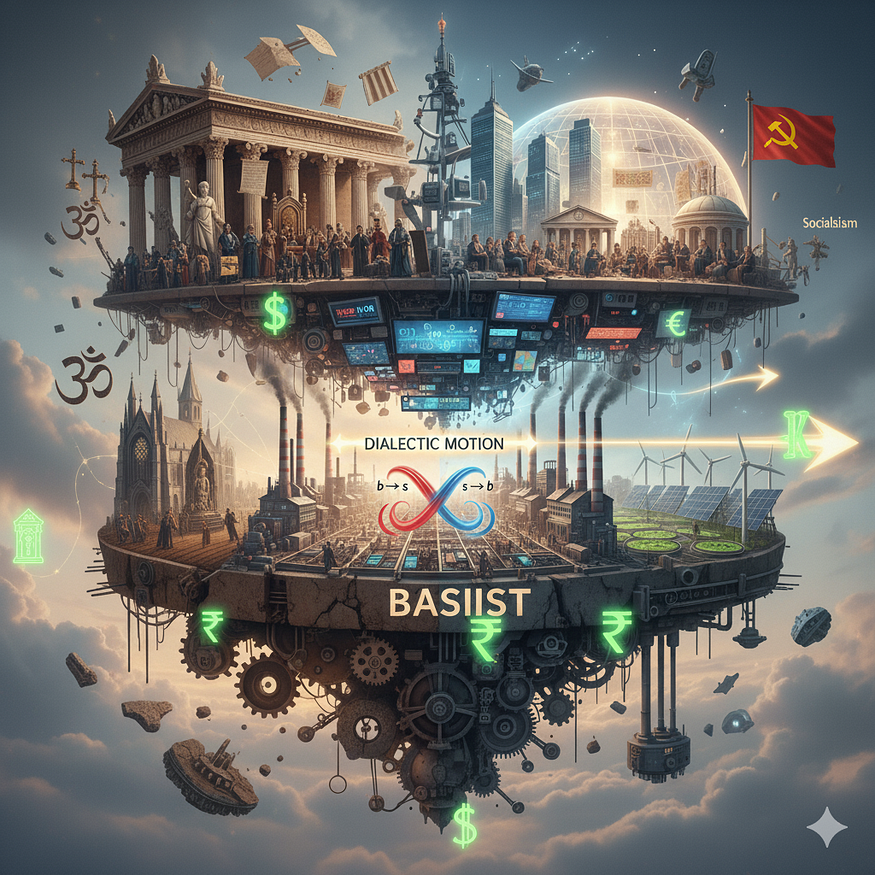
The present is a continuous dialectics between the past and the future. The past superstructure and the past base structure still have their bearings in the present. A section of society strives hard to restore or preserve the past, while another section dreams of and struggles for a progressive future.
The social consciousness and superstructural elements inherited from the past do not vanish overnight. As Marx noted, humanity must consciously struggle against them. Both the remnants of the old base and the old superstructure still exert influence over the present. Within society, some groups strive to restore or preserve elements of the past, while others envision and fight for a progressive future.
The development of the productive forces propels change in the material base, while the superstructure follows—but often with a lag. This lag may persist due to the absence or slackness of conscious reform movements among the working class, or conversely, due to the deliberate efforts of the ruling class to maintain the old social order—or at least its cultural remnants.
The base structure influences the superstructure (b → s), and the superstructure, in turn, influences the base (s → b). But the extent and direction of this mutual influence determine whether society advances or stagnates. Suppose we have a base structure b₁ and a corresponding superstructure s₁. The base b₁ creates and sustains s₁, while s₁ justifies and reinforces b₁. If the forces of influence are perfectly balanced—if s₂b = b₂s—then no real social change would ever occur.
When the base begins to transform—when b₁ moves toward a new form b₂—the existing superstructure s₁ tends to resist, pulling society back toward the old b₁. Likewise, when the superstructure begins to transform—when s₁ moves toward a new form s₂—the existing base structure b₁ resists, attempting to restore the earlier balance.
For genuine social transformation to occur, one of these forces must become dominant. Either the development of the base must overpower the inertia of the superstructure, or a revolutionary transformation in social consciousness must consciously act to accelerate and consolidate the change in the base. Only then does the dialectic move forward.
-to be continued-
Leave a Reply