
I. Engels on Dühring’s Theory of Force and Its Rebuttal
In the three chapters on the theory of force in Anti-Dühring, Engels takes up Dühring’s claim that political and military force is the primary determinant of social and economic relations. Dühring treats force as an autonomous historical power, capable of shaping economic life from the outside. Against this view, Engels reconstructs the real conditions under which force operates and exposes the material basis that Dühring systematically ignores.
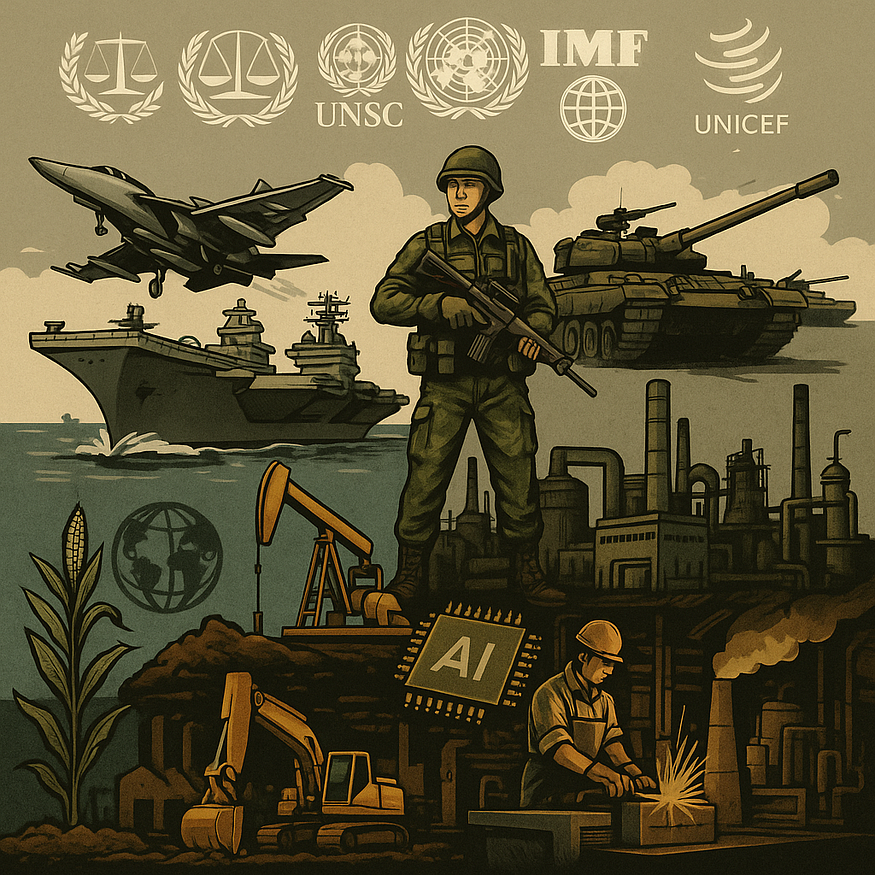
Engels begins by demonstrating that modern force is inconceivable without a definite level of economic development. Military power is not produced by will, courage, or political decree, but by the productive capacity of society itself. As Engels states, “The triumph of force depends upon the production of weapons, and the production of weapons depends upon production in general.” What appears as political or military superiority is therefore grounded in superiority of productive forces.
This dependence is most clearly visible in the organisation of modern armed forces. Engels emphasises that “Nothing is more dependent on economic prerequisites than precisely army and navy.” The ability to raise, equip, and sustain military forces presupposes an advanced productive base. Hence, “The army, and with it war, is possible only through the development of industry.” Whether industry is directed toward peaceful production or military destruction does not alter its determining role, since “Industry remains industry, whether it is applied to the production or the destruction of things.”
Technological advances in production thus directly reshape political and military relations. Engels points out that “And the introduction of fire-arms had a revolutionising effect not only on the conduct of war itself, but also on the political relationships of domination and subjection.” Military outcomes are therefore decided not by abstract force but by material conditions, a fact Engels underscores when he writes: “So, then, the revolver triumphs over the sword; and this will probably make even the most childish axiomatician comprehend that force is no mere act of the will, but requires the existence of very real preliminary conditions before it can come into operation…”
Having established that military and political force arise from economic development, Engels turns to the question of purpose. Against the notion that force exists for its own sake or for mere political display, he insists that force is always instrumental. “But force is only the means; the aim, on the other hand, is economic advantage.” Even where force appears autonomous, it remains bound by economic limits: “Force, however, cannot make any money; at most it can take away money that has already been made …”
For this reason, the exercise of force is never purely political. Its outcomes necessarily translate into material consequences, since “Every victory of force in the long run leads to economic results.”
Through this critique, Engels decisively overturns Dühring’s theory of force. Military and political power do not stand above economic life; they arise from it, depend on it, and ultimately serve economic ends. Force, far from being the foundation of society, is itself conditioned by the development of production and by the material interests of the ruling class.
II. Imperialism and Engels’ Theory of Force
Engels’ critique of Dühring’s theory of force provides a materialist framework that clarifies the logic of imperialism. Once force is understood as arising from economic development and serving economic ends, imperialism can no longer be treated as a matter of political ambition, national psychology, or military tradition. It must be understood as a necessary form of capitalist expansion under conditions of uneven economic development.
Imperial domination presupposes a hierarchy of productive capacities among societies. Those formations that achieve superiority of productive forces necessarily acquire military superiority, not as an independent achievement, but as a derivative of their economic base. Engels’ insistence that military power rests on industry explains why imperial power consistently flows from economically advanced centres toward less developed regions. The ability to manufacture weapons, maintain standing armies and navies, and sustain prolonged military expenditure is inseparable from advanced production and accumulated capital.
At the level of the Country, the same material logic governs the use of political force within capitalism. Political domination is employed to discipline and suppress competing capitals, to crush dissent, and to contain labour movements that struggle for higher wages, improved living conditions, and expanded social security.
At the same time, the bourgeois state also provides social security assistance, welfare spending, and limited concessions in order to secure the consent and goodwill of the working class and stabilise the conditions of accumulation. State power intervenes both repressively and integratively, limiting the claims of labour whenever they threaten profitability while selectively accommodating them when social stability or reproduction of labour-power requires it.
The provision and control of infrastructure is likewise a central function of the bourgeois nation-state. Roads, ports, energy systems, communications, and urban infrastructure are necessary conditions for capital accumulation, but control over infrastructure is simultaneously a form of control over the population itself.
These practices are not deviations from capitalism but integral to its normal functioning. What a state does to a capitalist nation, the imperialist nation or system seeks to do to the whole world. The same framework, once established domestically, necessarily extends outward, reproducing itself on a global scale. Imperialism similarly combines coercion with incorporation, repression with concession, building international infrastructure, development projects, and quasi-“global welfare” mechanisms, while using control over these infrastructures to secure economic advantage and political domination on a world scale.
For this reason, imperialist force is not episodic but structural. It is exercised not only in moments of open war, but continuously through the control of trade routes, strategic territories, and political conditions of exchange. In Engels’ framework, such force does not stand outside the economy; it is the political form through which economic power secures its reproduction. Military superiority thus functions as the guarantor of unequal economic relations already rooted in differences in productivity and development.
Equally decisive is Engels’ insistence that force is a means rather than an end. Imperialism does not deploy force for prestige or domination as such, but for material advantage. Even when force appears autonomous, it remains economically constrained. Force cannot create value; it can only redistribute wealth already produced. Imperialist coercion therefore serves to secure favourable conditions for appropriation, accumulation, and expansion.
Conclusion
Engels’ polemic against Dühring’s theory of force can help us, in certain essential aspects, in understanding modern imperialism. The preconditions for capitalism within a country and for imperialism at the level of the world are both economic. The process of accumulation in capitalism within a nation and the process of accumulation through imperialism on a world scale are both economic. The ambitions of capitalism within a country and the ambitions of imperialism globally are likewise economic in character. Political and military power do not stand above the fundamental laws of capital; they function as their instruments. Just as political and military force serves capital in organising, disciplining, and reproducing accumulation within a nation, so imperialist political and military power serves capital in organising, disciplining, and reproducing accumulation at the global level. In both cases, force is not the source of wealth, but the means through which economic domination is secured and maintained.
Leave a Reply