
Against Etymological Politics:
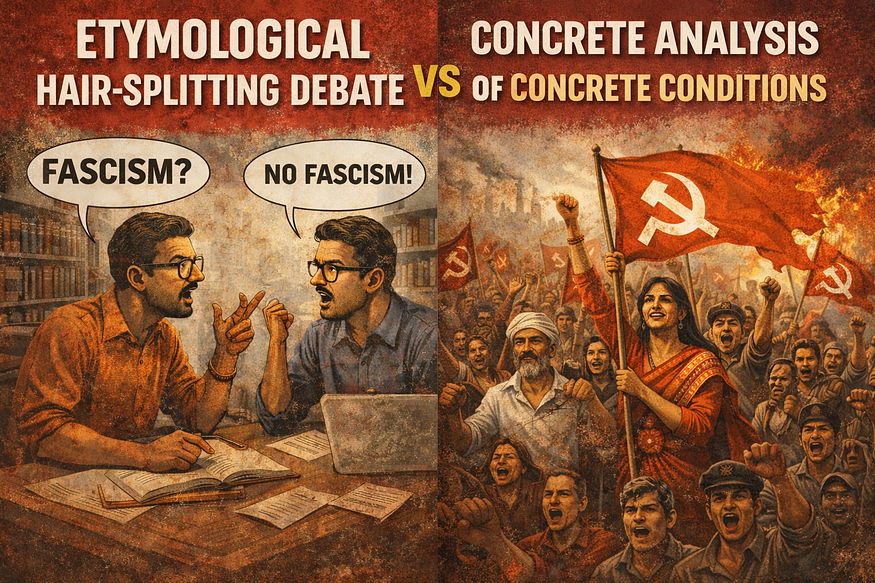
Marxism is not a politics of naming, moral signalling, or linguistic purity. It is a scientific method and a guide to revolutionary practice. Lenin defined it with absolute clarity: “Concrete analysis of concrete conditions.” Any approach that replaces this method with wordplay is not Marxism, but idealism in radical disguise.
The liberal and ultra-left obsession with whether present-day India should be called “fascist” rather than “neo-fascist” exemplifies this degeneration. It is not grounded in political economy, class analysis, or historical investigation. It is an etymological fixation masquerading as politics.
These critics do not analyse Indian capitalism. They do not examine the ruling-class alliance of monopoly capital, feudal remnants, and imperialist integration. They do not analyse the state, the reorganisation of consent and coercion, or the concrete mechanisms through which authoritarianism advances. They do not propose strategy, organisation, or mass struggle. They propose a word.
Italy in the 1930s was not Germany in the 1930s. Italy in the 1930s is not Italy in 2025. And Italy in the 1930s is certainly not India in 2025. History does not reproduce political forms mechanically; it transforms them through distinct material conditions, class structures, and historical paths. To demand that contemporary authoritarianism conform exactly to the classical European fascist model is to abandon empirical analysis in favour of historical analogy. Marxism rejects such imitation.
This is where the decisive historical difference between Europe and India must be stated clearly. In much of Europe, fascism represented the withdrawal of bourgeois-democratic rights that the working class had already won and materially exercised through mass parties, trade unions, and parliamentary struggle. In India, democratic rights were formally granted in 1950 but were never substantively realised for the working masses. Constitutional guarantees largely existed on paper, while real access to political power, economic security, and institutional protection remained structurally denied. It is therefore historically inaccurate to claim that the Indian working class has now “lost” democratic rights in the same sense as European workers under classical fascism. One cannot lose what one never substantively possessed.
Marx himself warned against the illusion of mechanical repetition: “History repeats itself, first as tragedy, second as farce.” Fascism does not return as a replica. Forms may echo the past, but their content is shaped by new historical conditions. Italy in the 1930s, Germany in the 1930s, and India today occupy entirely different positions within world capitalism and have followed fundamentally different paths of development.
India’s capitalism emerged through colonial domination, not through a bourgeois revolution. Contemporary authoritarianism operates through elections, identity mobilisation, media control, judicial hollowing, and the dominance of monopoly capital—without abolishing parliamentary forms. This cannot be understood through the classical fascist template.
On the basis of empirical Marxist analysis, the present conjuncture is therefore correctly characterised as neo-fascism. The prefix “neo” is not a concession; it is a theoretical necessity. It recognises historical transformation. Only those incapable of analysis mistake conceptual development for dilution.
The etymological camp is unconcerned with characteristics, class content, or strategy. Its entire political practice is criticism without responsibility. Liberal critics want the moral comfort of calling everything “fascism” without the burden of struggle. Ultra-left critics want revolutionary language without the discipline of mass politics. Both converge in the same sterile activity: attacking an established communist party while contributing nothing to resistance.
Their politics consists of denunciation instead of organisation, rhetoric instead of strategy, and armchair commentary instead of risk. They confuse naming with understanding and critique with action.
Marxism is not performed in comment sections. It is tested in struggle. Those serious about fighting authoritarianism must engage with concrete analysis, real forces, and real tasks—not semantic purity.
As Engels put it with enduring relevance:
“Etymological tricks are the last resort of idealist philosophy.”
And idealism—liberal or ultra-left—has never overthrown a ruling class.
Leave a Reply