
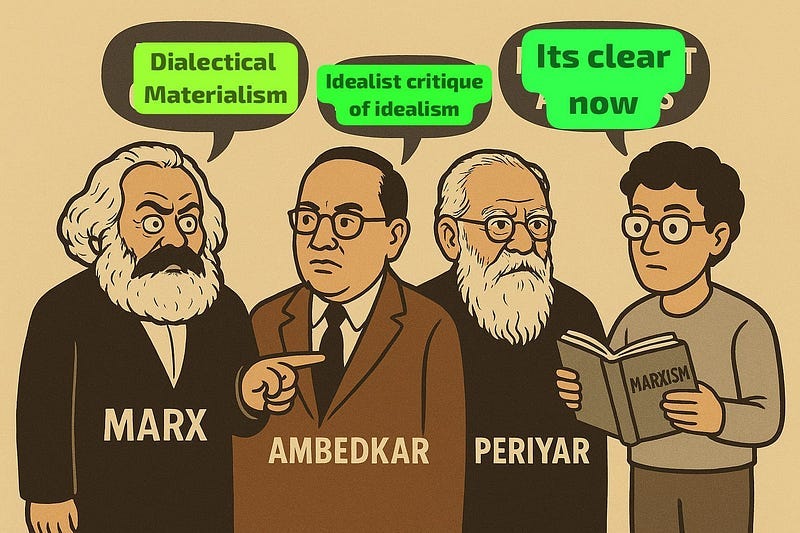
The Young Hegelian Trap: Understanding the Philosophical Limitations of Contemporary Ambedkarite and Periyarist Movements
The fundamental limitation that Marx and Engels identified in the Young Hegelians provides a precise theoretical framework for understanding both the historical role and contemporary stagnation of Ambedkarite and Periyarist movements in India. This parallel is not merely analogical but structural: both represent phases of ideological development that challenge dominant ideas while remaining trapped within the very idealist framework they purport to oppose.
The Idealist Critique of Idealism
The Young Hegelians — Feuerbach with his “religion of humanity,” Bauer with his atheism, Strauss with his historical criticism — focused their attack exclusively on religious consciousness while leaving untouched the material foundations of state power and private property. Similarly, Ambedkar and EVR mounted powerful critiques of Brahminical religion and caste ideology, yet their solutions remained largely within the realm of consciousness: conversion to Navayana Buddhism for Ambedkarites, Militant Atheism for Periyarists.
Before proceeding, an important clarification: the Old Hegelians are not equivalent to Sanatani orthodoxy in any precise sense. This analogy, while useful pedagogically, should not be taken as exact mirroring. Not everything in Europe finds its parallel in India — the intellectual history of India is different because the economic history of India is different from Europe. The feudal-to-capitalist transition that shaped European philosophy unfolded differently in the colonial and post-colonial Indian context.
Now,Applying the framework developed in The German Ideology to the Indian context reveals striking parallels:
“The Old Hegelians (Sanatanis) had comprehended everything as soon as it was reduced to a Hegelian logical category (Vedic scriptures). The Young Hegelians (Ambedkarite and Periyarist) criticised everything by attributing to it religious conceptions or by pronouncing it a theological matter. The Young Hegelians (Ambedkarite and Periyarist) are in agreement with the Old Hegelians (Sanatanis) in their belief in the rule of religion, of concepts, of a universal principle in the existing world. Only, the one party attacks this dominion as usurpation, while the other extols it as legitimate.
Since the Young Hegelians (Ambedkarite and Periyarist) consider conceptions, thoughts, ideas, in fact all the products of consciousness, to which they attribute an independent existence, as the real chains of men (just as the Old Hegelians (Sanatanis) declared them the true bonds of human society) it is evident that the Young Hegelians (Ambedkarite and Periyarist) have to fight only against these illusions of consciousness. Since, according to their fantasy, the relationships of men, all their doings, their chains and their limitations are products of their consciousness, the Young Hegelians (Ambedkarite and Periyarist) logically put to men the moral postulate of exchanging their present consciousness for human, critical or egoistic consciousness, and thus of removing their limitations. This demand to change consciousness amounts to a demand to interpret reality in another way, i.e. to recognise it by means of another interpretation.
The Young-Hegelian (Ambedkarite and Periyarist) ideologists, in spite of their allegedly “world-shattering” statements, are the staunchest conservatives. This critique, while acknowledging the historical context of the founders, applies with full force to most of their contemporary adherents. The most recent of them have found the correct expression for their activity when they declare they are only fighting against “phrases.” They forget, however, that to these phrases they themselves are only opposing other phrases, and that they are in no way combating the real existing world when they are merely combating the phrases of this world. The only results which this philosophic criticism could achieve were a few (and at that thoroughly one-sided) elucidations of Christianity (Vedic religion) from the point of view of religious history; all the rest of their assertions are only further embellishments of their claim to have furnished, in these unimportant elucidations, discoveries of universal importance.
It has not occurred to any one of these philosophers to inquire into the connection of German philosophy (Indian philosophy) with German reality (Indian reality), the relation of their criticism to their own material surroundings.”
This is the crux: both the orthodox Brahminical order and its Ambedkarite-Periyarist critics agree that the fundamental problem is one of ideas — religious conceptions, cultural practices, consciousness itself. They differ only on which set of ideas should prevail, not on whether ideas themselves constitute the primary terrain of struggle.
Applying this Marxist Critique ,we can identify three necessary consequences — logical outcomes inherent to their idealist foundations — that define the Ambedkarite and Periyarist movements:
First: Misunderstanding the Material Base of Caste
Ambedkarists and Periyarists fail to see cultural reality as a reflection of economic structures. They correctly identify caste as a cultural and ideological phenomenon but mistakenly treat it as an independent variable rather than as superstructure built upon a material base. Some even reverse the relationship, treating ideological structures (religion) as the foundation from which economic relations emerge.
By attacking cultural elements like religious symbols and social customs while proposing alternate cultures like Navayana Buddhism or atheism — yet ignoring the economic foundation, the property relations and modes of production that require caste for their reproduction — their struggle resembles cutting weeds while leaving roots intact. They aim to change consciousness without changing the social being that determines it.
Second: Misunderstanding the Class Character of the State
Their engagement with the state is premised on the liberal illusion that it is a neutral arbiter capable of delivering social justice. They cannot comprehend that the state exists to preserve ruling class interests, and that in the Indian context, the perpetuation of caste consciousness is a primary means through which it achieves this goal.
By dividing the working masses along caste lines, the state prevents the emergence of unified class consciousness and class action. A fight against caste is necessarily a fight against the state which strives hard to sustain the caste fissures. Seeing the state as a neutral spectator which has no role in this is a profound problem.
Third: Becoming Controlled Opposition
This combination of flaws makes these movements an ideal pet project for the ruling order. The state and the bourgeoisie actively incubate them as forms of controlled opposition. By funding, memorializing, and institutionalizing a politics that is vocally anti-Brahminical but functionally anti-revolutionary, they channel genuine anger into the safe confines of identity politics.
This creates a pseudo-revolutionary, and ultimately counter-revolutionary, force that attacks the symptoms of caste (cultural discrimination) while protecting its material core (class exploitation). Radical phraseology provides the appearance of dissent while practice reinforces the status quo.
Historical Conditioning vs. Contemporary Stagnation
This limitation was historically conditioned. The class character of the Dravidian movement constrained Periyar’s reach, while Ambedkar’s engagement with the colonial and post-colonial state imposed practical boundaries on his radicalism. Within their historical context, their work represented genuine progress — the Gandhian Congress was progressive compared to existing society, and Ambedkarite and Periyarist movements were more progressive than the Gandhian Congress on social questions, though not as revolutionary as Marxists.
However, what was historically conditioned limitation in the founders has become chosen stagnation in their followers. To remain at this “Young Hegelian” stage today — when productive forces have developed immensely and social contradictions have matured — constitutes intellectual regression. The excuse that “the founders couldn’t foresee the future” holds no validity for contemporary movements that refuse to analyze present material reality.
The Necessary Dialectical Evolution
A genuine progressive evolution of Ambedkar’s or Periyar’s thought should have reached Marxism by now, questioning property relations and the class nature of the state. This requires integrating insights about caste oppression within a materialist analysis that understands caste as embedded within and serving class exploitation.
The alternative is perpetual stagnation: radical in appearance, conservative in essence — fighting phrases with phrases while the material world producing oppression continues unchanged.
-to be continued-
Leave a Reply