
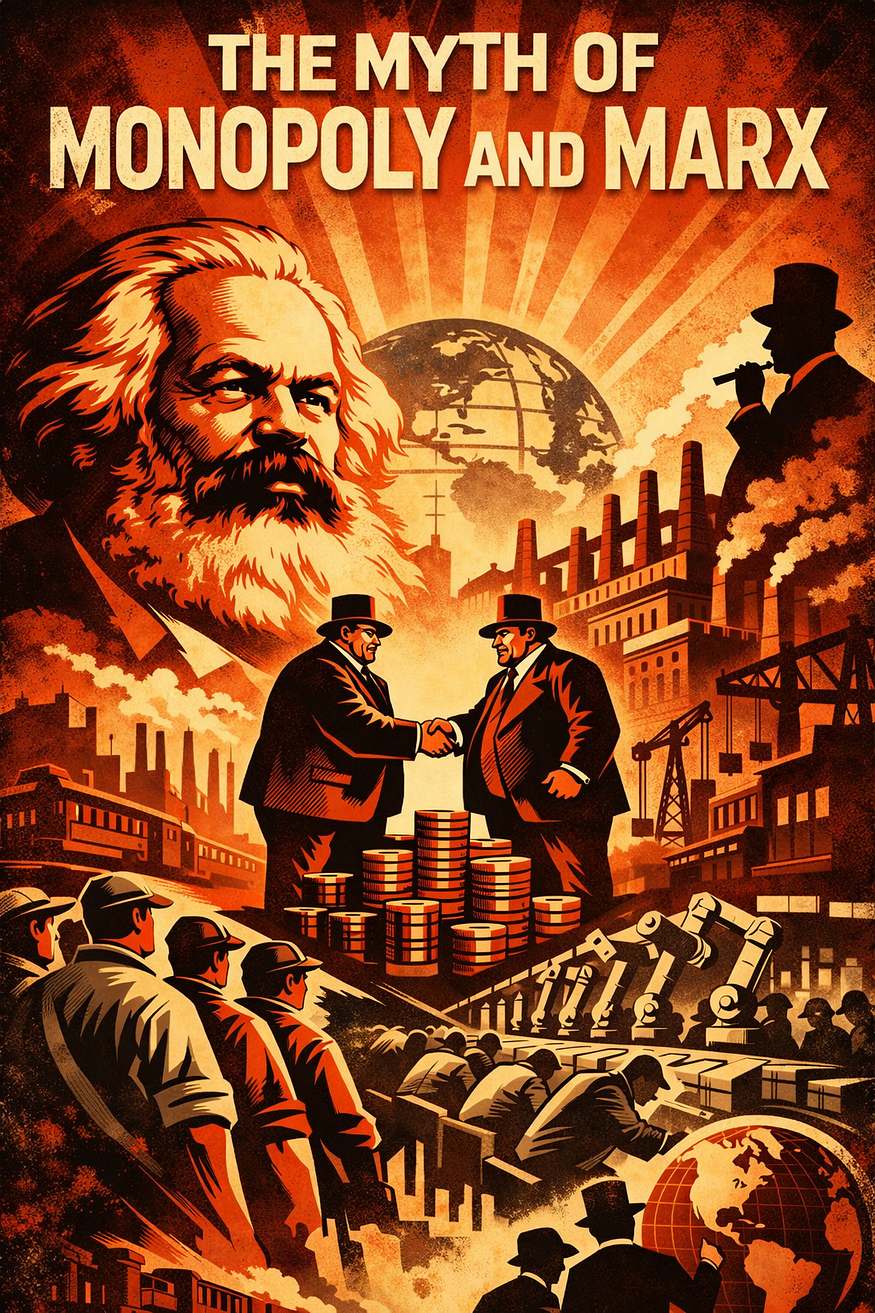
“In practical life we find not only competition, monopoly and the antagonism between them, but also the synthesis of the two, which is not a formula, but a movement. Monopoly produces competition, competition produces monopoly. Monopolists are made from competition; competitors become monopolists. If the monopolists restrict their mutual competition by means of partial associations, competition increases among the workers; and the more the mass of the proletarians grows as against the monopolists of one nation, the more desperate competition becomes between the monopolists of different nations. The synthesis is of such a character that monopoly can only maintain itself by continually entering into the struggle of competition.”
— Karl Marx, The Poverty of Philosophy
—
1.Monopoly and Competition
Marx treats competition and monopoly as internally related moments of capitalist accumulation, not as separate or successive systems. Competition produces monopoly through concentration and centralisation of capital. Monopoly does not abolish competition; it reorganises and displaces it.
The “synthesis” Marx refers to is a real movement, not a stable form or equilibrium. Monopoly exists only by continuously re-entering competition—technological, financial, and international. When monopolists limit competition among themselves, competition is intensified among workers and displaced onto the world market.
2.Contradictions in Capitalism
In the capitalist mode of production, the fundamental contradiction is between wage labour and capital. This is the primary contradiction because it arises from the basic social relation of capitalism: workers sell labour-power, capital appropriates surplus labour. It is this contradiction that defines capitalism as a historical mode of production and drives its overall motion.
At the same time, capitalism necessarily produces multiple contradictions that coexist simultaneously. These include contradictions between workers and workers, between capitalists and capitalists, and between different sections of capital and different sections of labour. In addition, capitalism generates contradictions with other classes in society, with pre-capitalist or non-capitalist social forms, and with nature itself, as accumulation increasingly collides with its material and social conditions. These contradictions operate within individual countries and between countries, taking the form of regional, national, and international antagonisms. Alongside these antagonisms, forms of collaboration also arise in every possible permutation and combination—within countries and across borders—between capitals, between workers, between capital and labour, and between particular classes or fractions against others. Such collaborations are not exceptions to contradiction but specific expressions of it, shaped by concrete historical and material conditions; they are temporary alignments within an ongoing process, not sequential stages or final resolutions.
3. The Monopoly-Stage Thesis: Core Claims
Several schools of thought associated with monopoly capitalism, and theories that wholly or partially base themselves on it, argue that capitalism has entered a qualitatively distinct phase dominated by monopoly or oligopoly. Beginning with Monopoly Capital and extending through later stagnationist and related approaches, these theories share a common premise: that capitalism has moved into a so-called monopoly stage in which administered prices replace competitive price formation.
Despite differences in scope and emphasis, these approaches converge on the following claims:
1. Capitalism has entered a distinct monopoly stage.
2. Price competition is replaced by administered prices.
3. The central problem shifts from surplus-value production to surplus absorption or transfer.
4. Crisis tendencies give way to chronic stagnation or persistent imbalance.
5. Classical Marxian “Labour Theory of Value”, lose explanatory centrality.
What unites these otherwise distinct approaches is the assumption that monopoly constitutes a qualitatively new historical stage of capitalism, displacing competition and weakening value regulation.
4.Why Monopoly-Stage Theory Breaks with Marx’s Method
These approaches depart from Marx on three decisive points.
First, they treat monopoly as a replacement of competition, rather than a form produced and continually reproduced by it. This confuses changes in the form of competition with its disappearance.
Second, they shift analysis from production to circulation, making demand, absorption, or transfer primary. This weakens Marx’s theory of exploitation, in which surplus value originates in production and only subsequently appears in circulation.
Third, they undermine the law of value by treating administered prices as evidence of its decline. Individual capitals may administer prices, but they cannot administer socially necessary labour time, productivity norms, or world-market constraints.
5.Monopoly in Practice
In practical usage, the “monopoly of a product” rarely signifies a single isolated capital. It usually denotes monopoly or duopoly control, that is, a cartel or syndicate structure in which a small number of dominant firms regulate a market through quotas, production targets, and planned output, rather than through free price competition.
In its simplest form, if X and Y are two firms exercising monopoly or duopoly control, this control is first established through agreements on production limits, market shares, or output quotas—that is, through syndication. Cross-holding of shares and overlapping ownership emerge as secondary stabilising mechanisms, reinforcing an already cartelised structure.In contemporary capitalism this structure becomes more complex through listed and unlisted shares, investment companies, mutual funds, bank holdings, and layered corporate control.
Such arrangements reduce open price warfare and competitive price reductions. However, this suspension applies only to output prices, not to the internal dynamics of accumulation. Even under cartelised pricing, capitals continue to introduce new technologies, intensify labour, reduce effective wages, replace labour with machinery, and reorganise production in order to lower costs and raise productivity. While the selling price may be temporarily fixed, the conditions of production are not. Socially necessary labour time continues to be redefined, and value relations remain in motion despite apparent price rigidity.
Assume, hypothetically, that X achieves a real monopoly over commodity X, and Y achieves a real monopoly over commodity Y. Both capitals now command enormous money flows. The question is not whether they will expand, but where they will expand. X will seek investment opportunities in the production of commodity Y, and Y will seek investment opportunities in the production of commodity X. Monopoly in one front will result in more rigorous competition in another front. Capital, by its very nature, cannot remain idle; it must seek self-expansion.
This logic necessarily extends beyond national borders. Even if capital were hypothetically to occupy all major commodities within a single country, there is no economic reason for it to stop at the border. The existence of other markets, other capitals, and other labour forces immediately reintroduces competition on the world scale. Capital export and foreign investment are therefore structural outcomes of accumulation, not policy choices.
In blunt heuristic terms, as long as more than one capital exists, competition persists. A world reduced to a single capital is not capitalism but an abstraction.
6.Conclusion
Monopoly is a metaphysical snapshot taken from the dialectical motion picture of capitalism.
Marx’s analysis already includes monopoly, but not as a new mode or stage of capitalism. Monopoly is a moment of accumulation that redistributes surplus value and reorganises competition without altering its source. Competition and monopoly are a dialectical reality, identified by Marx and Engels as early as The Poverty of Philosophy, long before Capital was written.
To argue that Marx analysed only a “competitive stage” of capitalism, which has since developed into a distinct “monopoly stage,” is therefore a gross misreading—not only of Capital, but of the fundamental dialectical character of the Marxist method itself. Marx did not construct stage theory based on surface market forms; he analysed real movement governed by value, accumulation, and class relations.
Monopoly-stage theories do not extend Marxist science. They retreat from it, replacing dialectical analysis with static stages and displacing production with circulation. In doing so, they obscure the continuity of capitalism’s laws and the persistence of exploitation at its core.
Leave a Reply