Category: History

  • Air, Water, Gold, Aluminium, Silver, Diamonds, and AI: LTV

    Air, Water, Gold, Aluminium, Silver, Diamonds, and AI: LTV

    Air, Water, Gold, Aluminium, Silver, Diamonds, and AI: LTV

    In a commodity-producing society, value does not arise from the intrinsic properties of things, nor from their scarcity, nor from their usefulness. Value is determined solely by the socially necessary labour time (SNLT) required to produce or reproduce a commodity under normal conditions of production.

    Shifts in technology, geological accessibility, and productivity therefore alter value only by altering socially necessary labour-time. The value of any existing commodity is not determined by the labour historically invested in it, but by the labour socially necessary to reproduce it now.

    Across air, water, gold, aluminium, silver, diamonds and AI

    one principle holds: natural abundance, technical difficulty, or historical cost matter only insofar as they shape the socially necessary labour time for production. Value arises from socially necessary labour-time; price merely oscillates around it. Prices fluctuate because of demand and supply shifts, monopoly power, tariff barriers, political coercion, or even literal force (“gun to the head”), but these distortions can only push prices away from value temporarily. They do not abolish the underlying law that anchors price behaviour.

    Air

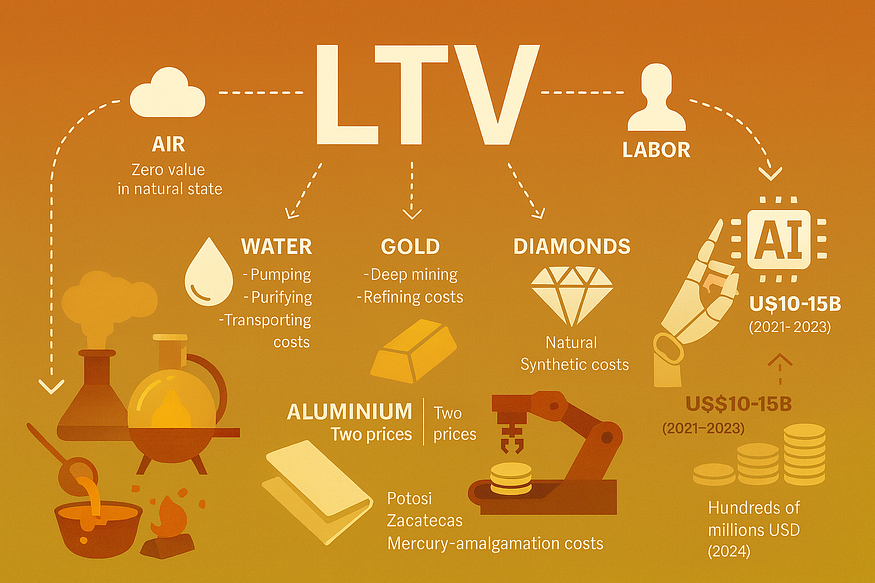
    Air is the simplest use-value without value. Since breathable air requires no labour to appropriate under ordinary conditions, it embodies zero SNLT and therefore has no value. Only when labour is applied — compressing, purifying, or transporting gases — does air acquire value as a commodity.

    If utility were the most important factor determining price and exchange value, then air should command the maximum price.

    Water

    Water behaves similarly when freely available at its natural source. River water requires no socially necessary labour, so it has no value. Labour becomes decisive only when water must be pumped, filtered, bottled, packaged, or transported. These labour processes confer value because they embody SNLT.

    Gold

    Gold demonstrates how scarcity affects value only via labour. Easily collected surface deposits historically required little labour, giving gold relatively low value. As those deposits declined, production shifted to deep mining and complex refining, increasing SNLT and therefore value. The value of gold rests on labour-time, not on mystical scarcity.

    Aluminium

    Aluminium provides one of history’s clearest proofs that labour — not rarity — determines value. Aluminium is the single most abundant metal in the Earth’s crust, comprising approximately 8% by weight of the top layer.

    Yet in the mid-19th century, aluminium was more valuable than gold because extraction required immense labour. Napoleon III even reserved aluminium cutlery for honoured guests, while others used gold.

    In 1886, the Hall–Héroult electrolytic process dramatically lowered the labour-time required for aluminium production. As SNLT fell, aluminium’s price collapsed from hundreds of dollars per kilogram to only a few dollars. The earth’s crust did not change; the labour required did.

    If scarcity were the most important factor, then aluminium would not have commanded a price higher than gold and silver before the 1880s.

    Silver

    Silver offers an equally decisive historical demonstration. The discovery of the extraordinarily rich silver mountain at Potosí in 1545, followed by the Mexican strikes at Zacatecas, radically lowered the SNLT required to produce silver.

    After the 1570s, the mercury-amalgamation process further reduced labour-time by enabling cheap refining of low-grade ores. Between 1500 and 1650, the purchasing power of silver fell by roughly 60–75%, as European prices rose 4–6×. Silver’s value fell because labour-time fell.

    Diamonds

    Diamonds operate under the same law, and recent empirical price data confirms it. Natural diamond extraction historically required extremely labour-intensive processes — geological surveying, deep-earth mining, sorting, cutting, and polishing — resulting in high SNLT and high value.

    Beginning in the 2010s and accelerating through the 2020s, the emergence of lab-grown diamonds, produced with far lower labour-time per carat, fundamentally altered market conditions.

    Recent data illustrates this:

    • 1-carat natural diamond prices fell from US$6,819 (May 2022) to US$4,997 (December 2024) — a 26.7% drop.
    • Rough-diamond prices have fallen approximately 40% from their 2021–2022 peak, with declines of 18% in 2024 and 15% in 2023.

    These declines do not reflect lower labour-time in natural diamond mining. They reflect cheaper substitutes — lab-grown diamonds — whose production requires far less SNLT. The market price falls toward the new reproduction cost, even though monopoly control (e.g., De Beers), tariffs, and demand cycles may distort the path.

    AI

    AI now provides a contemporary, intangible, but structurally exact demonstration of the law of value. OpenAI reportedly spent US$10–15 billion to develop and scale GPT-4, reflecting the exceptionally high socially necessary labour time (SNLT) required at that stage of technological development. This included massive compute expenditure, elite scientific labour, complex engineering pipelines, and scarce training infrastructure.

    By 2024–2025, however, DeepSeek showed that a model of broadly comparable capability — DeepSeek-V3 — could be developed and trained for hundreds of millions, not billions. This represented a major reduction in the SNLT required to reproduce a frontier model. A process that once demanded enormous quantities of computational and research labour could now be carried out much more efficiently and cheaply.

    This shift has two major consequences in terms of Marxian value theory.

    First, the value embodied in OpenAI’s earlier models undergoes moral depreciation. The historical labour embodied in GPT-4 no longer determines its value; the benchmark is now the lower labour-time required to reproduce a comparable system such as DeepSeek-V2. Value is set by the current reproduction cost, not the historical expenditure.

    Second, OpenAI’s competitive position is structurally altered. Because DeepSeek can reproduce a GPT-4-level model at a far lower labour-cost, OpenAI must now continuously invest even larger amounts of labour and capital just to maintain a technological lead. Instead of enjoying monopoly rents, it faces a permanently rising competitive pressure. The possibility of long-term monopoly pricing — once central to US bigtech imagination — is effectively shattered. The law of value forces the leading producer to lower prices and increase expenditure at the same time, reducing the ability to extract exceptional profits.

    In short, DeepSeek’s ability to produce a GPT-4-equivalent system at a fraction of the labour-time compels OpenAI to cheapen its prices while simultaneously increasing its investment to remain competitive. This is not a failure of business strategy; it is the law of value asserting itself against any attempt at monopoly.

    Conclusion

    From air to AI, one law governs:

    Value of any commodity is determined by the socially necessary labour time required for its current reproduction. When cheaper conditions of reproduction become socially generalised, the value correspondingly adjusts. Historical production costs do not govern value formation; rather, they play no role in determining the commodity’s present value once new reproduction conditions prevail.

    Prices fluctuate with demand, supply, monopoly, tariffs, and force — but these merely push prices away from value temporarily. Beneath market chaos, socially necessary labour time remains the gravitational center around which all prices revolve. This is not theory but empirical regularity, confirmed across centuries and commodities

  • Theory of Force and Imperialism

    Theory of Force and Imperialism

    I. Engels on Dühring’s Theory of Force and Its Rebuttal

    In the three chapters on the theory of force in Anti-Dühring, Engels takes up Dühring’s claim that political and military force is the primary determinant of social and economic relations. Dühring treats force as an autonomous historical power, capable of shaping economic life from the outside. Against this view, Engels reconstructs the real conditions under which force operates and exposes the material basis that Dühring systematically ignores.

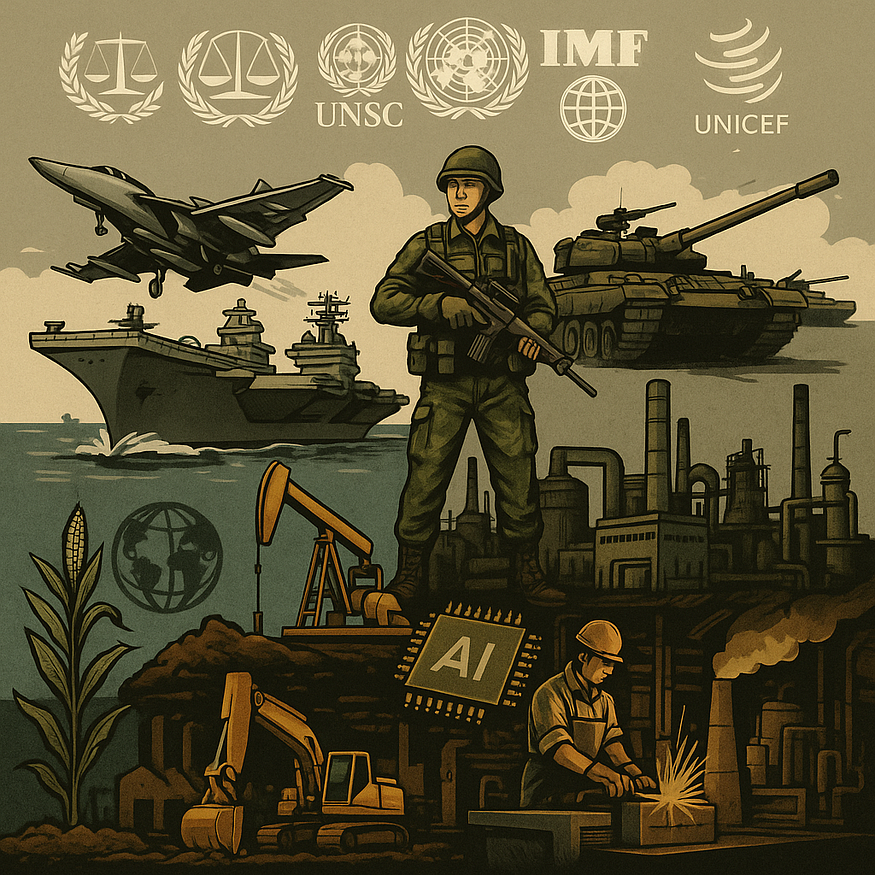
    Engels begins by demonstrating that modern force is inconceivable without a definite level of economic development. Military power is not produced by will, courage, or political decree, but by the productive capacity of society itself. As Engels states, “The triumph of force depends upon the production of weapons, and the production of weapons depends upon production in general.” What appears as political or military superiority is therefore grounded in superiority of productive forces.

    This dependence is most clearly visible in the organisation of modern armed forces. Engels emphasises that “Nothing is more dependent on economic prerequisites than precisely army and navy.” The ability to raise, equip, and sustain military forces presupposes an advanced productive base. Hence, “The army, and with it war, is possible only through the development of industry.” Whether industry is directed toward peaceful production or military destruction does not alter its determining role, since “Industry remains industry, whether it is applied to the production or the destruction of things.”

    Technological advances in production thus directly reshape political and military relations. Engels points out that “And the introduction of fire-arms had a revolutionising effect not only on the conduct of war itself, but also on the political relationships of domination and subjection.” Military outcomes are therefore decided not by abstract force but by material conditions, a fact Engels underscores when he writes: “So, then, the revolver triumphs over the sword; and this will probably make even the most childish axiomatician comprehend that force is no mere act of the will, but requires the existence of very real preliminary conditions before it can come into operation…”

    Having established that military and political force arise from economic development, Engels turns to the question of purpose. Against the notion that force exists for its own sake or for mere political display, he insists that force is always instrumental. “But force is only the means; the aim, on the other hand, is economic advantage.” Even where force appears autonomous, it remains bound by economic limits: “Force, however, cannot make any money; at most it can take away money that has already been made …”

    For this reason, the exercise of force is never purely political. Its outcomes necessarily translate into material consequences, since “Every victory of force in the long run leads to economic results.”

    Through this critique, Engels decisively overturns Dühring’s theory of force. Military and political power do not stand above economic life; they arise from it, depend on it, and ultimately serve economic ends. Force, far from being the foundation of society, is itself conditioned by the development of production and by the material interests of the ruling class.

    II. Imperialism and Engels’ Theory of Force

    Engels’ critique of Dühring’s theory of force provides a materialist framework that clarifies the logic of imperialism. Once force is understood as arising from economic development and serving economic ends, imperialism can no longer be treated as a matter of political ambition, national psychology, or military tradition. It must be understood as a necessary form of capitalist expansion under conditions of uneven economic development.

    Imperial domination presupposes a hierarchy of productive capacities among societies. Those formations that achieve superiority of productive forces necessarily acquire military superiority, not as an independent achievement, but as a derivative of their economic base. Engels’ insistence that military power rests on industry explains why imperial power consistently flows from economically advanced centres toward less developed regions. The ability to manufacture weapons, maintain standing armies and navies, and sustain prolonged military expenditure is inseparable from advanced production and accumulated capital.

    At the level of the Country, the same material logic governs the use of political force within capitalism. Political domination is employed to discipline and suppress competing capitals, to crush dissent, and to contain labour movements that struggle for higher wages, improved living conditions, and expanded social security.

    At the same time, the bourgeois state also provides social security assistance, welfare spending, and limited concessions in order to secure the consent and goodwill of the working class and stabilise the conditions of accumulation. State power intervenes both repressively and integratively, limiting the claims of labour whenever they threaten profitability while selectively accommodating them when social stability or reproduction of labour-power requires it.

    The provision and control of infrastructure is likewise a central function of the bourgeois nation-state. Roads, ports, energy systems, communications, and urban infrastructure are necessary conditions for capital accumulation, but control over infrastructure is simultaneously a form of control over the population itself.

    These practices are not deviations from capitalism but integral to its normal functioning. What a state does to a capitalist nation, the imperialist nation or system seeks to do to the whole world. The same framework, once established domestically, necessarily extends outward, reproducing itself on a global scale. Imperialism similarly combines coercion with incorporation, repression with concession, building international infrastructure, development projects, and quasi-“global welfare” mechanisms, while using control over these infrastructures to secure economic advantage and political domination on a world scale.

    For this reason, imperialist force is not episodic but structural. It is exercised not only in moments of open war, but continuously through the control of trade routes, strategic territories, and political conditions of exchange. In Engels’ framework, such force does not stand outside the economy; it is the political form through which economic power secures its reproduction. Military superiority thus functions as the guarantor of unequal economic relations already rooted in differences in productivity and development.

    Equally decisive is Engels’ insistence that force is a means rather than an end. Imperialism does not deploy force for prestige or domination as such, but for material advantage. Even when force appears autonomous, it remains economically constrained. Force cannot create value; it can only redistribute wealth already produced. Imperialist coercion therefore serves to secure favourable conditions for appropriation, accumulation, and expansion.

    Conclusion

    Engels’ polemic against Dühring’s theory of force can help us, in certain essential aspects, in understanding modern imperialism. The preconditions for capitalism within a country and for imperialism at the level of the world are both economic. The process of accumulation in capitalism within a nation and the process of accumulation through imperialism on a world scale are both economic. The ambitions of capitalism within a country and the ambitions of imperialism globally are likewise economic in character. Political and military power do not stand above the fundamental laws of capital; they function as their instruments. Just as political and military force serves capital in organising, disciplining, and reproducing accumulation within a nation, so imperialist political and military power serves capital in organising, disciplining, and reproducing accumulation at the global level. In both cases, force is not the source of wealth, but the means through which economic domination is secured and maintained.

  • The Soup, the Bowl and the Spoon

    The Soup, the Bowl and the Spoon

    The Soup, the Bowl, and the Spoon:

    The Fixed Bowl Fallacy

    Marx says in a polemic against Weston “Citizen Weston’s argument rested, in fact, upon two premises: firstly, the amount of national production is a fixed thing, a constant quantity or magnitude, as the mathematicians would say; secondly, that the amount of real wages, that is to say, of wages as measured by the quantity of the commodities they can buy, is a fixed amount, a constant magnitude.”

    Marx responds that National production is not constant. Year after year, the value and mass of production increase. The productive powers of labor expand continuously, requiring ever-changing amounts of money to circulate this growing output. What holds true across years holds true for every average day: the magnitude of national production changes continuously. Apart from population changes, this must be so because of the continuous change in the accumulation of capital and the productive powers of labor.

    “Citizen Weston illustrated his theory by telling you that a bowl contains a certain quantity of soup, to be eaten by a certain number of persons, an increase in the broadness of the spoons would produce no increase in the amount of soup.”

    Marx’s response established the analytical framework: “Citizen Weston, on his part, has forgotten that the bowl from which the workmen eat is filled with the whole produce of national labour, and that what prevents them fetching more out of it is neither the narrowness of the bowl nor the scantiness of its contents, but only the smallness of their spoons.”

    Capitalism does not operate with a fixed bowl. Through rising productivity, technological change, and the organization of labor, it constantly expands total social wealth. The bowl grows. Yet capitalism simultaneously and systematically limits the spoon — the worker’s share of that wealth — unless forced otherwise.

    Let us use this Bowl-Spoon analogy to study and understand capitalism’s reality through the lens of Marx’s labor theory of value.

    The Analogy and Its Components

    The metaphor distinguishes two elements:

    • The bowl represents the total social product
    • The spoon represents wages — the portion of that value workers receive

    What remains after the spoon extracts from the bowl constitutes capital’s share for the next round of accumulation.

    In Marx’s terms:

    C + V + S = Total social product (the bowl)

    Where:

    • C (constant capital) represents the means of production — machinery, raw materials, buildings — reproduced in each cycle
    • V (variable capital) represents wages paid to workers — what they consume to reproduce their labor power
    • S (surplus value) represents the unpaid labor appropriated by capital

    Workers produce the entire new value V + S through their labor but receive only V as wages. Capital appropriates S and accumulates it, expanding total capital to C + S in the next cycle.

    Absolute Poverty: The Size of the Spoon

    Absolute poverty refers to the absolute size of the spoon. It answers a concrete question: does the worker receive enough to meet minimum material needs — food, shelter, basic security?

    Capitalism expands productive capacity. Marx recognized this without hesitation: “The number and extent of his so-called necessary wants, as also the modes of satisfying them, are themselves the product of historical development” (Capital, Vol. I).

    As productivity rises, the bowl grows, making it possible for the spoon to grow as well. Capitalism has therefore often reduced absolute poverty compared to earlier modes of production. Marx plainly acknowledged: “The material position of the worker has improved” (Wage Labour and Capital).

    To deny this constitutes not radicalism but denial of material reality.

    Exploitation: The Gap Between Soup Produced and Soup Received

    This improvement in material conditions does not tell the whole story. Marx immediately adds what is usually ignored: “But at the cost of his social position” (Wage Labour and Capital).

    Exploitation does not concern how small the spoon is. It concerns how much soup the worker produces beyond what they receive. Marx defines exploitation precisely: “Surplus labour is the excess of labour performed beyond the necessary labour” (Capital, Vol. I).

    Necessary labor V fills the spoon. Surplus labor S fills capital’s share. A worker can therefore escape absolute poverty and still be exploited if they produce far more soup than they are allowed to consume. Absolute poverty and exploitation are related but distinct phenomena.

    Relative Poverty: When the Bowl Grows Faster Than the Spoon

    Relative poverty does not mean deprivation. It means a declining share of growing social wealth.

    Marx explains the social nature of satisfaction: “Our desires and pleasures spring from society; we measure them, therefore, by society and not by the objects which serve for their satisfaction” (Wage Labour and Capital).

    More sharply: “A house may be large or small; as long as the neighbouring houses are likewise small, it satisfies all social requirement for a residence. But let there arise next to the little house a palace, and the little house shrinks to a hut” (Wage Labour and Capital).

    Under capitalism, the bowl expands rapidly. Capital resists the spoon’s growth while workers fight to enlarge it. The distance between them widens, though the absolute size of the spoon may also increase. Capitalism as a system, therefore, tends to abolish absolute poverty while intensifying relative poverty.

    Who Makes the Bowl Bigger, and Who Makes the Spoon Bigger

    The class logic becomes clear here. Capital, as a system, expands total social wealth. Competition compels it to raise productivity, introduce machinery, and expand output. The imperative to accumulate drives technological advancement and organizational efficiency.

    But capital has no inherent tendency to enlarge the spoon. Marx is explicit: “The general tendency of capitalist production is not to raise, but to sink the average standard of wages” (Value, Price and Profit).

    The enlargement of the spoon occurs only through class struggle. Marx therefore insists: “Trades unions work well as centres of resistance against the encroachments of capital” (Value, Price and Profit).

    Capital expands the wealth-bowl. Class struggle determines its distribution — the spoon’s size.

    A Concrete Example: Two Societies

    Consider two societies:

    Society A (Low Technology):

    • C = 10
    • V = 10
    • S = 1
    • Rate of exploitation = S/V = 1/10 = 0.1 = 10%

    Society B (High Technology):

    • C = 100
    • V = 20
    • S = 20
    • Rate of exploitation = S/V = 20/20 = 1 = 100%

    In the high-technology, high-capital society, exploitation is considerably higher, yet workers receive more in absolute terms — more actual commodities — than workers in the low-technology, low-capital society despite being exploited less.

    The productivity of any labor is directly proportional to the productivity of the constant capital employed. The increase in productivity increases the absolute amount of commodities workers enjoy, despite higher exploitation.

    Society A: Absolute Poverty With Low Exploitation

    The bowl is small because productivity is low. Workers produce only slightly more soup than fills their own spoon, leaving a small surplus.

    • The spoon is small → workers are poor (no phones, no bicycles)
    • Workers receive the major part of what they produce → low exploitation

    This society exhibits absolute poverty even with low exploitation because of backward productive forces.

    Society B: High Exploitation Without Absolute Poverty

    The bowl is large because productivity is high. Workers produce a great deal of soup in absolute terms and receive a much larger spoon than in Society A. But most of the soup they produce is appropriated by capital.

    • The spoon is larger → workers consume more commodities(consumes smartphones,owns a car)
    • Workers receive only small part of what they produce → high exploitation exists

    This society exhibits exploitation without absolute poverty.

    The Core Insight

    The bowl-soup-spoon analogy clarifies that poverty concerns the size of the spoon while exploitation concerns the division of the soup. They often appear together but describe different realities. Confusing them leads either to denying exploitation when workers live better or to assuming exploitation without analyzing production.

    The Paradox: Capital Accumulation as Precondition for Workers’ Material Improvement

    Because workers’ material gains depend on the expansion of total social wealth, the increase of capital becomes a necessary precondition for any lasting improvement in workers’ conditions — even as this same accumulation deepens their exploitation.

    Marx states this without ambiguity: “To say that the worker has an interest in the rapid growth of capital means only this: that the more speedily the worker augments the wealth of the capitalist, the larger will be the crumbs which fall to him” (Wage Labour and Capital).

    The growth of capital enlarges the bowl. Without that expansion, there is no material basis for a larger spoon. But this growth does not abolish exploitation; it reproduces it on an expanded scale.

    Conclusion

    Absolute poverty and exploitation are related but not identical. Absolute poverty concerns the size of the spoon. Exploitation concerns the gap between soup produced and soup received. Relative poverty emerges when the bowl grows faster than the spoon.

    Capital creates wealth by expanding the bowl. Class struggle determines how much of that wealth reaches the spoon. Capitalism can abolish absolute poverty while deepening exploitation and relative poverty simultaneously. This is not a contradiction to be resolved morally but a structural dynamic to be understood scientifically.

    The growth of capital — the expansion of the bowl — is therefore an essential precondition for the improvement of workers’ material conditions. Yet this same growth perpetually reproduces the extraction of surplus value, widening the gap between what workers produce and what they receive.

    Marx captures this contradiction precisely: “The most favorable condition for wage-labour is the most rapid possible growth of productive capital… The more productive capital grows, the more the division of labour and the application of machinery expands. The more the division of labour and the application of machinery expands, the more competition among the workers expands and the more their wages contract” (Wage Labour and Capital).

    Understanding this contradiction is essential for analyzing capitalism scientifically rather than morally.

    Let us not fall into the traps of: (1) Liberal confusion that equates poverty with exploitation, (2) Moral Marxism that equates exploitation with misery, (3) Vulgar economism that equates higher wages with the end of exploitation.