
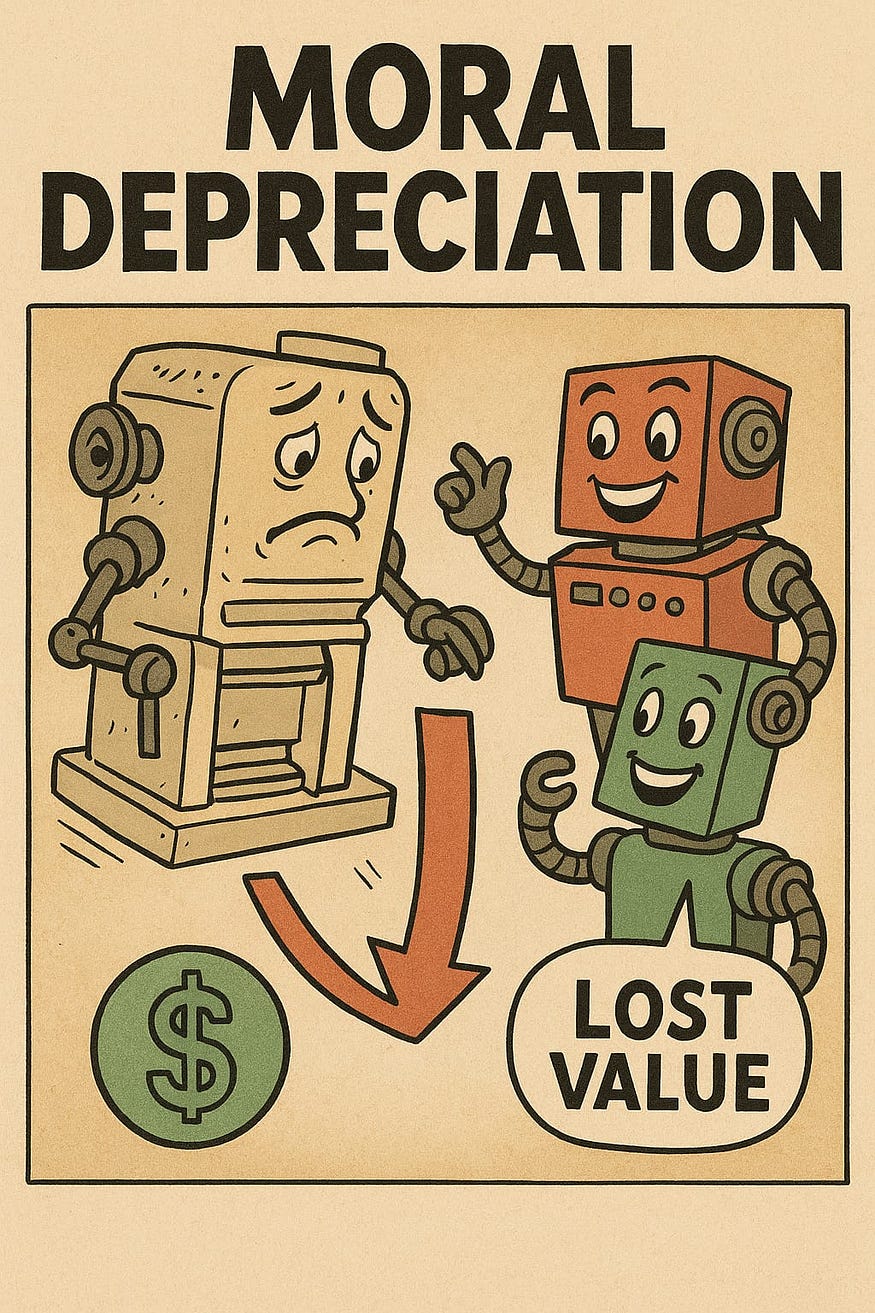
“But in addition to the material wear and tear, a machine also undergoes, what we may call a moral depreciation. It loses exchange-value, either by machines of the same sort being produced cheaper than it, or by better machines entering into competition with it. In both cases, be the machine ever so young and full of life, its value is no longer determined by the labour actually materialised in it, but by the labour-time requisite to reproduce either it or the better machine. It has, therefore, lost value more or less.” — Marx
With this concept of “moral depreciation,” Marx identifies a crucial vulnerability in capital: its value is not fixed but is subject to erosion from technological progress and competition. This occurs not through physical use, but because the same or a better machine can now be produced at a lower cost. Consequently, the value of any existing machine is set not by the historical labor invested in it, but by the current, socially necessary labor time required to reproduce it. The underlying principle is that value is determined by the cost of (re)production, not the original cost.
This principle extends beyond machinery to other forms of capital. For commodity capital, consider a company that has produced a good for X rupees and placed it on a supermarket shelf. If a competitor then brings an identical product to market for X-Y rupees, the first company is forced to devalue its stock and sell at the new, lower price. Its capital is morally depreciated by the cheaper reproduction of the same commodity.
On an international scale, this becomes a powerful driver of global economic dynamics. When one nation innovates and systematically lowers the cost of production, it devalues the industrial capital of its competitors. The factories and technologies of other countries become economically obsolete, not because they are worn out, but because the global benchmark for “socially necessary labor time” has fallen. This makes national investments in education, infrastructure, and efficient policy a race to achieve competitive advantage by imposing moral depreciation on rivals, while factors like corruption or wasteful spending accelerate a nation’s own vulnerability.
This dynamic is starkly illustrated by China’s focused strategy. Through state planning, it has drastically reduced the socially necessary labor time for countless goods, thereby imposing massive moral depreciation on the industrial capital of the US and other Western nations. Their manufacturing assets, even if physically intact, were devalued by more efficient global competitors.
This phenomenon, however, is not new. Its historical precedent was set when English traders, armed with superior technology for cloth production, entered the Indian market. By producing cloth more cheaply, they morally depreciated the manufacturing capital of Indian weavers, demonstrating that the devaluation of capital through competition is a foundational and enduring feature of capitalist development.
The contemporary example,
OpenAI spent an estimated $10-$15 billion in capital, largely from Microsoft, to build and scale its AI engines like GPT-4. This cost covered the immense computational power and extensive research required to pioneer the technology. In contrast, DeepSeek created a comparable machine, DeepSeek-V2, for a fraction of that cost. Industry analysis suggests their development and training costs were likely in the hundreds of millions of dollars, not billions. This drastic reduction in the cost of production has morally depreciated the value of OpenAI’s original capital. The societal cost to reproduce a state-of-the-art AI is now far lower, meaning the financial value of OpenAI’s initial multi-billion dollar investment has been significantly reduced by this new, more efficient competition.
Leave a Reply