
Air, Water, Gold, Aluminium, Silver, Diamonds, and AI: LTV
In a commodity-producing society, value does not arise from the intrinsic properties of things, nor from their scarcity, nor from their usefulness. Value is determined solely by the socially necessary labour time (SNLT) required to produce or reproduce a commodity under normal conditions of production.
Shifts in technology, geological accessibility, and productivity therefore alter value only by altering socially necessary labour-time. The value of any existing commodity is not determined by the labour historically invested in it, but by the labour socially necessary to reproduce it now.
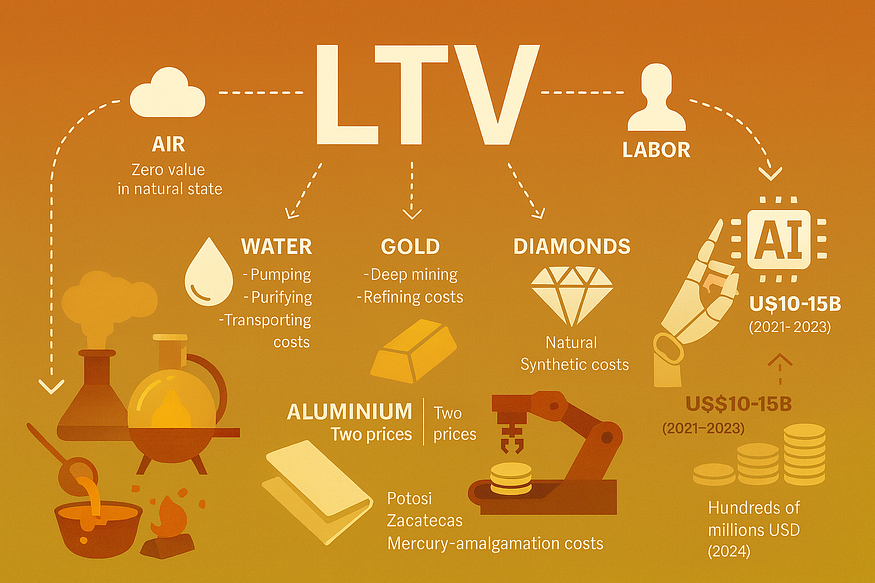
Across air, water, gold, aluminium, silver, diamonds and AI
one principle holds: natural abundance, technical difficulty, or historical cost matter only insofar as they shape the socially necessary labour time for production. Value arises from socially necessary labour-time; price merely oscillates around it. Prices fluctuate because of demand and supply shifts, monopoly power, tariff barriers, political coercion, or even literal force (“gun to the head”), but these distortions can only push prices away from value temporarily. They do not abolish the underlying law that anchors price behaviour.
Air
Air is the simplest use-value without value. Since breathable air requires no labour to appropriate under ordinary conditions, it embodies zero SNLT and therefore has no value. Only when labour is applied — compressing, purifying, or transporting gases — does air acquire value as a commodity.
If utility were the most important factor determining price and exchange value, then air should command the maximum price.
Water
Water behaves similarly when freely available at its natural source. River water requires no socially necessary labour, so it has no value. Labour becomes decisive only when water must be pumped, filtered, bottled, packaged, or transported. These labour processes confer value because they embody SNLT.
Gold
Gold demonstrates how scarcity affects value only via labour. Easily collected surface deposits historically required little labour, giving gold relatively low value. As those deposits declined, production shifted to deep mining and complex refining, increasing SNLT and therefore value. The value of gold rests on labour-time, not on mystical scarcity.
Aluminium
Aluminium provides one of history’s clearest proofs that labour — not rarity — determines value. Aluminium is the single most abundant metal in the Earth’s crust, comprising approximately 8% by weight of the top layer.
Yet in the mid-19th century, aluminium was more valuable than gold because extraction required immense labour. Napoleon III even reserved aluminium cutlery for honoured guests, while others used gold.
In 1886, the Hall–Héroult electrolytic process dramatically lowered the labour-time required for aluminium production. As SNLT fell, aluminium’s price collapsed from hundreds of dollars per kilogram to only a few dollars. The earth’s crust did not change; the labour required did.
If scarcity were the most important factor, then aluminium would not have commanded a price higher than gold and silver before the 1880s.
Silver
Silver offers an equally decisive historical demonstration. The discovery of the extraordinarily rich silver mountain at Potosí in 1545, followed by the Mexican strikes at Zacatecas, radically lowered the SNLT required to produce silver.
After the 1570s, the mercury-amalgamation process further reduced labour-time by enabling cheap refining of low-grade ores. Between 1500 and 1650, the purchasing power of silver fell by roughly 60–75%, as European prices rose 4–6×. Silver’s value fell because labour-time fell.
Diamonds
Diamonds operate under the same law, and recent empirical price data confirms it. Natural diamond extraction historically required extremely labour-intensive processes — geological surveying, deep-earth mining, sorting, cutting, and polishing — resulting in high SNLT and high value.
Beginning in the 2010s and accelerating through the 2020s, the emergence of lab-grown diamonds, produced with far lower labour-time per carat, fundamentally altered market conditions.
Recent data illustrates this:
- 1-carat natural diamond prices fell from US$6,819 (May 2022) to US$4,997 (December 2024) — a 26.7% drop.
- Rough-diamond prices have fallen approximately 40% from their 2021–2022 peak, with declines of 18% in 2024 and 15% in 2023.
These declines do not reflect lower labour-time in natural diamond mining. They reflect cheaper substitutes — lab-grown diamonds — whose production requires far less SNLT. The market price falls toward the new reproduction cost, even though monopoly control (e.g., De Beers), tariffs, and demand cycles may distort the path.
AI
AI now provides a contemporary, intangible, but structurally exact demonstration of the law of value. OpenAI reportedly spent US$10–15 billion to develop and scale GPT-4, reflecting the exceptionally high socially necessary labour time (SNLT) required at that stage of technological development. This included massive compute expenditure, elite scientific labour, complex engineering pipelines, and scarce training infrastructure.
By 2024–2025, however, DeepSeek showed that a model of broadly comparable capability — DeepSeek-V3 — could be developed and trained for hundreds of millions, not billions. This represented a major reduction in the SNLT required to reproduce a frontier model. A process that once demanded enormous quantities of computational and research labour could now be carried out much more efficiently and cheaply.
This shift has two major consequences in terms of Marxian value theory.
First, the value embodied in OpenAI’s earlier models undergoes moral depreciation. The historical labour embodied in GPT-4 no longer determines its value; the benchmark is now the lower labour-time required to reproduce a comparable system such as DeepSeek-V2. Value is set by the current reproduction cost, not the historical expenditure.
Second, OpenAI’s competitive position is structurally altered. Because DeepSeek can reproduce a GPT-4-level model at a far lower labour-cost, OpenAI must now continuously invest even larger amounts of labour and capital just to maintain a technological lead. Instead of enjoying monopoly rents, it faces a permanently rising competitive pressure. The possibility of long-term monopoly pricing — once central to US bigtech imagination — is effectively shattered. The law of value forces the leading producer to lower prices and increase expenditure at the same time, reducing the ability to extract exceptional profits.
In short, DeepSeek’s ability to produce a GPT-4-equivalent system at a fraction of the labour-time compels OpenAI to cheapen its prices while simultaneously increasing its investment to remain competitive. This is not a failure of business strategy; it is the law of value asserting itself against any attempt at monopoly.
Conclusion
From air to AI, one law governs:
Value of any commodity is determined by the socially necessary labour time required for its current reproduction. When cheaper conditions of reproduction become socially generalised, the value correspondingly adjusts. Historical production costs do not govern value formation; rather, they play no role in determining the commodity’s present value once new reproduction conditions prevail.
Prices fluctuate with demand, supply, monopoly, tariffs, and force — but these merely push prices away from value temporarily. Beneath market chaos, socially necessary labour time remains the gravitational center around which all prices revolve. This is not theory but empirical regularity, confirmed across centuries and commodities
Leave a Reply