Category: Economics

  • The Great Health Insurance Heist

    The Great Health Insurance Heist

    The Great Health Insurance Heist: A Citizen’s Guide to the Scam You’re Already Paying For

    Politician: Thank you. My dear citizens, today is a historic day! We are launching “Aarogya Suraksha” – a scheme to provide free health insurance for all! No more worrying about medical bills. You can now walk into any empaneled private hospital and get top-quality treatment. Because, let’s be honest, our government hospitals are not as clean or modern as we would like. This is a new dawn!

    Citizen: That sounds fantastic, sir. So, this insurance – how much will it cost me?

    Politician: Not a single rupee! It is absolutely free for you. The government will pay your premium. Health insurance is a pillar of financial prudence, and we are making it accessible to everyone.

    Citizen: I see. So, you, personally, will pay for me?

    Politician: No, no. From the state treasury. The people’s money for the people’s welfare!

    Citizen: And this treasury money… you will give it to this gentleman’s insurance company?

    Insurance Owner: That is correct. We are the risk managers. We will pool the premiums and ensure the scheme runs smoothly.

    Citizen: For everyone in the country? That’s a lot of premiums. But sir, you are a business. After you pay out all the hospital claims, and after your office costs, salaries, and advertising… you need to make a profit, right? That’s why you’re in business.

    Insurance Owner: That is a fundamental principle of commerce. We provide a valuable service, and a reasonable profit is our reward for efficiency and capital investment.

    Citizen: Understood. So, when I’m sick, this “claim money” you get from the government… you will hand it over to me?

    Bureaucrat: No. The model is cashless. The payment is made directly to the healthcare provider upon completion of treatment. The beneficiary does not handle funds.

    Citizen: So, you will treat me for free?

    Hospital Owner: Absolutely. The insurance will cover everything. You just need your Aadhaar card.

    Citizen: But why would you do that? You’re also a business. After you pay for the doctors, the medicines, the equipment… you also need to make a profit.

    Hospital Owner: Naturally. A margin is essential for growth, innovation, and maintaining our world-class facilities. The treatment is free for you, but the system sustains itself.

    Citizen: It’s all becoming clear. So, the government takes tax money, gives it to the insurance company, which takes a profit, who then pays the hospital, which also takes a profit. Two layers of profit, all from the public treasury.

    Politician: You are missing the point! The point is service delivery! The point is that the citizen gets treatment!

    Citizen: My question is, why are these specific companies chosen? How do we know they are the best?

    Politician: They are renowned, trusted partners! Furthermore, they are strong believers in our nation’s development… They even contribute to the democratic process…

    Citizen: They fund your election campaigns?

    Politician: They make lawful donations to the political process, which is the lifeblood of any democracy! We need funds to reach the people, to tell them about our good work like this scheme!

    Citizen: Which brings me to my final point. The government is always short of money. Where will you find the billions needed for this?

    Bureaucrat: The allocation will be re-prioritized. Inefficient and redundant expenditures will be rationalized. The budget for the Public Health Infrastructure mission is being scaled down, as the new scheme will ultimately reduce the burden on it.

    Citizen: Let me get this straight. The government will cut funding for public hospitals and use that money to fund this new scheme.

    Let’s be clear about what we are evolving from. Ideally, the system should be simple and efficient:
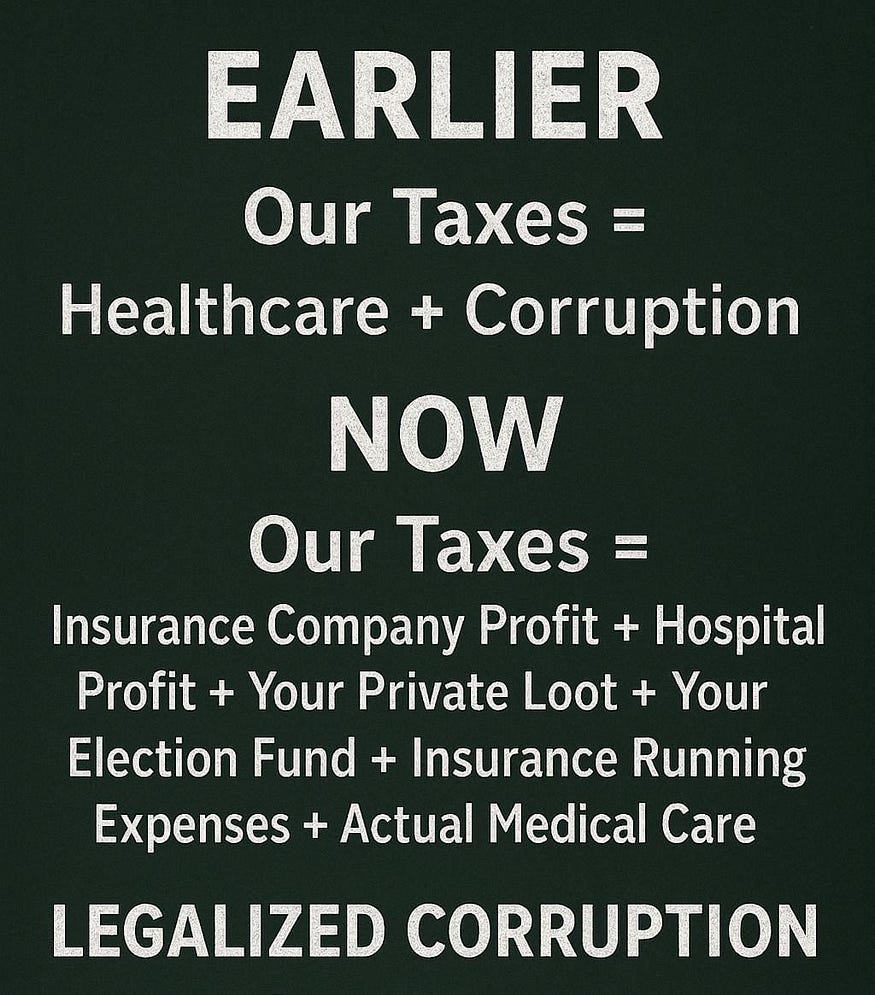
    Our Taxes= Healthcare in Public Hospitals.

    But we all know the old reality. It was:
    Our Taxes= Healthcare + Corruption.

    It was a leaky bucket. But now, you haven’t fixed the leaks. You have created a whole new, more expensive bucket, and you’ve made the leaks a formal part of the design! You have evolved corruption into a legal, institutionalized system.

    Now, the formula is:
    Our Taxes= Insurance Company Profit + Hospital Profit + Politician’s Private Loot + Your Election Fund + Insurance Running Expenses + Actual Medical Care.

    This isn’t progress. This is corruption 2.0. You’ve replaced small, under-the-table bribes with massive, on-the-books profits for your partners, funded entirely by the public. You didn’t stop the theft; you just wrote a law to justify it.

    Politician: This is slander! A gross oversimplification of a complex policy!

    Citizen: The math is simple. You haven’t eliminated corruption. You’ve just privatized it and made the taxpayer pay a premium for it. What a brilliant scam.
    My apologies.I meant to say scheme.

  • Air, Water, Gold, Aluminium, Silver, Diamonds, and AI: LTV

    Air, Water, Gold, Aluminium, Silver, Diamonds, and AI: LTV

    Air, Water, Gold, Aluminium, Silver, Diamonds, and AI: LTV

    In a commodity-producing society, value does not arise from the intrinsic properties of things, nor from their scarcity, nor from their usefulness. Value is determined solely by the socially necessary labour time (SNLT) required to produce or reproduce a commodity under normal conditions of production.

    Shifts in technology, geological accessibility, and productivity therefore alter value only by altering socially necessary labour-time. The value of any existing commodity is not determined by the labour historically invested in it, but by the labour socially necessary to reproduce it now.

    Across air, water, gold, aluminium, silver, diamonds and AI

    one principle holds: natural abundance, technical difficulty, or historical cost matter only insofar as they shape the socially necessary labour time for production. Value arises from socially necessary labour-time; price merely oscillates around it. Prices fluctuate because of demand and supply shifts, monopoly power, tariff barriers, political coercion, or even literal force (“gun to the head”), but these distortions can only push prices away from value temporarily. They do not abolish the underlying law that anchors price behaviour.

    Air

    Air is the simplest use-value without value. Since breathable air requires no labour to appropriate under ordinary conditions, it embodies zero SNLT and therefore has no value. Only when labour is applied — compressing, purifying, or transporting gases — does air acquire value as a commodity.

    If utility were the most important factor determining price and exchange value, then air should command the maximum price.

    Water

    Water behaves similarly when freely available at its natural source. River water requires no socially necessary labour, so it has no value. Labour becomes decisive only when water must be pumped, filtered, bottled, packaged, or transported. These labour processes confer value because they embody SNLT.

    Gold

    Gold demonstrates how scarcity affects value only via labour. Easily collected surface deposits historically required little labour, giving gold relatively low value. As those deposits declined, production shifted to deep mining and complex refining, increasing SNLT and therefore value. The value of gold rests on labour-time, not on mystical scarcity.

    Aluminium

    Aluminium provides one of history’s clearest proofs that labour — not rarity — determines value. Aluminium is the single most abundant metal in the Earth’s crust, comprising approximately 8% by weight of the top layer.

    Yet in the mid-19th century, aluminium was more valuable than gold because extraction required immense labour. Napoleon III even reserved aluminium cutlery for honoured guests, while others used gold.

    In 1886, the Hall–Héroult electrolytic process dramatically lowered the labour-time required for aluminium production. As SNLT fell, aluminium’s price collapsed from hundreds of dollars per kilogram to only a few dollars. The earth’s crust did not change; the labour required did.

    If scarcity were the most important factor, then aluminium would not have commanded a price higher than gold and silver before the 1880s.

    Silver

    Silver offers an equally decisive historical demonstration. The discovery of the extraordinarily rich silver mountain at Potosí in 1545, followed by the Mexican strikes at Zacatecas, radically lowered the SNLT required to produce silver.

    After the 1570s, the mercury-amalgamation process further reduced labour-time by enabling cheap refining of low-grade ores. Between 1500 and 1650, the purchasing power of silver fell by roughly 60–75%, as European prices rose 4–6×. Silver’s value fell because labour-time fell.

    Diamonds

    Diamonds operate under the same law, and recent empirical price data confirms it. Natural diamond extraction historically required extremely labour-intensive processes — geological surveying, deep-earth mining, sorting, cutting, and polishing — resulting in high SNLT and high value.

    Beginning in the 2010s and accelerating through the 2020s, the emergence of lab-grown diamonds, produced with far lower labour-time per carat, fundamentally altered market conditions.

    Recent data illustrates this:

    • 1-carat natural diamond prices fell from US$6,819 (May 2022) to US$4,997 (December 2024) — a 26.7% drop.
    • Rough-diamond prices have fallen approximately 40% from their 2021–2022 peak, with declines of 18% in 2024 and 15% in 2023.

    These declines do not reflect lower labour-time in natural diamond mining. They reflect cheaper substitutes — lab-grown diamonds — whose production requires far less SNLT. The market price falls toward the new reproduction cost, even though monopoly control (e.g., De Beers), tariffs, and demand cycles may distort the path.

    AI

    AI now provides a contemporary, intangible, but structurally exact demonstration of the law of value. OpenAI reportedly spent US$10–15 billion to develop and scale GPT-4, reflecting the exceptionally high socially necessary labour time (SNLT) required at that stage of technological development. This included massive compute expenditure, elite scientific labour, complex engineering pipelines, and scarce training infrastructure.

    By 2024–2025, however, DeepSeek showed that a model of broadly comparable capability — DeepSeek-V3 — could be developed and trained for hundreds of millions, not billions. This represented a major reduction in the SNLT required to reproduce a frontier model. A process that once demanded enormous quantities of computational and research labour could now be carried out much more efficiently and cheaply.

    This shift has two major consequences in terms of Marxian value theory.

    First, the value embodied in OpenAI’s earlier models undergoes moral depreciation. The historical labour embodied in GPT-4 no longer determines its value; the benchmark is now the lower labour-time required to reproduce a comparable system such as DeepSeek-V2. Value is set by the current reproduction cost, not the historical expenditure.

    Second, OpenAI’s competitive position is structurally altered. Because DeepSeek can reproduce a GPT-4-level model at a far lower labour-cost, OpenAI must now continuously invest even larger amounts of labour and capital just to maintain a technological lead. Instead of enjoying monopoly rents, it faces a permanently rising competitive pressure. The possibility of long-term monopoly pricing — once central to US bigtech imagination — is effectively shattered. The law of value forces the leading producer to lower prices and increase expenditure at the same time, reducing the ability to extract exceptional profits.

    In short, DeepSeek’s ability to produce a GPT-4-equivalent system at a fraction of the labour-time compels OpenAI to cheapen its prices while simultaneously increasing its investment to remain competitive. This is not a failure of business strategy; it is the law of value asserting itself against any attempt at monopoly.

    Conclusion

    From air to AI, one law governs:

    Value of any commodity is determined by the socially necessary labour time required for its current reproduction. When cheaper conditions of reproduction become socially generalised, the value correspondingly adjusts. Historical production costs do not govern value formation; rather, they play no role in determining the commodity’s present value once new reproduction conditions prevail.

    Prices fluctuate with demand, supply, monopoly, tariffs, and force — but these merely push prices away from value temporarily. Beneath market chaos, socially necessary labour time remains the gravitational center around which all prices revolve. This is not theory but empirical regularity, confirmed across centuries and commodities

  • Labour Theory of Value

    Labour Theory of Value

    Disclaimer & Introduction

    The following notes represent my current understanding of Karl Marx’s value theory, compiled from my readings of Capital and related texts.

    PART I — THE LAW OF VALUE AND THE DYNAMICS OF CAPITALIST PRODUCTION

    Chapter 1. The Fundamental Law of Value

    1. The value of a commodity is determined by the quantity of labour socially necessary to produce it.
    2. Socially necessary labour-time is the labour-time required to produce any use-value under the conditions of production normal for a given society, and with the average degree of skill and intensity of labour.
    3. The value of a commodity is determined by the socially necessary labour-time required for its production — not by the labour that this or that individual may expend upon it.
    4. The value of a commodity is the objectified labour-time contained in it.

    Chapter 2. Social Value and Individual Value

    1. The real value of a commodity is not its individual value, but its social value; that is, the real value is not measured by the labour-time that the article in each individual case costs the producer, but by the labour-time socially required for its production.
    2. Each individual commodity, in which equal quantities of labour are embodied, has the same value. But the labour-time that forms the substance of value is the labour-time socially necessary, not the time that the article actually cost the producer.
    3. The labour-time that an individual worker may expend upon a thing does not determine its value, if this labour is not necessary under the given social conditions.
    4. If an individual worker were to take more time than is socially required, the excess labour would not count as value.
    5. Only labour-time that is socially necessary counts in the creation of value. The excess labour-time expended by the individual producer creates no value.
    6. Commodities do not exchange according to the labour-time that each particular producer has spent, but according to the socially average labour-time.

    Chapter 3. The Consequences of Inefficiency

    1. Whether a commodity is the product of more or less labour-time than is socially necessary determines whether its individual value is above or below the social value at which it is sold.
    2. If a commodity is the product of labour that is inefficient, it contains more than the socially necessary labour-time. It has therefore a greater individual value, but it does not obtain this value in exchange.

    Chapter 4. Competition as the Enforcer of Socially Necessary Labour-Time

    1. The struggle of competition constantly strives to reduce the value of commodities to the socially necessary labour-time.
    2. Competition compels the individual capitalist to cheapen his commodities, to reduce their value by reducing the labour-time socially necessary for their production.
    3. The individual capitalist strives to reduce the individual value of his commodity below its social value…But this social value is determined by the socially necessary labour-time.

    Chapter 5. Innovation and Extra Surplus-Value

    1. If he succeeds in reducing the labour-time required for production below the social average, his commodity has a lower individual value, but it sells at the social value.
    2. Hence, the capitalist who applies the improved method of production appropriates to surplus-labour a greater portion of the working day than the other capitalists in the same trade.

    Chapter 6. Technological Change and the Movement of Social Value

    1. To the extent that the use of machinery becomes general, the value of commodities falls and with it the socially necessary labour-time. The individual producer must introduce the new methods or be driven from the field by competition.
    2. Every change in the productive power of labour affects the value of commodities. Labour-time counts only to the extent that it is socially necessary.
    3. If the time socially necessary for their production be reduced, the value of the commodities falls, although the labour-time actually expended by the individual producers may remain unchanged.
    4. If the labour-time socially required is reduced, the value of the commodities falls, whatever the labour-time of the individual producer may be.

    PART II — VALUE AND THE MONEY-FORM

    Chapter 7. The Basis of Price in Value

    1. Value is determined by labour-time; price is this value transformed into money.
    2. Price is the money-name of the labour realized in a commodity.
    3. The value of a commodity does not depend upon money, but money depends upon value.
    4. The price, or money-form of commodities, is the expression of their value.
    5. The value of commodities, measured in money, appears as their price.
    6. The price of a commodity therefore expresses its value in money.

    Chapter 8. The Divergence of Price from Value

    1. Value is the basis of price.
    2. The price of a commodity is not equal to its value. It can rise above or fall below its value.
    3. The possibility of a quantitative incongruity between price and value is inherent in the price-form itself.

    Chapter 9. Value as Regulator of Market Prices

    1. Price may rise above or fall below value, but value determines the centre of gravity around which prices revolve.
    2. The value forms the centre of gravity of the constant oscillations of market-prices.
    3. Market-price stands now above, now below value, but value remains governing in the long run.
    4. The continual oscillations of market-prices are only the fluctuations around the value of the commodity.
    5. The continual rise and fall of market-prices is caused by the variations of supply and demand, but supply and demand themselves bring prices back to the value.
    6. The values of commodities and their prices are numerically different and may diverge.
    7. Commodities may be sold at prices deviating from their values, but these deviations balance each other.

    Chapter 10. Transformation into Prices of Production

    1. The transformation of values into prices of production does not abolish the law of value.
    2. Market-prices oscillate around prices of production, and these again around values.
    3. The value of commodities determines the average prices, although prices do not directly coincide with values.

    PART III — LABOUR-POWER: THE SPECIAL COMMODITY

    Chapter 11. Labour-Power as a Commodity

    1. Labour-power can appear on the market only when it is offered for sale or sold as a commodity.
    2. The worker must be free to dispose of his labour-power as his own commodity.
    3. The possessor of labour-power must be compelled to offer for sale that very labour-power which exists only in his living self.

    Chapter 12. The Value of Labour-Power

    1. Labour-power, like every other commodity, has a value.
    2. The value of labour-power is determined by the labour-time necessary for the production and reproduction of this specific commodity.
    3. The value of labour-power is determined by the value of the means of subsistence necessary for the maintenance of the worker.
    4. The labour-time necessary to produce the means of subsistence determines the value of labour-power.
    5. The number and extent of the worker’s necessary wants are themselves historically developed.
    6. The value of labour-power is conditioned by the customary standard of life in a given country and epoch.

    Chapter 13. The Use-Value of Labour-Power

    1. The use-value of labour-power is labour itself.
    2. Labour creates value.
    3. The use-value of labour-power consists in the fact that it creates value and a value greater than it costs.
    4. The value of labour-power and the value which labour creates are two entirely different magnitudes.
    5. The consumption of labour-power is the production of surplus-value.

    Chapter 14. Necessary Labour, Surplus Labour, and Exploitation

    1. During one portion of the working day the worker produces merely the value of his labour-power; during the remaining portion he produces surplus-value.
    2. The difference between the value created by the worker and the value of labour-power is surplus-labour appropriated by the capitalist.
    3. The secret of the self-expansion of capital is that labour-power is a commodity whose use-value is a source of value.

    Chapter 15. The Wage Form and the Concealment of Exploitation

    1. What the capitalist buys is not labour but labour-power.
    2. The wage-form extinguishes every trace of the division of the working day into necessary labour and surplus labour.
    3. The wage appears as the value or price of labour itself, although in fact it is only the price of labour-power.

    PART IV — NATIONAL DIFFERENCES IN WAGES

    Chapter 16. Determinants of National Differences in the Value of Labour-Power

    1. The average level of wages in different countries depends, apart from other circumstances, upon the productiveness of national labour.
    2. The value of labour-power depends upon conditions of production which differ from country to country.
    3. The quantity of the means of subsistence which enter into the value of labour-power differs from country to country, and the labour-time required to produce these means of subsistence differs accordingly.
    4. The national differences in the value of the means of subsistence determine national differences in the value of labour-power.
    5. The average needs of the labourer differ in different countries and epochs.
    6. The habits and requirements of workers differ from nation to nation and enter into the determination of the value of labour-power.

    Chapter 17. Why Money-Wages Vary Across Nations

    1. Wages vary from country to country according to the productivity of labour and the cost of the necessaries of life.
    2. Wages vary according to the amount of necessary means of subsistence and the degree of development of productive forces.
    3. The value of labour-power may be the same in different countries while money-wages differ.
    4. The value of labour-power may be the same in England and France, yet the English labourer may receive higher wages.
    5. Time-wages vary from country to country, even if the value of labour-power is the same.
    6. National wage differences are not proportional to national differences in the value of labour-power.
    7. This difference arises because the productive power of labour is greater in England.
    8. Differences between national wages depend, among other things, on the division of the day into necessary and surplus labour.
    9. The English worker receives higher wages than the Continental worker, but this corresponds to the greater intensity of English labour.
    10. High wages in a country do not indicate less exploitation.
    11. The rate of surplus-value may be higher where wages are higher, because of the greater productivity and intensity of labour.

    -to be continued-